


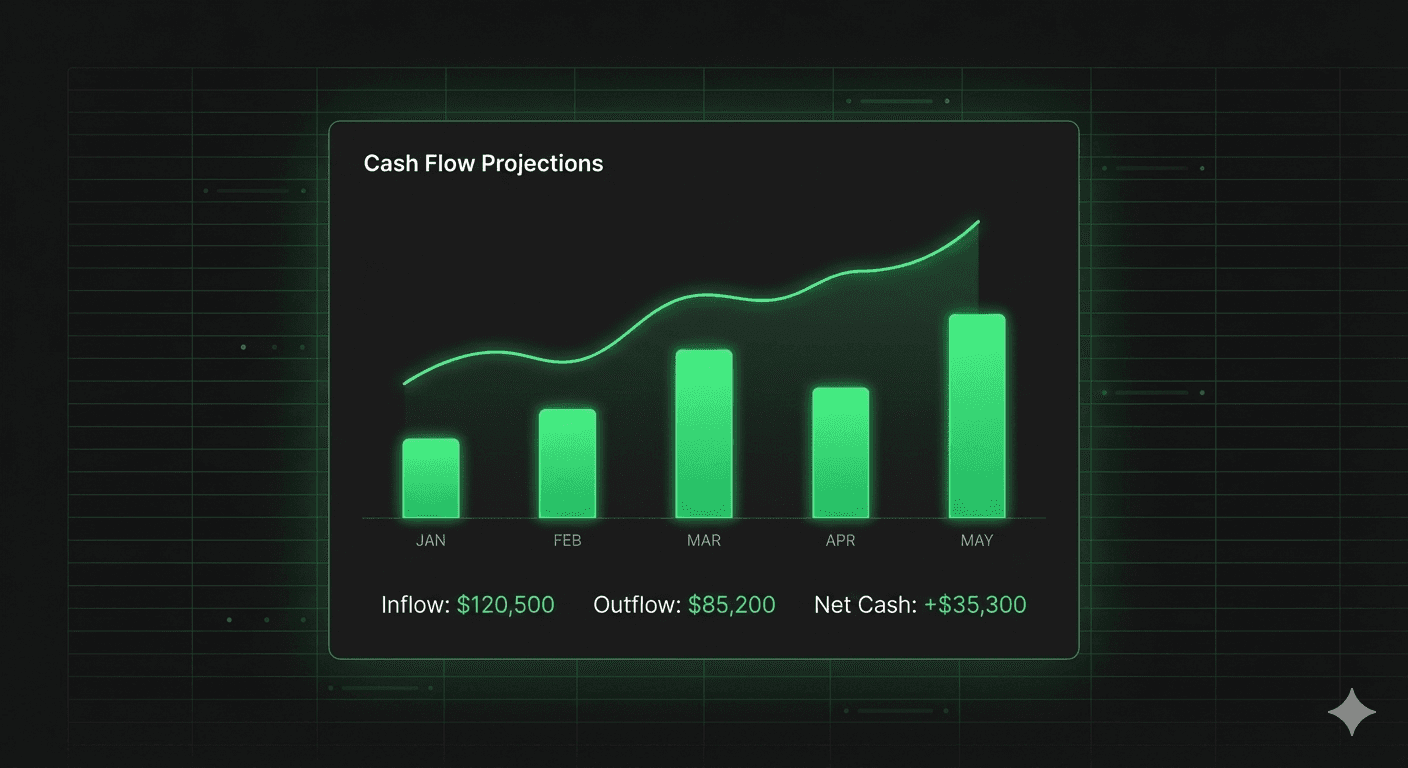
Why Runway Management Separates Survivors from Statistics
Every startup operates on borrowed time. The clock starts ticking the moment capital hits your bank account, and how you manage that countdown determines whether you build something lasting or become another cautionary tale. Runway is not just a number on a spreadsheet. It represents the window of opportunity to prove your thesis, iterate your product, and reach the milestones that unlock your next chapter.
For SaaS and ecommerce founders navigating the pre-seed to Series A journey, runway management becomes the operational discipline that underpins everything else. The best product roadmap means nothing if you run out of cash six months before reaching product-market fit. The most promising sales pipeline collapses when you cannot afford to keep the team that builds and sells.
Understanding Your Real Runway Position
The formula itself is simple: runway = cash on hand ÷ net monthly burn. Net burn is what you spend minus what you collect each month, excluding financing inflows like a raise; gross burn is total spend alone, useful for understanding your cost structure but not for survival math. In our experience, most founders still overestimate their runway, often by a quarter or more, because they run that division on an average burn rate rather than realistic projections. Burn rate rarely stays constant. Seasonal hiring, annual contracts, one-time expenses, and growth investments all create variability that can dramatically shorten your actual survival window.
The discipline starts with honest accounting. Track MRR growth against expense growth. If expenses climb faster than revenue, your burn accelerates and runway compresses. Many founders discover this pattern too late, when the compression has already created a crisis that limits their options.
Calculating runway requires distinguishing between committed costs and variable spending. Salaries, rent, and contracted services represent the floor. Marketing spend, new hires, and discretionary investments sit above that floor. Understanding this distinction reveals how much runway you actually control versus how much depends on decisions you have already made.
The 90-Day Cash Crunch Phenomenon
A pattern emerges repeatedly across startups: the cash position that looked manageable three months ago suddenly feels desperate. This 90-day cash crunch happens because founders focus on monthly burn without tracking the cumulative impact of small decisions. Each incremental expense seems reasonable in isolation but compounds into a runway problem.
The 90-day window matters because it represents the minimum time required for most corrective actions. Fundraising takes 90+ days from first meeting to wire transfer. Significant cost restructuring requires notice periods and transition time. Revenue acceleration initiatives need months to show results. When you have only 90 days of runway remaining, your options have already narrowed severely.
Smart founders treat the 90-day mark as a critical threshold. Dropping below it triggers predetermined responses: pausing non-essential hiring, reducing marketing experiments, renegotiating vendor contracts, and initiating bridge conversations with existing investors. These actions buy time without requiring the desperate measures that signal distress to the market.
Cash Conservation Tactics That Actually Work
Extending runway requires either reducing burn or increasing revenue. For most early-stage companies, expense reduction produces faster results than revenue acceleration. The tactics that work share a common characteristic: they preserve core capabilities while eliminating spending that does not directly drive the metrics that matter.
Start with vendor renegotiation. Many SaaS tools and services offer significant discounts for annual prepayment or for startups in growth mode. A single afternoon spent renegotiating your top ten vendor contracts can save thousands monthly. Cloud infrastructure costs often hide significant optimization opportunities that require no capability reduction.
Hiring pace represents the largest controllable expense for most startups. Each new hire adds not just salary but benefits, equipment, onboarding time, and management overhead. Before approving any requisition, calculate the runway impact: if a $120K hire reduces runway from 18 months to 15 months, the role better be essential to reaching milestones that justify that compression.
Marketing efficiency improvements often yield quick wins. Analyze customer acquisition cost by channel and double down on what works while cutting what does not. Many startups discover that a large share of their marketing spend produces strikingly few customers. Reallocating or eliminating the underperforming spend immediately improves unit economics and extends runway.
Revenue Acceleration as Runway Extension
While expense reduction provides immediate runway relief, revenue acceleration offers a more sustainable path forward. The challenge lies in timing: most revenue initiatives take months to show results, making them less effective in acute crisis situations but essential for long-term runway management.
Pricing optimization often delivers the fastest revenue impact. Many founders underprice their products, leaving money on the table with every customer. A 20% price increase on new customers has no implementation cost and begins generating additional revenue immediately. Existing customers can often be migrated to new pricing at renewal without significant churn.
Upselling and cross-selling to existing customers generates revenue without the acquisition cost burden. Customers who already trust your product represent the lowest-friction expansion opportunity. Track net revenue retention to understand how much growth your existing customer base can deliver independent of new acquisition.
Annual prepayment incentives convert monthly customers into committed cash upfront. Offering a meaningful discount, typically 15-20%, for annual commitment accelerates cash collection and provides visibility into future revenue. The discount cost is often less than the carrying cost of monthly billing plus churn risk.
Forecasting That Enables Proactive Management
Runway management requires forecasting that extends beyond simple burn rate division. Build a rolling 18-month cash flow model that incorporates revenue projections, committed expenses, and planned investments. Update it monthly with actuals and adjust projections based on what you learn.
The model should include scenario planning. What happens if revenue growth slows by 25%? What if a major customer churns? What if your largest hire takes twice as long as planned? Each scenario produces a different runway number and reveals the sensitivity of your position to various risks. Learn more about building robust forecasts in our financial forecasting guide.
Track leading indicators that predict cash flow changes before they hit your bank account. Pipeline coverage, sales cycle length, churn rate trends, and expansion revenue momentum all signal future cash position. Monitoring these metrics enables intervention before problems become crises.
When to Raise and When to Extend
The decision to raise additional capital versus extend runway through operational discipline depends on several factors: market conditions, milestone proximity, and the dilution implications of raising in your current position.
Raising capital from a position of strength, with demonstrated traction and comfortable runway, produces better terms than raising under pressure. Investors sense desperation and adjust valuations accordingly. To pick an illustrative number, the gap between a strong raise and a desperate one can easily be worth 15-20 points of extra dilution, a difference that compounds against founder economics over time.
Extending runway makes sense when you are close to milestones that would materially improve your fundraising position. If six more months of operation would demonstrate the product-market fit signals that justify a higher valuation, the dilution savings from waiting often exceed the risks of operating on tighter runway. Use our equity dilution calculator to model the impact of different raise scenarios.
However, extending runway should never mean starving the business of resources needed to hit milestones. The goal is efficiency, not austerity. Cutting so deeply that you cannot execute defeats the purpose of having runway in the first place.
Building Runway Discipline Into Your Operating Rhythm
Effective runway management requires ongoing attention, not crisis response. Build cash position monitoring into your weekly leadership discussions. Review the rolling forecast monthly. Conduct quarterly runway stress tests that model various scenarios.
Create clear decision rules tied to runway thresholds. At 18 months, operate normally with growth investments. At 12 months, begin fundraising conversations and increase hiring scrutiny. At 9 months, activate cost optimization initiatives. At 6 months, shift to capital preservation mode. These rules remove emotion from decisions and ensure timely action.
Communicate runway position to your team appropriately. Excessive transparency about cash position can create anxiety that harms performance. Insufficient transparency prevents the team from making informed trade-offs. Find the balance that keeps key contributors aligned with business reality without creating panic.
The Role of Financial Visibility in Survival
Founders who survive tight runway situations share a common trait: they see problems coming before they become critical. This visibility comes from robust financial infrastructure that tracks the right metrics, forecasts accurately, and surfaces warning signals early.
Investing in financial operations during flush times pays dividends during lean times. Clean books, accurate forecasts, and clear dashboards enable the rapid decision-making that runway crises demand. Scrambling to understand your true cash position when you are already in trouble wastes precious time and leads to poor decisions.
Futureproof exists to give founders this visibility. AI-powered forecasting, real-time cash position tracking, and scenario modeling tools help you see around corners and make confident decisions about your most precious resource: time. When you know exactly where you stand and where you are headed, runway management becomes a strategic discipline rather than a survival scramble.
Ready to stop guessing? Use our free startup runway calculator to model your burn rate, test different scenarios, and know exactly when to start fundraising. If fundraising is on the horizon, take our Startup Fundraising Scorecard to see how ready you are across 15 dimensions VCs evaluate.
Ready to take control of your runway? Get started with Futureproof and build the financial clarity that keeps founders in control of their own destiny.