


Futureproof vs Forecastr
A model is only as good as the books underneath it.
Forecastr gives a startup planning software and a dedicated finance expert to build in it, pulling actuals from the accounting system you keep somewhere else. Futureproof keeps that accounting system itself. Margo rebuilds burn, runway, and the months ahead on posted entries every night, and five other agents work the books, the receivables, the payables, the revenue metrics, and the investor reporting beside her.
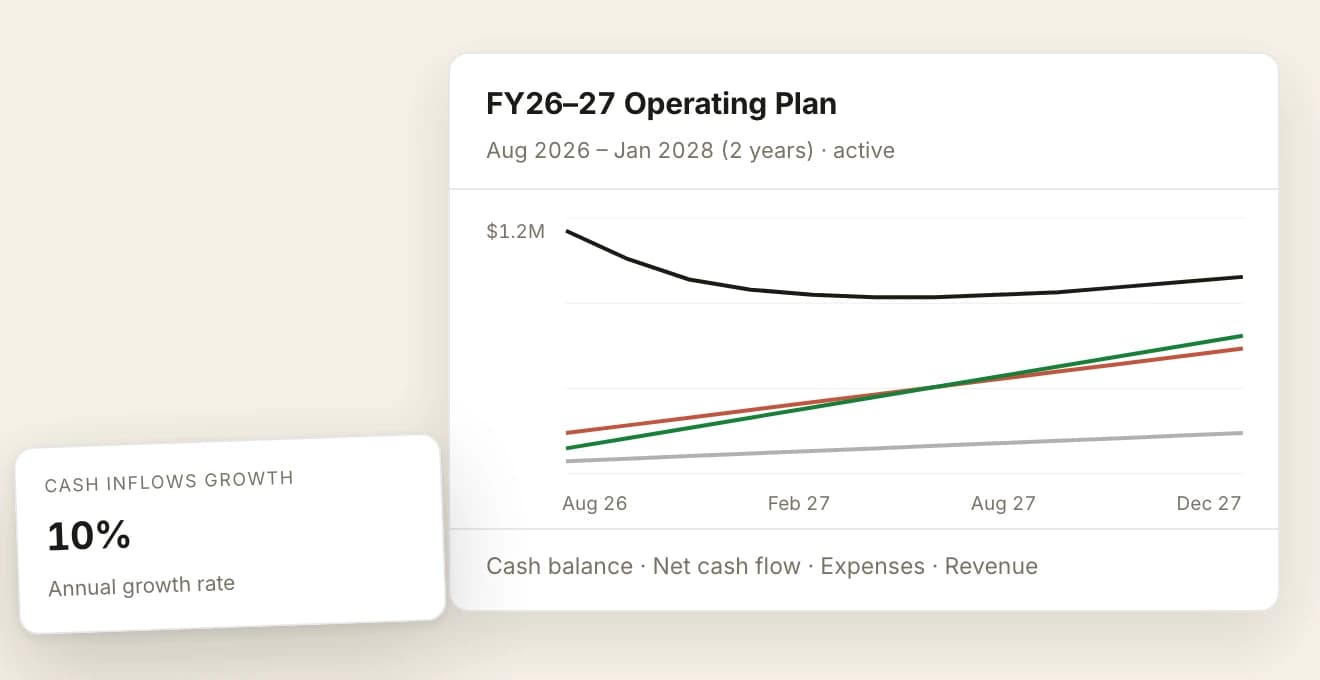
Signs the planning engagementsits outside your books.
A good finance expert builds a good model. The trouble is rarely the model. It is that the model describes a set of books kept in another system, on a cadence somebody else sets, and the founder still owns everything underneath it.
The model is an engagement
Every plan comes with a dedicated finance expert, described on their pricing page as the functional owner of your model, who leads monthly reviews and quarterly re-forecasts. That is a service cadence. Decisions about a hire or a test arrive weekly, and a review cycle is the wrong clock for them.
Actuals come from elsewhere
Their own words are to pull actuals from accounting, and the accounting sources listed are QuickBooks and Xero. The plan inherits whatever state those books are in, so a late close is a late plan, and a figure that disagrees with the income statement has to be traced through two systems.
The books stay yours to keep
Whoever codes the transactions, reconciles the accounts, chases the invoices, and closes the month is still doing that job somewhere else. Planning software sits on top of that work rather than doing it, so the evening it costs does not go away.
Two ways to get a forecast.One of them closes the books.
Eighteen jobs a startup has to get done every month, and how each product handles them. Every Forecastr cell is taken from their own site.
| Futureproof | Forecastr | |
|---|---|---|
| Where the numbers live | Your own general ledger, closed every month | A plan fed by actuals from accounting |
| Keeping the books | Vic codes and reconciles every night | Pulled from QuickBooks or Xero |
| Who does the work | Six agents, each owning a lane | A dedicated finance expert on every plan |
| AI in the product | Agents post, draft, and reconcile nightly | AI chatbot on every plan, AI CFO in preview |
| Human review each month | A call with a financial specialist, included | Monthly forecast updates with your expert |
| Transaction categorization | Vic codes each entry to your chart | Not documented on their site |
| How current the numbers are | Rebuilt nightly on posted entries | Dashboards update as connected data syncs |
| Revenue over time | Recognized across the contract term | Not documented on their site |
| Burn and runway | Recomputed on posted entries every night | Burn by department, vendor, or category |
| Revenue metrics | MRR roll-forward built from the ledger | KPI summary dashboard on every plan |
| Scenario planning | Priced on the spot against cash and floor | Scenario creation and comparison on Growth |
| Hiring plan modeling | Open roles priced against cash and floor | Hiring decisions run as scenarios |
| Cap table | The cap table of record, beside the ledger | Not documented on their site |
| Investor data room | Documents, and which ones were opened | A data room, and secure model links |
| Board reporting | Drafted from the closed period for your edits | Board reports built with your expert |
| Self-serve platform | Sign up and connect the accounts | A self-guided tour, then a demo |
| Getting started | Connect the accounts and the ledger opens | Model built with your expert in two weeks |
| How you buy it | Self-serve sign-up and a 14-day trial | Annual plans, demo to buy |
Forecastr statements checked 2026-09-20 on forecastr.com, including their pricing page.
Moving is three steps.None of them is a project.
The history moves from the accounting system rather than from the model, so nothing has to be rebuilt from memory.
Connect the accounts
Bank accounts and company cards connect through Plaid, and Stripe connects directly, all in one pass. Payroll comes in by CSV import, one file per run, which is the only way payroll enters the ledger today.
Move the history
Books kept in QuickBooks move across in a one-click migration, and other accounting systems come in by file export. Prior-year balances carry in, so the first month is a continuation rather than a restart.
Run the first month
Vic codes and reconciles overnight, and Margo rebuilds burn, runway, and the months ahead on what posted. The assumptions behind the old model become scenarios priced on live entries.
What stays the same.Your accountant among them.
Changing where the forecast is built does not mean changing everything attached to it. Four things carry over exactly as they are.
- Your accountant
- Futureproof does not file taxes. Your CPA keeps filing and advising, working from books reconciled through the year and closed each month, and every report exports to CSV whenever they ask for one.
- Your bank
- Accounts and cards connect through Plaid and stay exactly where they are. Theo captures the bills and schedules the pay run against available cash, and the payment itself is released in your own bank.
- Your history
- Prior books migrate in rather than start over, and a full export of your data is available at any time. Nothing about the arrangement depends on staying.
- Your judgment
- The agents draft and recommend. You approve, adjust, or decline, and every action lands on the audit trail with the reasoning attached to it.
What founders want to knowbefore they switch tools.
No. Forecastr pairs software with a dedicated finance expert, which helps, but the cadence is theirs: their pricing page describes monthly reviews and quarterly re-forecasts. Futureproof's agents do the work themselves. Margo works from your own general ledger, keeps the forecast current on her own, and answers the moment you ask, with a whole team behind her on books, receivables, and payables.
Pricing starts at $1,000/month and covers all six agents: Vic on books and close, Remi on receivables, Theo on payables, Margo on forecasts, Hugo on revenue metrics, and Nia on investor reporting, with a monthly review call with a human financial specialist included. There are no per-seat fees and no modules. The comparison worth making is against hiring those lanes or buying them one subscription at a time.
Forecastr is planning software sold with a dedicated finance expert, built on actuals pulled from QuickBooks or Xero. Futureproof keeps the accounting system itself. Six agents work that general ledger every night across books and close, receivables, payables, forecasts, revenue metrics, and investor reporting, so the forecast and the income statement come from the same entries.
For the questions early-stage founders ask most, a scenario is arithmetic on current books, and that is what Margo does: a hire, a group of hires, a price change, or a cut, each priced against posted cash and against the minimum runway the founder chose to hold. Consolidated multi-entity modeling is specialist work that Futureproof does not do, and does not claim to.
Yes, and it is the structural difference between the two. Vic codes every bank, card, and Stripe movement to the chart of accounts and reconciles the accounts nightly, then prepares the close. Forecastr's own site describes pulling actuals from an accounting system, which means the books stay wherever they are kept today.
Most early-stage founders do not. Vic codes each movement to the chart of accounts, reconciles nightly, and prepares the close, bringing anything that needs a judgment call to you as a decision. A bookkeeper may still help with unusual work, with far less of the routine left to do.
Yes. It is built for startups from pre-revenue through Series A, where nobody has been hired to run finance yet. Early-stage founders gain most from having the books and the forecast in one place, without a separate accounting subscription underneath the model.
Yes. Stripe connects directly, and subscription revenue is recognized across the term it is billed for, whether the contract is monthly, annual, usage-based, tiered, or a mix. The contract waterfall shows each month of recognized and deferred revenue, built from the same entries as the income statement.
Connecting is one sitting. Bank accounts and company cards connect through Plaid, Stripe connects directly, payroll comes in by CSV import, one file per run, and books kept in QuickBooks migrate across in one click. Forecastr's own homepage puts its model build at two weeks, which is a different shape of start: one is a connection, the other is a build.
Yes. Every report exports to CSV, and a full export of the underlying data is available at any time, so an accountant works from the same reconciled books rather than from a rebuilt year. Futureproof does not file taxes, so tax work stays with them.
One ledger. Six agents. Your call.
Own the ledger.Then model on it.
Connect the accounts and the team starts on the books tonight. The next hire, the next channel, and the next round get decided without waiting on a calendar.
Starting at $1,000/month for all six agents, with a monthly review call with a human financial specialist included. No per-seat fees, no modules.