


Futureproof vs Puzzle
Your finances should not be a puzzle.
Puzzle calls itself the accounting core where agents work for you, and it categorizes, reconciles and drafts statements. Futureproof takes the lanes beside that core as well, with Remi on receivables, Theo on payables, Margo on the forecast and the models, Hugo on revenue metrics and Nia on investor reporting, all writing to the same ledger.
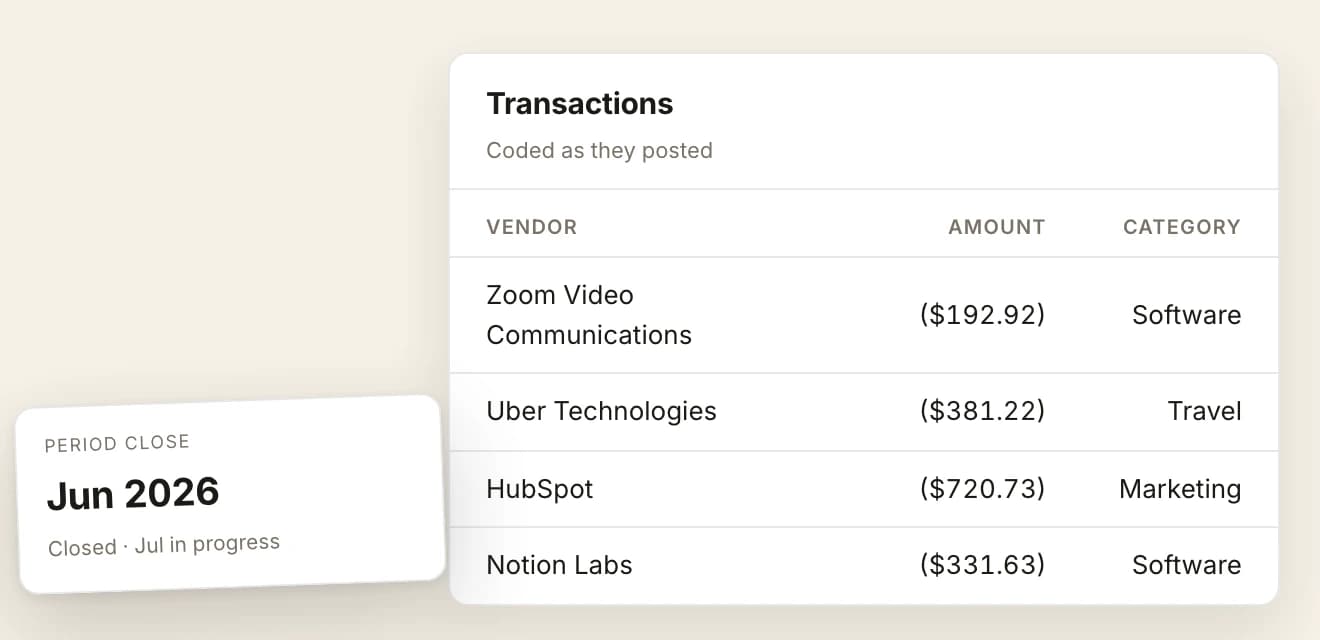
The books are handled.The decisions are not.
Three places the accounting core ends and the rest of the finance function starts, taken from what Puzzle publishes about its own product.
Insights stop before the model
Cash, burn, runway and margin describe the position you are already in. Puzzle states plainly that it does not generate financial models from that data and names planning partners instead, so the next hire and the next round get priced somewhere else.
Sending an invoice is not collecting
Invoices can be sent, tracked and reconciled. The follow-up when one goes past due, and the timing of the bills going out against the cash on hand, still sit with whoever remembers to look.
The investor pack is assembled by hand
Reports can be downloaded and shared with a board. The update, the deck and the diligence folder around them still get built by a person, and the cap table lives with a partner tool rather than beside the books.
One core in common.Five lanes that are not.
Where the two overlap and where they separate. Statements about Puzzle are their own published wording.
| Futureproof | Puzzle | |
|---|---|---|
| AI agents that do the work | Six agents, each owning a lane | AI agents run accounting workflows |
| Monthly human specialist review | Included in the plan, every month | Expert Reviewed Bookkeeping plans |
| Profit and loss, balance sheet | Built from the ledger, open to the entry | Auto-drafted financial statements |
| Bank reconciliation | Reconciled nightly, exceptions flagged | AI-powered reconciliations, Complete |
| Transaction categorization | Coded nightly, exceptions flagged | Up to 98% auto-categorization |
| Burn rate and runway | Rebuilt nightly from posted entries | Insights: cash, burn, runway, margin |
| Recurring revenue metrics | Hugo computes them from the ledger | ARR and MRR in investor reporting |
| Revenue earned across a term | A schedule per contract, run monthly | Automated from the Complete tier |
| Cap table and dilution | Modeled beside the cash it changes | Partner tools such as LTSE, Pulley |
| Scenario forecasting | Margo prices the hire before you make it | No models; planning partners named |
| Investor data room | Nia keeps the room current | Reports shared with investors |
| Board reporting | Nia drafts the deck from closed months | Downloadable reports for the board |
| Self-serve platform | Sign up and connect the same day | Four self-serve tiers, online signup |
| Collections and bill pay | Remi chases, Theo schedules, you release | Send, track and reconcile invoices |
Puzzle statements checked 2026-09-20 on puzzle.io, including their pricing page.
Keep the automation.Add the other five lanes.
Three steps. The coding you already trust keeps happening, and the work around it stops being yours.
Connect the accounts
Bank accounts and cards connect read-only through Plaid, with billing and sales channels alongside them. One sitting, and from then on the agents pull what they need without waiting on an export.
Import the history
Accounting history comes across as a file export and imports into your own ledger, so closed periods stay readable and the comparison to last year survives the move.
Meet the other five
Receivables, payables, the forecast, revenue metrics and investor reporting each get an owner on day one. The work arrives as drafts and proposals in one queue, and you release it.
The books change hands.The controls stay yours.
More of the function handled does not mean less of it under your control. Four things stay exactly where they are.
- Your accountant
- Invite them into the workspace and they work in the same ledger the agents write to, with every figure opening to the entry behind it. Futureproof does not file taxes and does not replace the person who does.
- Your bank
- Accounts and cards stay where they are, and the connections that bring data in are read-only. Payments are scheduled and flagged for you, never sent on their own.
- Your history
- Prior periods come across with the import and stay readable, so the move costs you a file export rather than a year of comparisons.
- Your approvals
- Six agents working instead of one lane does not mean six things happening behind you. Each proposal waits in one queue, and the audit trail records what was released and when.
What teams askabout the other five lanes.
There is more of it covered. Puzzle automates the accounting core and sells review plans on top of it, and its published scope stops at the books: it states that it does not generate financial models, and cap table sits with partner tools. Futureproof is a full team of AI agents that do the work across six lanes: Vic closes and flags exceptions, Margo forecasts and prices scenarios, Remi and Theo run AR and AP, and you approve their work in one queue instead of driving a tool.
Pricing starts at $1,000 a month and covers all six AI agents: Vic (bookkeeping), Remi (AR), Theo (AP), Margo (FP&A), Hugo (revenue metrics) and Nia (investor reporting). The same six roles hired as humans cost $384K to $605K a year in salaries. Puzzle is AI bookkeeping, one slice of that stack. Futureproof replaces the stack.
Puzzle is accounting software that automates bookkeeping and financial reporting, with expert review plans available on top. Futureproof is an AI finance team: six agents covering bookkeeping, AR, AP, FP&A, RevOps and investor relations. Puzzle gives you the accounting core. Futureproof gives you the whole finance team.
Yes. Futureproof handles bookkeeping, bank reconciliation and financial reporting, plus the work Puzzle points elsewhere for: scenario models and cap table modeling. An investor data room sits on the same ledger, so one system carries one set of numbers.
Most early-stage founders do not. Futureproof handles categorization and reconciliation automatically, and the monthly review call with a human financial specialist replaces hours of data entry. A bookkeeper or accountant may still handle specialist work such as tax filing, which Futureproof does not do.
Futureproof connects to Stripe and recognizes subscription revenue across monthly plans, annual contracts and multi-month billing cycles: anything earned over time gets a schedule and moves into income as the service is delivered. More complex arrangements are worth walking through on a demo before you sign up.
Yes. It is built for companies from pre-revenue onward. Cash flow modeling and cap table modeling are the two that matter earliest, and Puzzle states that it does not generate financial models and keeps cap table with partner tools, which is the usual reason a company outgrows an accounting-only product.
Setup is one sitting. Connect banks, cards and Stripe, and transactions are categorized from there without anyone coding them by hand.
Both carry burn and runway, and both put reports in front of a board. Futureproof adds LTV to CAC, gross margin by segment, burn multiple and scenario forecasting, all computed from posted entries without a spreadsheet or an export in between.
Yes. Invite them into the workspace as a member, with no seat to purchase, and they work in the same ledger the agents write to, with every reported figure opening to the entry behind it and a full audit trail beside it.
Your numbers. Your answers. Smarter moves.
Bookkeeping was the first lane.Take the other five.
Connect the accounts, import the history, and let the first close run overnight. In the morning six lanes have an owner instead of one.
Starting at $1,000/month for all six agents. No per-seat fees and no modules.