


Futureproof vs QuickBooks
Accounting sold in tiers. Finance does not arrive that way.
QuickBooks is accounting software for all types of businesses, with forecasting, automated deferred revenue and custom KPI dashboards on the Advanced plan, expert help as its own subscription, and access counted in users. Futureproof is one plan: six agents working your ledger, plus a monthly review call with a human financial specialist.
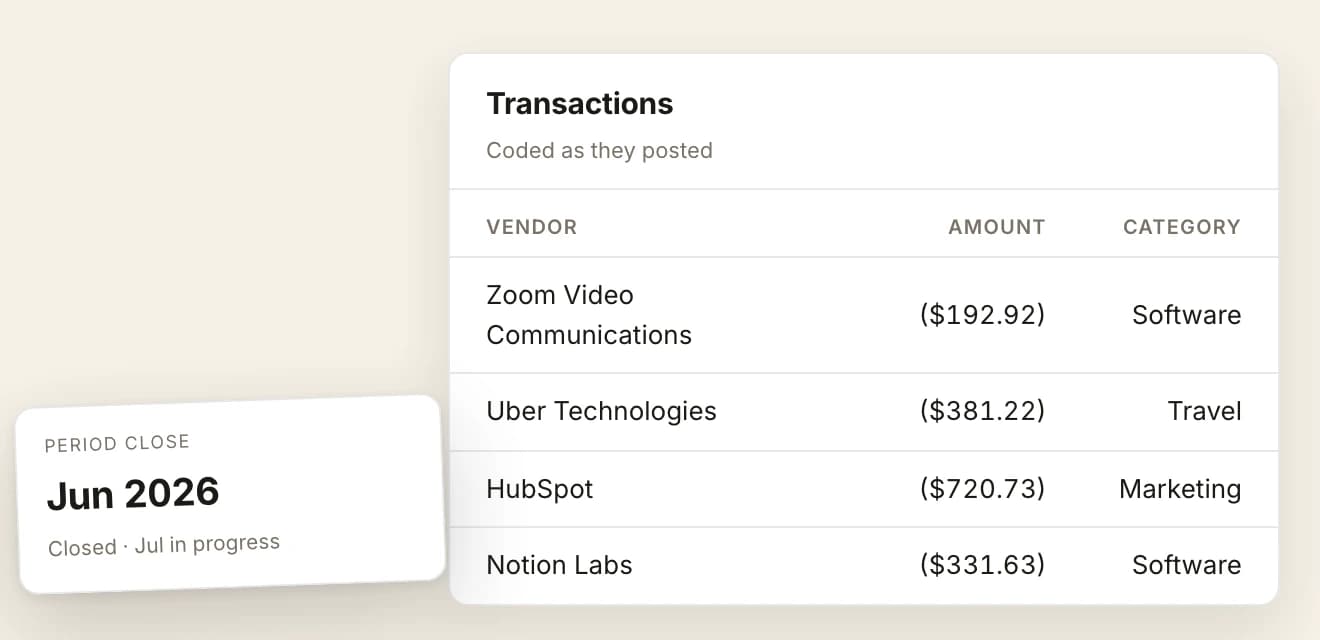
The books are fine.The shape of the plan is not.
Three moments companies describe when general accounting software stops matching the company using it.
The feature is one plan up
Forecasting cash flow and profit, automated deferred revenue and custom KPI dashboards are Advanced features, and budgets and project profitability start at Plus. The capability exists. It arrives with a plan change.
Access is counted in users
Plans are sized at one, three, five or twenty-five users, with accountant access on top, and payroll is a separate add-on. Every person who needs to read the numbers is a line on the subscription.
The raise runs on spreadsheets
A cap table, a data room, an investor update and the metrics an investor asks for get assembled by hand out of exports, then reconciled back against the books. None of that work happens where the books are kept.
The same finance work.Two different shapes.
What each side does, and where it sits. Statements about QuickBooks describe their own published product.
| Futureproof | QuickBooks | |
|---|---|---|
| AI agents that do the work | Six agents, each owning a lane | Named AI agents for books and payments |
| Monthly human specialist review | Included in the plan, every month | Expert Assisted, sold separately |
| Profit and loss, balance sheet | Built from the ledger, open to the entry | Customizable standard reports |
| Bank reconciliation | Reconciled nightly, exceptions flagged | Automatic sync, AI reconciliation |
| Bookkeeping done by AI | Vic codes and closes every night | Accounting AI, from Essentials up |
| Revenue earned across a term | A schedule per contract, run monthly | Deferred revenue, Advanced plan |
| Burn rate and runway | Rebuilt nightly from posted entries | Cash flow and profit forecast, Advanced |
| Recurring revenue metrics | Hugo computes them from the ledger | Custom KPI dashboards, Advanced |
| Cap table and dilution | Modeled beside the cash it changes | Equity accounts on the chart |
| Investor data room | Nia keeps the room current | Reports export to Excel and PDF |
| Scenario forecasting | Margo prices the hire before you make it | Forecasts built from history, Advanced |
| Board reporting | Nia drafts the deck from closed months | Management-ready custom reports |
| Collections and bill pay | Remi chases, Theo schedules, you release | Invoicing and payments, Payments AI |
| Who can read the numbers | No per-seat fees | 1 to 25 users by plan, plus accountants |
QuickBooks statements checked 2026-09-20 on quickbooks.intuit.com, including their pricing page.
One sitting to connect.One night to catch up.
Nothing about the move is a project. Connect the accounts, bring the history over, and read the first close in the morning.
Connect the accounts
Bank accounts and cards connect read-only through Plaid, and billing and sales channels connect alongside them. It takes one sitting, and nothing after that depends on somebody exporting a file.
Bring the history over
Books kept in QuickBooks migrate in one click, so your accounting history lands in your own ledger and the books open with your past already in them rather than starting at zero on the day you sign up.
Run the first close
The agents work the backlog overnight. In the morning there are reconciled accounts, coded transactions, the decisions waiting on you, and a record of everything that happened while the office was empty.
New ledger.Same people around it.
Switching accounting systems is the kind of thing companies put off for a year. Four things stay exactly where they are.
- Your accountant
- Invite them into the workspace and they work in the same books the agents do, with every figure opening to the entry underneath it and no seat to buy. Futureproof does not file your taxes and does not replace the person who does.
- Your bank
- Accounts and cards stay where they are. The connections that bring data in are read-only, so nothing here can move money or change anything at your bank.
- Your history
- Prior periods come across with the migration and stay readable, so the comparison to last year survives the move instead of starting over on day one.
- Your approvals
- The agents draft, propose and schedule. Anything that would move money or change the books waits for you, and every action stays traceable in the audit trail.
What teams askabout leaving accounting software.
QuickBooks alternatives come in two kinds. Other ledgers move the same finance function into different accounting software, and everyone who was doing the work around it keeps doing it. A finance team removes the work. Futureproof is the second kind: six AI agents do the bookkeeping, collections, bill pay, forecasting, revenue metrics and investor reporting on one ledger, a human financial specialist reviews your books monthly, and pricing starts at $1,000 a month. If your pain is which accounting product you use, switch ledgers. If your pain is doing the finance work, switch to a finance team.
There is less of it to manage. QuickBooks automates categorization and reconciliation, and the plan decides how much else it covers: forecasting, automated deferred revenue and custom KPI dashboards sit on Advanced, and expert help is a separate subscription. Futureproof puts the whole function on one plan. Vic does the bookkeeping and hands you exceptions, Remi chases invoices, Theo handles bills, Margo forecasts cash. You review and approve instead of doing.
Pricing starts at $1,000 a month and covers all six AI agents: Vic (bookkeeping), Remi (AR), Theo (AP), Margo (FP&A), Hugo (revenue metrics) and Nia (investor reporting). The same six roles hired as humans cost $384K to $605K a year in salaries. QuickBooks is general accounting software, one slice of that stack. Futureproof replaces the stack.
Yes. Books kept in QuickBooks migrate in one click, and bank accounts and cards connect read-only through Plaid at the same time, so the ledger opens with your history in it and clean ongoing transactions from the first day.
Most early-stage founders do not. Futureproof handles categorization and reconciliation automatically, and the monthly review call with a human financial specialist replaces hours of data entry. A bookkeeper or accountant may still handle specialist work such as tax filing, which Futureproof does not do.
Bank accounts and credit cards connect read-only through Plaid, Ramp connects, and Stripe brings in billing. On the sales side, Amazon and eBay connect directly, Shopify is in beta, and TikTok Shop is coming soon.
No, it is a good fit. Early-stage companies need runway visibility and cap table clarity more than anyone. The difference is where those answers are built: Margo rebuilds runway from posted entries every night, and dilution is modeled beside the cash it changes rather than in a separate tool with its own copy of the numbers.
Yes. It is built for companies from pre-revenue onward, and the two things that matter earliest are cash flow forecasting and cap table modeling. Both run on the same ledger the statements come from, so the runway figure in a board update and the line in the accounts are the same number twice.
Setup is one sitting. Connect banks, cards and Stripe, and transactions are categorized from there without anyone coding them by hand.
Yes. Invite them into the workspace as a member, with no seat to purchase, and they work in the same ledger the agents write to, with every reported figure opening to the entry behind it and a full audit trail beside it.
Everything is exportable at any time. The books, the journal entries and the reports are yours, and a full export of your data is available whenever you ask for it, so nothing about the arrangement locks them inside one vendor.
Your numbers. Your answers. Smarter moves.
Hand the ledger a team.Keep the final say.
Connect the accounts, bring the history across, and let the first close run overnight. The books are current in the morning and stay that way.
Starting at $1,000/month for all six agents. No per-seat fees and no modules.