


There’s a moment every founder faces when someone asks, “So how much revenue are you actually making?” and they freeze. Not because they don’t know their numbers, but because they’re not sure which number the questioner is asking for.
Are they asking about last month’s cash? This year’s bookings? What the company expects to make? The question feels simple, but the answer isn’t. And if a founder can’t nail this down, they’re flying blind.
Hundreds of founders stumble through this conversation. They’ve got spreadsheets. They’ve got projections. They’ve got big dreams. But when it comes to clearly articulating their recurring revenue model, they sound like they’re guessing. And investors can smell uncertainty from a mile away.
The truth is, understanding ARR and MRR isn’t just about having the right answer in a pitch meeting. It’s about knowing whether a business model actually works. These metrics are the difference between building a sustainable company and chasing revenue that evaporates the moment the founder stops running. For the complete picture of how these metrics connect to your overall financial health, see our guide on runway, burn rate, and cash flow clarity.
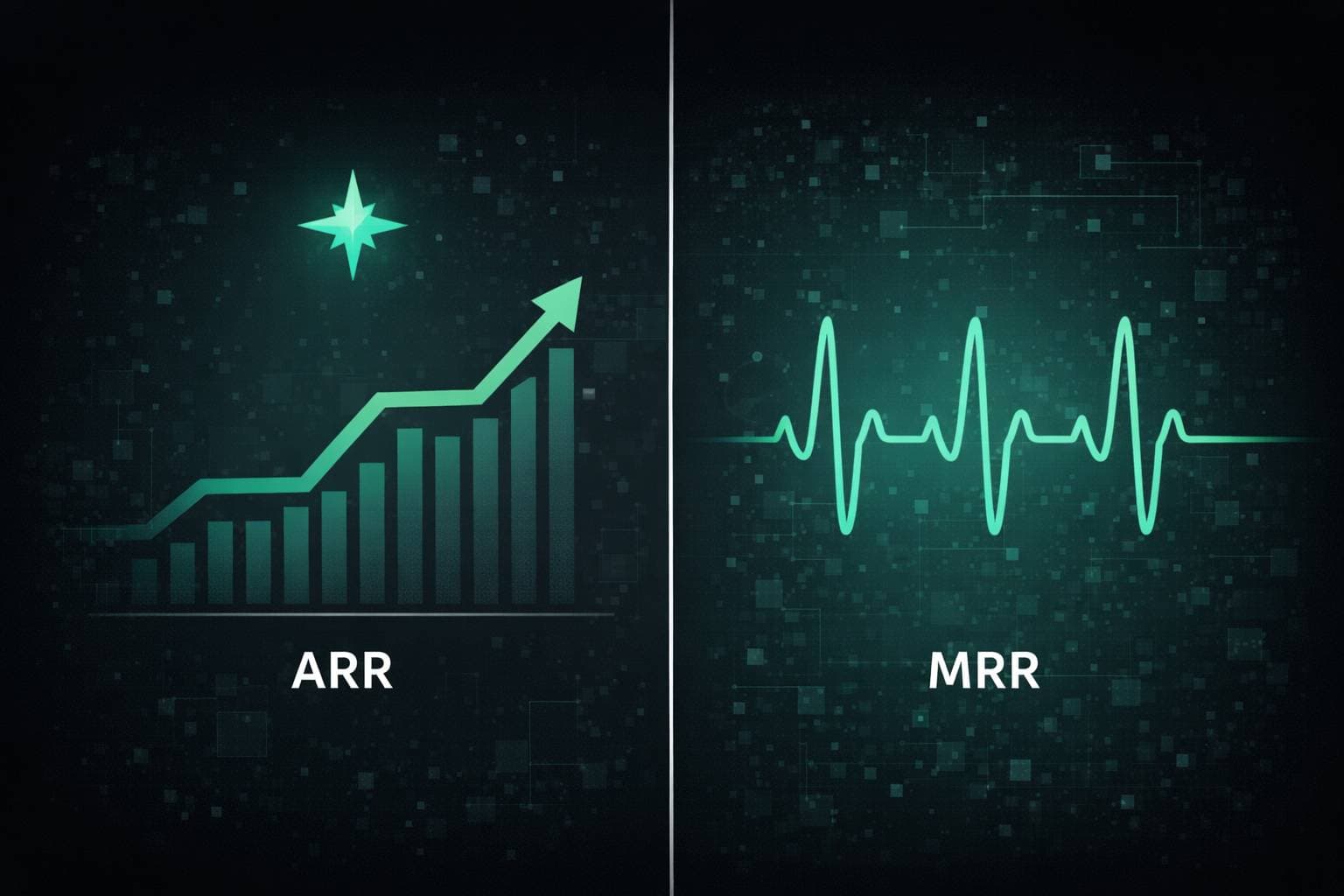
Annual Recurring Revenue (ARR): Your North Star
ARR is the total annualized value of active subscriptions. It’s a point-in-time run rate: today’s recurring revenue base, annualized, before churn, expansion, or new sales change it. A snapshot, not a forecast. Think of it as the altitude reading for your recurring revenue engine, the predictable, recurring income that keeps the lights on and the team paid.
Here’s what makes ARR powerful: it’s current. It doesn’t care what a company made last year. It reflects what customers are committed to right now, annualized. That’s why investors love it. It’s predictable. It’s comparable. It’s honest.
ARR only counts subscription revenue. One-time fees, implementation charges, and professional services don’t make the cut. Why? Because they don’t recur. ARR is about what a company can count on month after month, year after year. If a company has to go out and sell it again next month, it’s not recurring. If it happens automatically because a customer is under contract, it counts.
This distinction matters more than founders think. Many inflate their ARR by including one-time revenue, then wonder why their growth metrics look terrible when those sales don’t repeat. This is lying to oneself, and eventually, it’s lying to investors.
How to Calculate ARR: Breaking It Down
Let’s say a customer purchases the following from a SaaS platform:
Annual Platform Fee: $4,500
User Seats (annual): $750
Starter Implementation (one-time): $1,200
The ARR from this customer is $5,250 ($4,500 + $750). The implementation fee doesn’t count. It’s gone after delivery. It might show up in the P&L for the month, but it has no place in the ARR calculation. When you’re ready to project how your recurring revenue flows through to profitability, our pro forma income statement generator can help you model the full picture.
Now let’s walk through a real-world scenario that includes expansion and contraction because in the real world, customers don’t just sign and stay static. They grow. They shrink. They churn.
January: Customer signs a $9,600 annual contract.
Monthly revenue expectation: $800 ($9,600 ÷ 12)
ARR: $9,600
Every month, the company expects to recognize $800 in revenue from this customer. But the ARR, the total amount expected over the next twelve months stays at $9,600 until something changes.
March: Customer downsells to $7,800.
Monthly revenue expectation: $650 ($7,800 ÷ 12)
ARR: $7,800
They cut back. Maybe they lost a team member. Maybe budget got tight. Whatever the reason, ARR just dropped by $1,800. The monthly revenue expectation is now $650. This is the new baseline until the next change.
July: Customer upsells to $12,000.
Monthly revenue expectation: $1,000 ($12,000 ÷ 12)
ARR: $12,000
They expanded. Maybe they hired. Maybe they launched a new product line. ARR just jumped to $12,000, and the monthly revenue expectation is now $1,000.
Notice something critical: ARR always reflects the current contract value projected forward for twelve months. It’s not what a company earned last year. It’s not a prediction based on hopes. It’s math based on what customers are committed to right now.
ARR Benchmarks by Stage
What’s considered “good” ARR depends entirely on stage. Comparing a Seed-stage company to a Series B company is meaningless.
Here’s a framework we use when coaching founders. These bands are Futureproof rules of thumb drawn from that work, not a published industry index:
Pre-Seed / Seed (Finding Product/Market Fit)
ARR: $0 - $500K
YoY Growth: 100%+ (often 200-300% in early months)
CMGR: 10-15%
At this stage, companies are still figuring it out. Growth rates should be wild: doubling, tripling, even quadrupling some months. Why? Because they’re starting from zero. Small numbers compound fast. If a company isn’t seeing explosive growth at this stage, it hasn’t found product/market fit yet.
Early Stage (Finding Repeatability)
ARR: $500K - $2M
YoY Growth: 100-200%
CMGR: 8-12%
The company has found something that works. Now it’s trying to make it repeatable. Growth should still be strong, doubling year over year, but it’s starting to stabilize. Systems are being built. Teams are being hired. What works is being scaled.
Growth Stage (Scaling)
ARR: $2M - $10M
YoY Growth: 80-150%
CMGR: 6-10%
This is the execution phase. The company knows what works. It’s doing it at scale. Growth rates start to come down from triple digits, but the business is still growing aggressively. This is where most venture-backed companies should be aiming.
Expansion Stage (Market Leadership)
ARR: $10M - $50M+
YoY Growth: 50-100%
CMGR: 4-8%
The company is a real player now. It’s competing for market share. It’s defending against competitors. Growth rates slow, but absolute dollar growth is massive. Adding $5M in ARR at this stage is harder than adding $500K at seed, but it’s also more valuable.
If a company is below these benchmarks, it’s either not finding product/market fit or not executing on growth. If it’s above them, it’s on fire, or about to burn out trying to sustain the pace. Founders need to know which one they are.
Monthly Recurring Revenue (MRR): Your Heartbeat
MRR is the monthly equivalent of ARR. While ARR measures annual predictability, MRR measures monthly predictability. For month-to-month subscription businesses, MRR is often more relevant than ARR.
Think of MRR as a company’s heartbeat. It’s the rhythm of the business. Every month, a certain amount of recurring revenue is expected to hit the bank account. If that number is growing, the heart is strong. If it’s shrinking, the business is in cardiac arrest.
MRR is especially important for businesses with monthly contracts or those tracking rapid changes. If a company is selling month-to-month SaaS subscriptions, MRR gives a much clearer picture of what’s happening right now than ARR does.
How to Calculate MRR: The Monthly View
Take the same customer from the ARR example, but now they’re on a monthly plan:
Monthly Platform Fee: $375
Monthly User Seats: $62.50
Onboarding Fee (one-time): $1,200
The MRR from this customer is $437.50 ($375 + $62.50). Again, one-time fees don’t count. They’re nice when they happen, but they don’t recur, so they’re not part of the MRR calculation.
Let’s walk through a real scenario that shows the full complexity of MRR movement:
Starting MRR: $50,000
This is the baseline, the recurring revenue the company expects this month based on existing customers.
New Customers This Month: +$8,000
New signups. Fresh logos. This is New MRR, the lifeblood of growth.
Expansion: +$3,000
Existing customers upgraded, added seats, or moved to higher tiers. This is Expansion MRR, and it’s pure gold because it costs almost nothing to earn.
Contraction: -$2,000
Some customers downgraded. They’re not gone, but they’re paying less. This is Contraction MRR, and it’s a warning sign that value delivery might be slipping.
Churn: -$4,000
Customers who cancelled entirely. This is Churned MRR, and it’s the enemy. Every dollar here is a dollar that needs to be replaced just to stay even.
Ending MRR: $55,000
The math: $50,000 + $8,000 + $3,000 - $2,000 - $4,000 = $55,000
Net New MRR this month: $5,000 (10% growth). That’s healthy at most stages.
The Relationship Between ARR and MRR
The simplest relationship is mathematical: ARR = MRR × 12. If a company has $50,000 MRR, it has $600,000 ARR. Easy.
But the strategic relationship is more nuanced.
ARR is the metric for board meetings, fundraising, and valuation conversations. It’s the big picture. When a company says “we’re a $5M ARR business,” everyone understands what that means.
MRR is the metric for operational decisions. It’s the heartbeat. When the team wants to know if last month’s marketing campaign worked, they look at MRR. When they’re deciding whether to hire that next salesperson, they model the impact on MRR.
Most investors prefer ARR because it smooths out monthly fluctuations and makes comparisons easier. But operationally, MRR is often more useful because it shows what’s happening right now.
MRR Benchmarks: What Good Looks Like
Unlike ARR, which has clear stage-based benchmarks, MRR benchmarks are more about growth rates. Measured as Compound Monthly Growth Rate (CMGR), these are the real indicator. Same caveat as the ARR bands: these are our rules of thumb from coaching founders, not a published index:
Seed Stage: 10-15% CMGR (doubling every 5-7 months)
The company is in hypergrowth mode. Every customer matters. Every experiment could be the breakthrough. If growth isn’t at double-digit rates every month, the pace isn’t fast enough.
Early Stage: 8-12% CMGR (doubling every 6-9 months)
The company is finding its groove. Growth is still aggressive, but a machine is starting to be built. Teams are being hired. Processes are being automated. What works is being scaled.
Growth Stage: 6-10% CMGR (doubling every 7-12 months)
This is execution mode. The company knows what works. More of it is being done. Growth is still strong, but the law of large numbers is kicking in. Adding 10% MRR growth on $100K is easier than adding 10% on $1M.
Expansion Stage: 4-8% CMGR (doubling every 9-18 months)
The company is established. It’s competing for market share. It’s defending against competitors. Growth rates slow, but absolute dollar growth is massive. This is where companies go public or get acquired.
If CMGR is consistently below the stage benchmark for three months running, something’s broken. The company is either not acquiring customers fast enough, or losing them too quickly, or both. This signal shouldn’t be ignored. It’s the business indicating something needs to change.
The Real Question: What Are You Optimizing For?
ARR and MRR aren’t just vanity metrics. They tell whether a business model works. But reading them well requires one more distinction: run-rate ARR versus committed ARR. Run-rate ARR is MRR × 12, so by definition it moves in lockstep with MRR. Committed ARR counts only revenue under contract, the annual and multi-year deals that survive month-to-month wobble.
The divergence between those two is the real signal. If committed ARR is growing while run-rate momentum stalls, annual contracts are being signed while the month-to-month base erodes underneath them. Renewal season will reveal whether those contracts were earned with value or bought with discounts. If run-rate ARR is growing but committed ARR is flat, customers are being added who haven’t committed to anything. A house is being built on sand. One bad month and they’re gone.
The best SaaS businesses have both metrics moving in the same direction: up and to the right. New customers are signing. Existing customers are staying. Expansion is happening. Churn is low. The machine is working.
The metric a founder chooses to track reveals what they believe about their business. The choice should be made wisely. Because the metric that gets optimized for becomes the business that gets built.
For a complete walkthrough of how to set up the financial systems that feed these metrics accurately, see our complete guide to bookkeeping for startups.
Futureproof automatically calculates both ARR and MRR, tracks your growth rates, and shows you exactly where your recurring revenue stands. No spreadsheets. No guesswork. Just clarity. If you’re ready to stop flying blind and start tracking the metrics that actually matter, book a demo and see how we turn recurring revenue chaos into clarity.