Ad spend leaves on today's card statement, suppliers take their deposit on their own terms, and the marketplace pays out when it pays out. Futureproof books all three in one ledger and projects the balance forward week by week, so the next move is priced against the cash you will actually have.
Cash flow forecasting for an ecommerce brand is the work of lining money that arrives on marketplace payout schedules up against money that leaves on supplier terms, card statements, and ad platforms. For most brands those three timings sit in three systems, so the answer to whether a move is affordable arrives a week after the moment to make it.
Payout timing hides the answer
Amazon holds a settlement for two weeks, a reserve holds part of it longer, and the card bill for the ads that produced those orders is already due. The balance you see in the bank is not the balance the decision turns on.
You under-bet your best moves
A supplier offers a better price on a larger run, a campaign starts working, a new channel opens. You hesitate, not because the move is wrong, but because you cannot see whether cash carries it. The hesitation costs more than the risk would have.
Supplier terms set the clock
Lead time and payment terms decide when money has to leave, months before the stock earns anything back. Without those dates on the same timeline as your payouts, every reorder is negotiated against a balance you are guessing at.
Set it up once.The forecast keeps itself current.
Setup is one sitting. After that the ledger posts the day every night and the projection rebuilds on it, so the cash answer is already current when the offer arrives.
01
Connect
Sales channels, bank accounts, credit cards, and supplier bills connect in one sitting, so the money coming in and the money going out land in the same ledger.
02
The day gets posted
Overnight the agents work through it: payouts matched to the orders behind them, fees and refunds coded, supplier bills entered against their due dates.
03
Margo projects forward
The weekly balance rebuilds from posted entries, scheduled supplier payments, and projected marketplace payouts, so each week ahead carries a number rather than a feeling.
04
You place the bet
Margo brings the affordable range and the weeks that run tight. Whether you spend, reorder, or wait is your call, and nothing is committed on your behalf.
The questions a growth move turns on.Answered before you commit.
Three questions about money already promised in one direction or the other, each answered from posted entries rather than a spreadsheet rebuilt every quarter.
Which channel owes the most?
What a channel has sold and what a channel has paid over are two different numbers. On September 13th the split ran $247,688 outstanding on Amazon, $120,861 on the ecommerce store, and $57,281 on eBay. The channel holding most of your money is rarely the one the revenue chart would nominate.
Which invoices are overdue?
Sixteen invoices carry their own amount, due date, and status, so money owed on terms is legible before the date rather than after it. INV-4109 sits at $14,800.00 due soon, INV-4111 at $18,400.00 already overdue, INV-4108 at $11,900.00 paid and closed.
What is due to suppliers?
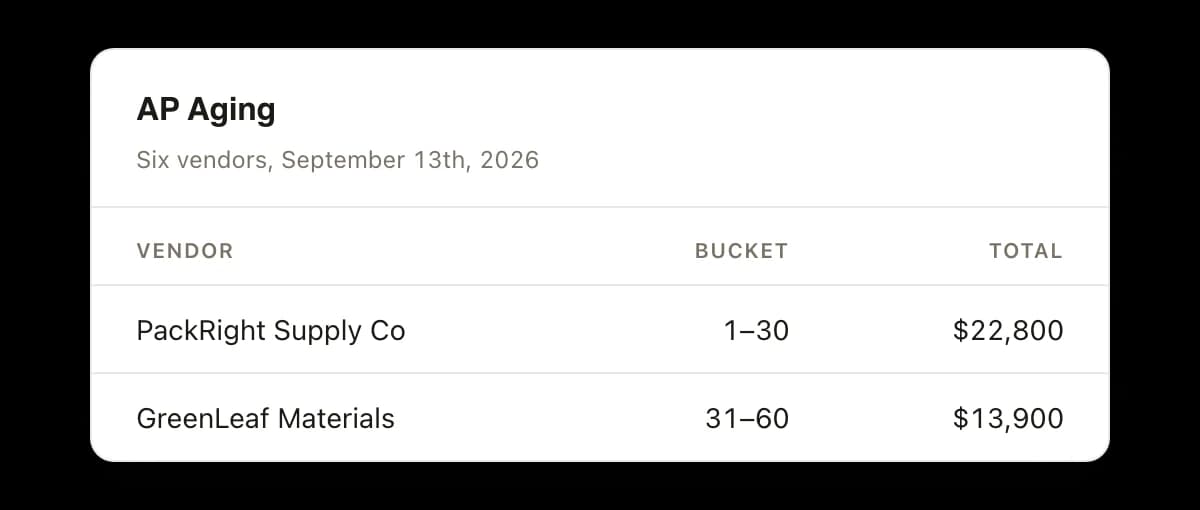
Supplier bills age the same way, by vendor and by bucket: PackRight Supply Co at $22,800 in the one to thirty day bucket, GreenLeaf Materials at $13,900 at thirty-one to sixty, across six vendors. What you owe and when it falls due is the other half of the week the cash has to carry.
Every number here has an owner.Three lanes, one ledger.
MargoFP&A
The weeks ahead, priced
Margo builds the cash forecast from posted entries, projected payouts, and scheduled outflows, models a change in revenue or spend against it, and says how many units the cash covers on each payment date.
TheoAP Agent
The money already promised
Theo codes supplier bills and freight against the orders they belong to and schedules each payment against its terms, so the outflow sits on the forecast before it hits the bank. Theo schedules and flags payments, he does not send them.
HugoRevOps Analyst
Where the margin is going
Hugo reports revenue and margin by channel and by SKU as the days post, so a forecast built on this quarter's economics is built on numbers that moved this week, not last year's averages.
The surfaces behind the answers.And the arithmetic under them.
What the cash covers on three dates, the weeks the projected balance runs tight, and how long the unpaid balances have been sitting.
What the cash covers
Two ceilings decide how big a run can be: what the projected balance allows, and what the components already on hand allow. The lower one is the answer, and the row under it shows what would be left in the bank once the run is paid for, before any of that stock sells.
What the cash covers, on three dates
Now
In 30 days
In 60 days
Units the cash coversPriced against the projected balance
Cash ceilingWhat the balance alone allows
Stock ceilingWhat the components on hand allow
Cash left after the runBefore the stock sells
Futureproof does not decide what to order. It reports what the cash covers.
Margo prices a run against the projected balance now, in thirty days, and in sixty, net of the operating costs and supplier payments already committed. On your account every column is built from your own bank, your own channels, and your own supplier terms.
The weeks that run tight
The opening balance runs across all thirteen weeks, so the tight ones are visible in it: $30,409 from the week of October 5th, then minus $121,133 from the week of November 2nd, under a chart of the projected closing balance and the range around it.
How long it has been owed
Money already earned sits here until it lands, aged by how long it has been outstanding. On September 13th, $266,172 of the balance was more than ninety days out, against $1,202 still inside current.
The rolling cash spreadsheet,and the weekend it costs.
What it replaces
A cash sheet rebuilt by hand every Monday
↓
Margo
FP&A
What it replaces
Supplier due dates tracked in an inbox
↓
Theo
AP Agent
What it replaces
Payout timing worked out after the fact
↓
Vic
Bookkeeper
What operators ask next,before the money moves.
Futureproof books your orders, fees, refunds, payouts, supplier bills, and card spend in one ledger, then projects the balance forward week by week. Marketplace payout cycles and reserves are projected on their own timing, and scheduled supplier payments sit on the same weeks, so the forecast shows when the balance runs tight rather than reporting it afterwards.
Yes. Raise or cut the projected inflows and the weekly balance answers again, so you can see what a larger campaign or a softer month does to the weeks ahead. You can also price a production run against the projected balance on each payment date. Margo brings the numbers and the decision stays yours.
No. Futureproof answers the money half. Margo prices a run against your projected cash on each payment date, net of the operating costs and ad spend already committed, and reports how many units that cash covers. What to order, and when, stays your call.
A spreadsheet is a copy of the numbers that goes stale the moment a payout lands or a supplier bill arrives. Futureproof forecasts from the same ledger that holds your books, and the ledger posts every night, so the model and the actuals cannot disagree. Nobody rebuilds the tab before the meeting.
Amazon and eBay connect directly. Shopify support is in beta, and TikTok Shop is coming soon. Your bank accounts, credit cards, and supplier bills connect in the same step, so payout timing and operating costs both land in the forecast.
Your numbers. Your answers. Smarter moves.
Say yes to the next movewithout the weekend.
Connect your channels, your bank, and your suppliers, and the question of whether cash carries the move is answered the day it comes up.