


 Bookkeeper
I close your books every day. Channel by channel.
Marketplace settlements, store orders, wholesale invoices, and the fees taken out of each one post to one ledger that replaces your accounting software. By the time you open your laptop the day is closed, and every entry behind it opens line by line.
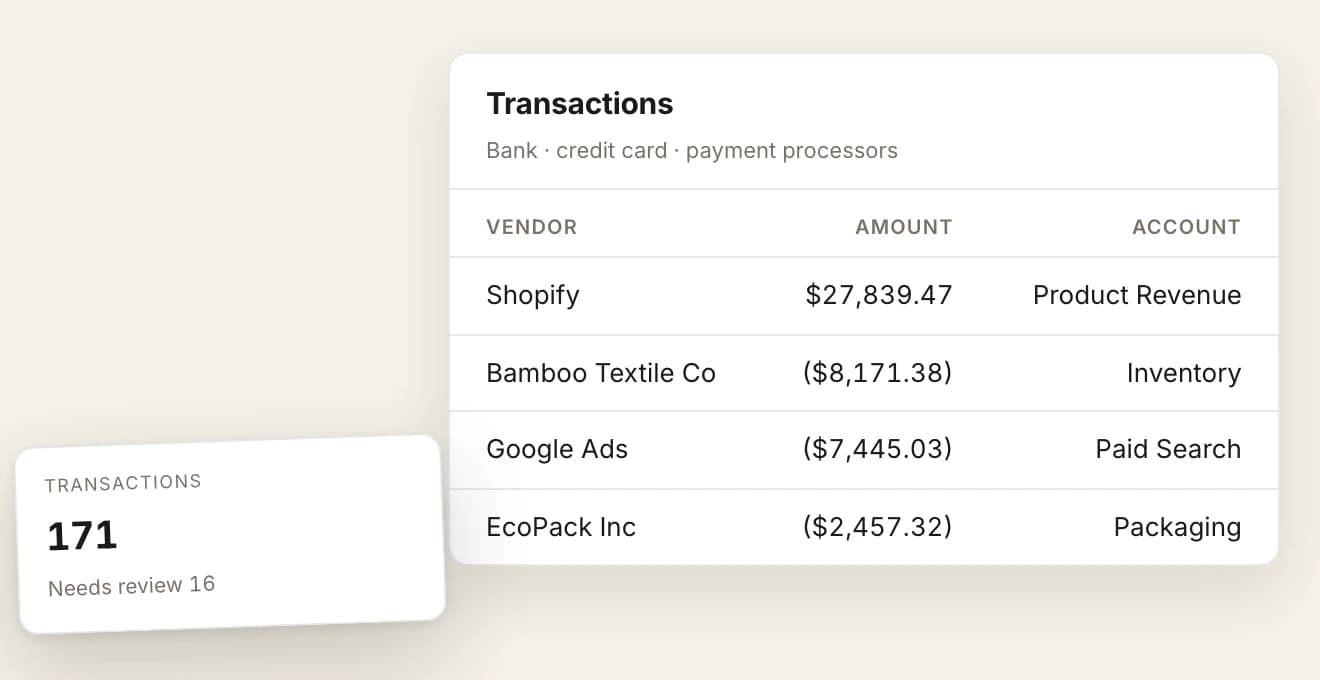
I read the day you sold.Then I post it.
Three things happen on my desk: what arrives from your channels and your accounts, what I write into the ledger, and what I put in front of you.
Orders, refunds, and settlements from Amazon and eBay, and from Shopify in beta. Every bank account and credit card you connect. The supplier bills behind the stock, and the wholesale invoices behind the retailers.
Revenue on its own line, each fee type on another, refunds and returns against the order they reverse. All of it in one ledger, coded to the account it belongs to rather than parked in a catch-all.
A closed day, a profit and loss statement built from posted entries rather than an export of them, and a short list of the items I could not tie out, each with the reason beside it.
My night is whyyour morning is quiet.
The work that makes your morning boring happens overnight. Between your last order of the day and the moment you open your laptop, the day's channel activity is coded, matched, and posted to one ledger, and anything that does not tie out is waiting for you with the reason attached.
- Every ten minutes
Lines coded as they land
New activity on your bank accounts and credit cards is coded to the account it belongs to as it arrives, so nothing waits in a pile for a month-end catch-up.
- Every night
The day opens for close
I open the period for the day just ended and work through what it needs, rather than waiting for someone to ask for a number in three weeks.
- Overnight
Payouts matched back
Each deposit is matched to the orders, fees, refunds, and holds that make it up, so a payout that came in light reads as a line item instead of a mystery.
- Every day
The channel day posts
The day of selling posts to the ledger, revenue separate from referral fees, fulfillment fees, and returns, which is what lets the statements read straight off the entries.
- Every Monday
Close readiness checked
I check what would stop the month from closing cleanly, list it, and put it in front of you while there is still a week to do something about it.
Every line I coded,on your screen.
The account each line landed in is on the row beside it, so a figure you disagree with opens down to the transaction under it.
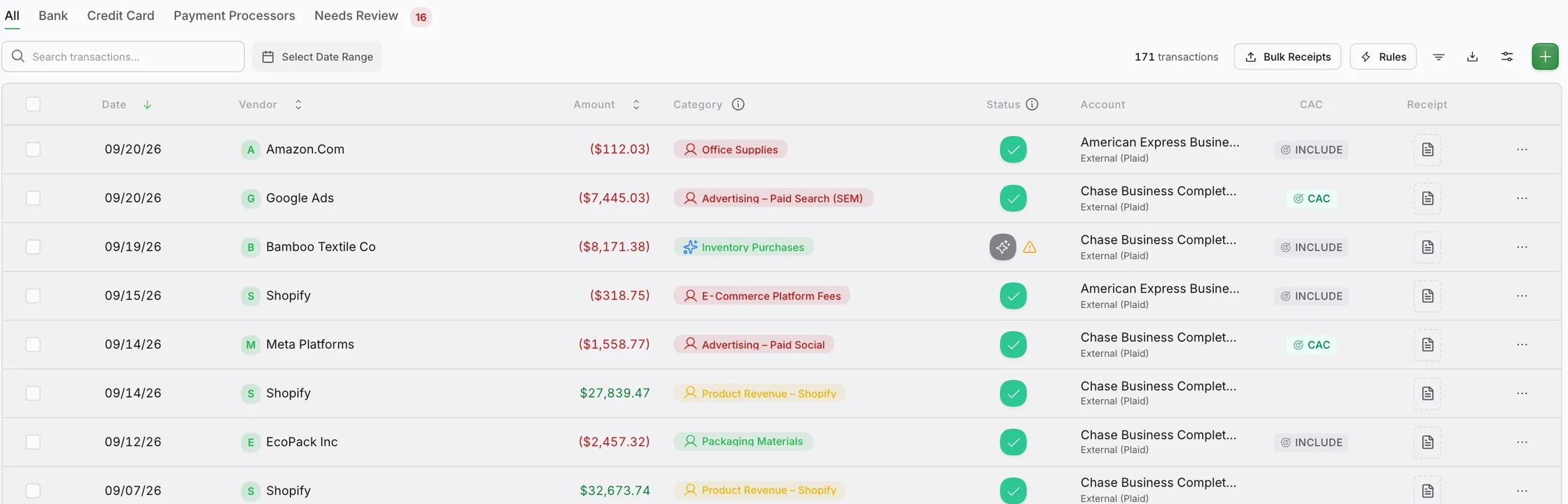
The transactions surface: every bank and credit card line coded to its own account, with the ones needing a human marked for review.
I do the posting.You keep the call.
Ask me anything the books can answer, read what I raise on my own, and keep the approval where it belongs.
- Ask meAsk why a payout came in under the orders behind it, and I show the referral fees, fulfillment fees, refunds, and holds that explain the gap, each one traceable to the entry it came from.
- I flagWhen a settlement does not tie out, or a return lands in a period after the sale it reverses, I raise it with the reason rather than leaving you a variance to work out.
- You approveI draft the entries and the close; you approve them. I never change a price or an order in a channel, I never write into another system, and I never file your return.

I close the day.Three agents build on it.
The ledger I keep is the same one the rest of the team reads from, which is why the margin number and the accounting are never two different systems.


Everything else operators askabout the close.
Vic splits every marketplace fee onto its own line in the ledger: referral fees, fulfillment fees, storage fees, advertising fees, and removal fees. Because each type is posted separately rather than netted into the deposit, an operator can see what a channel costs per order and per product, and a fee rate that changes shows up as a line item rather than as a smaller number in the bank.
Yes. Wholesale invoices with Net 30 and Net 60 terms sit in the same ledger as daily marketplace and store activity. Revenue is recognized when the order ships, and payments are matched to the invoices they settle when they arrive, so the two sides of the brand close together instead of being kept in separate spreadsheets.
Vic matches each deposit back to the orders, fees, refunds, and holds behind it, and raises the difference the same day with the reason attached. A payout that is light because of a fee change, a reserve, or a return that processed after the settlement period reads as an explained line rather than as an unexplained variance weeks later.
Coming from QuickBooks, a one-click migration brings the history across. Other systems move over with file exports. After that the books live in one ledger that replaces the accounting software rather than sitting on top of it, which is why the close and the channel numbers come from the same place.
We never sell your data, and we share it only with the vetted service providers that run the platform, never with other customers and never with advertisers. Access inside your account is limited to the people you invite.

Your books, closed daily
Give me the close.Keep your weekend.
Connect your channels, your bank accounts, and your credit cards, and the first close runs the same night.
Starting at $1,000/month for all six agents, with a monthly review call with a human financial specialist included. No per-seat fees, no modules.