


 FP&A
FP&AI price the next order against the cash you have.
Money leaves on the deposit, stock sells months later, and the payout lands later still. I hold those dates in one plan, rebuilt every night from posted entries, so the week your balance gets tight has a name while there is still time to act on it.
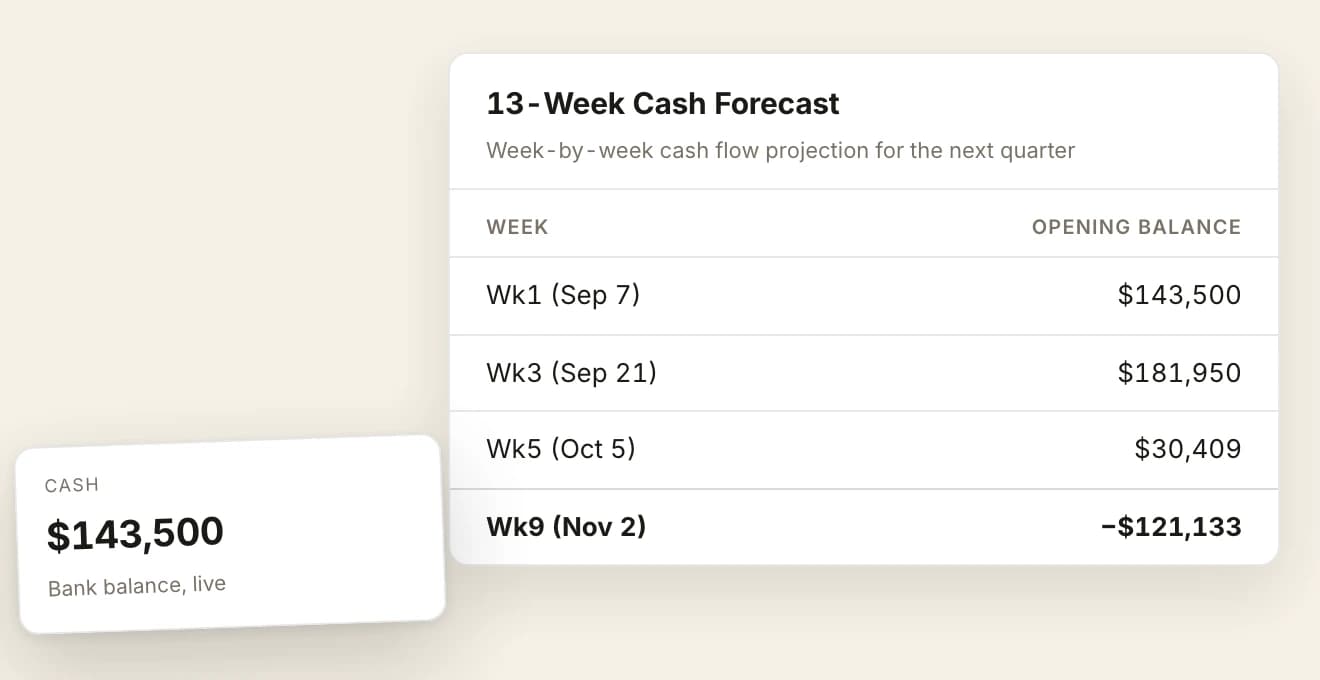
I read the cash you hold.Then I run it forward.
A forecast is only as honest as what it starts from. This is what comes in, what I record, and what I put in front of you.
The closed day behind you, every bank account and credit card you connect, the supplier payments already scheduled, the orders on the water, and the payouts each channel still owes you.
A thirteen-week plan rebuilt nightly in one ledger: the balance you open each week with, the money committed against it, and the payouts expected before it.
The week the balance goes tight, the cash a reorder takes out and the date it leaves, and the assumptions I used, so you can argue with any of them.
The plan is rebuiltevery single night.
A cash plan goes stale the day it is built. Every night I rebuild yours from what the books actually posted, lay the supplier payments and expected payouts on top, and carry the balance forward week by week, so the plan you open in the morning is the plan as of last night.
- Every night
The cash plan rebuilt
The thirteen weeks ahead are rebuilt from posted entries, with the committed outgoings and the money still coming in carried into each week.
- Nightly
Payout timing modeled
Marketplace payout cycles and the reserves held against them are projected forward, so the cash you are owed lands in the week it will actually arrive.
- Every Monday
Reorders priced
Every product due for reorder is priced against the balance on the day the deposit would clear, so affordability is settled before you go to the supplier.
- Weekly
Landed cost drift
Where the cost of landing a unit has moved away from the assumption the plan was built on, I show you the gap rather than quietly keeping the old number.
- Early each month
Plan against actual
What you expected and what the books recorded are put side by side, so a plan that keeps missing in the same direction gets corrected instead of trusted.
Thirteen weeks of cash,week by week.
One plan with the opening balance on every week, the commitments underneath it, and the week that dips marked.
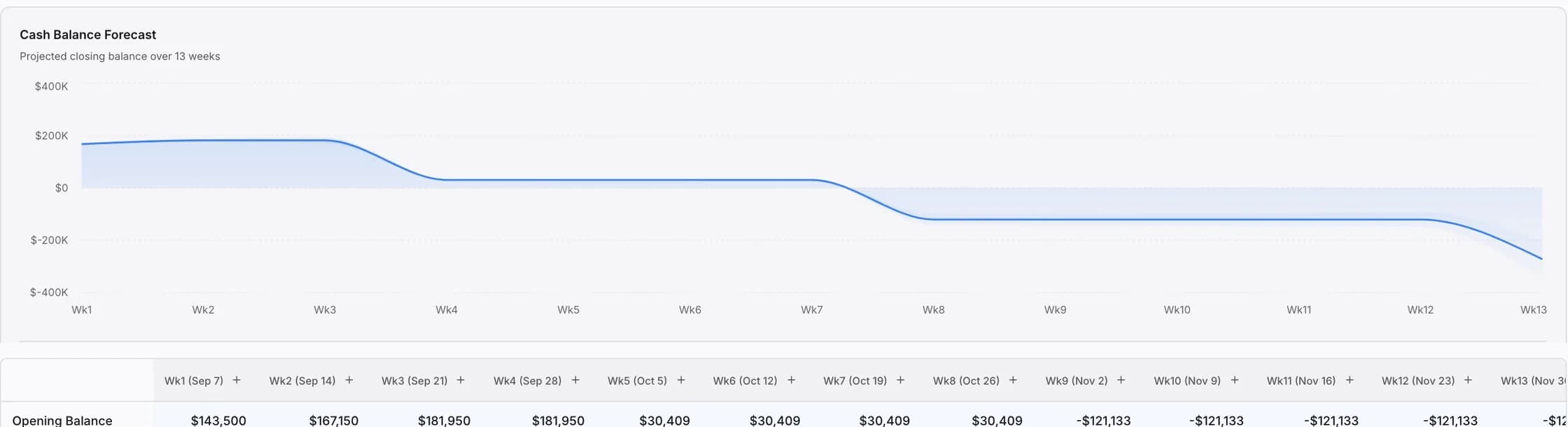
The thirteen-week plan: the projected closing balance drawn across the quarter, with the opening balance for every week listed underneath it.
I do the modeling.You place the order.
My job is to make the arithmetic honest and early. What you do with it is the part only you can do.
- Ask meAsk whether you can fund the next container, and I show the deposit, the balance due, and the balance on each of those dates after the costs you have already committed.
- I flagThe first week your projected balance drops under the floor you set, a payout arriving later than the plan assumed, or a landed cost that has drifted away from the number the plan was built on.
- You approveI never move money and I never place an order. I do not tell you which product deserves a bigger bet either; I tell you what a buy costs, when the cash leaves, and whether the balance covers it.

The plan starts elsewhere.Three agents feed it.
A forecast that starts from a guess is a guess. Mine starts from closed books, scheduled payments, and money already owed to you.


Everything else operators askabout the cash plan.
The supplier payments already scheduled, the orders on the water, and the payouts each channel still owes sit in the same thirteen-week plan. When a reorder is due, the deposit and the balance land on the weeks they will actually clear, so the cost of a buy is visible against the balance before the wire goes out rather than after.
A spreadsheet is accurate on the day it is built and drifts every day after. Margo rebuilds the plan nightly from posted entries, so the opening balance, the committed payments, and the money still owed are current. The output is also dated: the week the balance turns has a date on it rather than a general warning.
No. Margo answers the cash half of the question: what a purchase order takes out, when it leaves, and whether the projected balance covers it on that date. How deep to go on a product stays the operator's call, made with the margin and sell-through the rest of the team reports.
A product with no reliable sell-through or no lead time on file gets a withheld answer and the reason for it, rather than an invented date. Every figure in the plan traces back to posted entries or to an assumption the operator can see and change.
We never sell your data, and we share it only with the vetted service providers that run the platform, never with other customers and never with advertisers. Access inside your account is limited to the people you invite.

Your cash, weeks ahead
See the tight weekwhile you can still move.
Connect your channels, your bank accounts, and your credit cards, and the first thirteen-week plan is built the same night.
Starting at $1,000/month for all six agents, with a monthly review call with a human financial specialist included. No per-seat fees, no modules.