


Hero SKU keeps stocking out
Every stockout day is revenue your competitors collect. And the reorder math, sell-through against lead time against cash on hand, is buried in a spreadsheet you do not fully trust.

A purchase order is a cash decision before it is an inventory decision. Money leaves on the deposit, stock sells months later, and the payout lands later still. Futureproof books every landed cost, supplier payment, and marketplace payout in one ledger, so that gap carries a number.
One purchase order, followed to cash
Inventory cash flow is the distance between the money a purchase order takes out of the bank and the money that stock eventually hands back. For most brands that distance stays invisible until the balance gets tight, because landed cost, supplier terms, and payout timing live in three places that never meet.
Every stockout day is revenue your competitors collect. And the reorder math, sell-through against lead time against cash on hand, is buried in a spreadsheet you do not fully trust.
Slow-moving SKUs quietly tie up working capital that could fund Q4 ad spend, the next launch, or a second run on your top performer. You cannot see which SKUs, so the cash stays trapped.
Order too small, you stock out. Order too big, you starve ads for sixty days. Without a model tying lead time, velocity, and bank balance together, you are guessing on the biggest spend you make all year.
Setup is one sitting. After that the ledger does the arithmetic every night, so the cash position behind a reorder is already current when you go to use it.
Sales channels, bank accounts, credit cards, and supplier bills connect in one sitting, so stock movement and the money behind it land in the same ledger.
Overnight the agents work through it: payouts matched to the orders behind them, supplier bills coded, inbound costs allocated, the day closed.
By morning your stock, your open orders, and your cash plan carry the same posted entries, so a reorder question is answered with this week's numbers.
Margo brings you the number and you approve, adjust, or decline. Nothing is committed on your behalf, and every action lands on the audit trail.
Three questions an operator asks before money leaves for stock, each one answered from posted entries instead of a spreadsheet rebuilt every quarter.
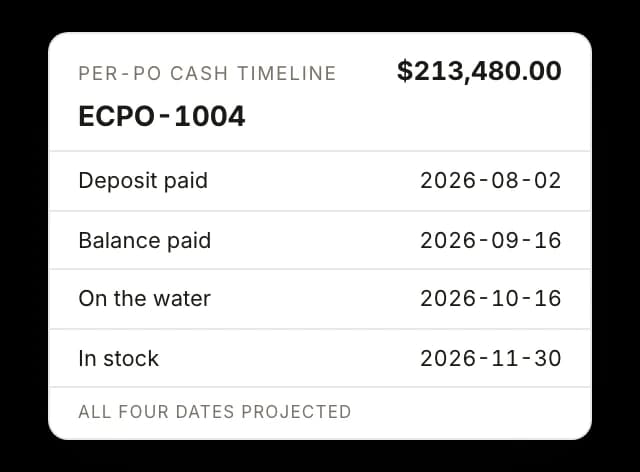
ECPO-1004 is $213,480.00 across two payments, the deposit on 2026-08-02 and the balance on 2026-09-16, with the container on the water by 2026-10-16 and the stock sellable on 2026-11-30. Margo lays those cash events on your forecast and flags any week the balance drops under your minimum. Every date here is projected.
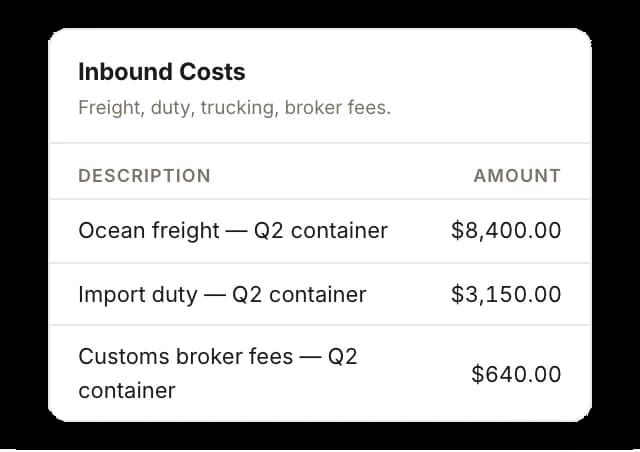
Ocean freight at $8,400.00, import duty at $3,150.00, and customs broker fees at $640.00 are allocated across the units on the order, by unit, by value, or by weight. The cash you are committing is the landed number, not the factory quote, so the margin you price against survives the container.
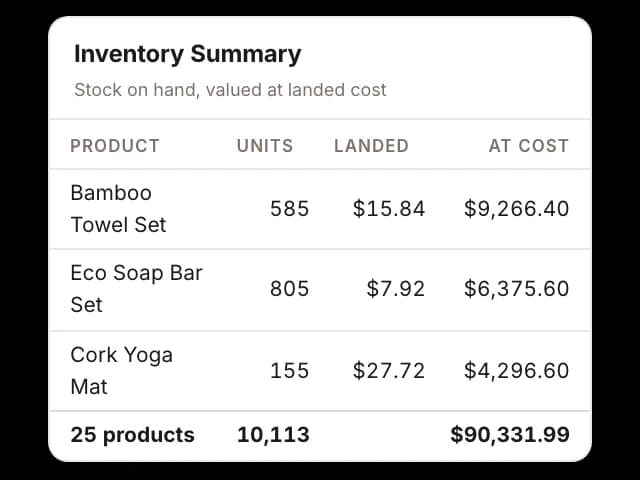
Each product shows the units on hand, the average landed cost behind them, and what that stock is worth at cost: 805 units at $7.92 is $6,375.60 standing still, 155 at $27.72 is $4,296.60. Across 25 products the shelf stops being a feeling and becomes a figure you can act on.

Theo codes supplier invoices, freight, duty, and insurance against the order they belong to and allocates them per unit, then schedules the supplier payments against the cash that funds them.

Hugo values stock on hand at cost and at retail, tracks how fast each SKU sells, and reports how long the current stock covers, so trapped capital is a figure instead of a feeling.

Margo prices a production run against your projected balance on each payment date, after the operating costs and ad spend already committed, and says how many units that cash covers. What to order stays your call.
Stock valued at cost, the cash plan it feeds, and the orders already committed against it.
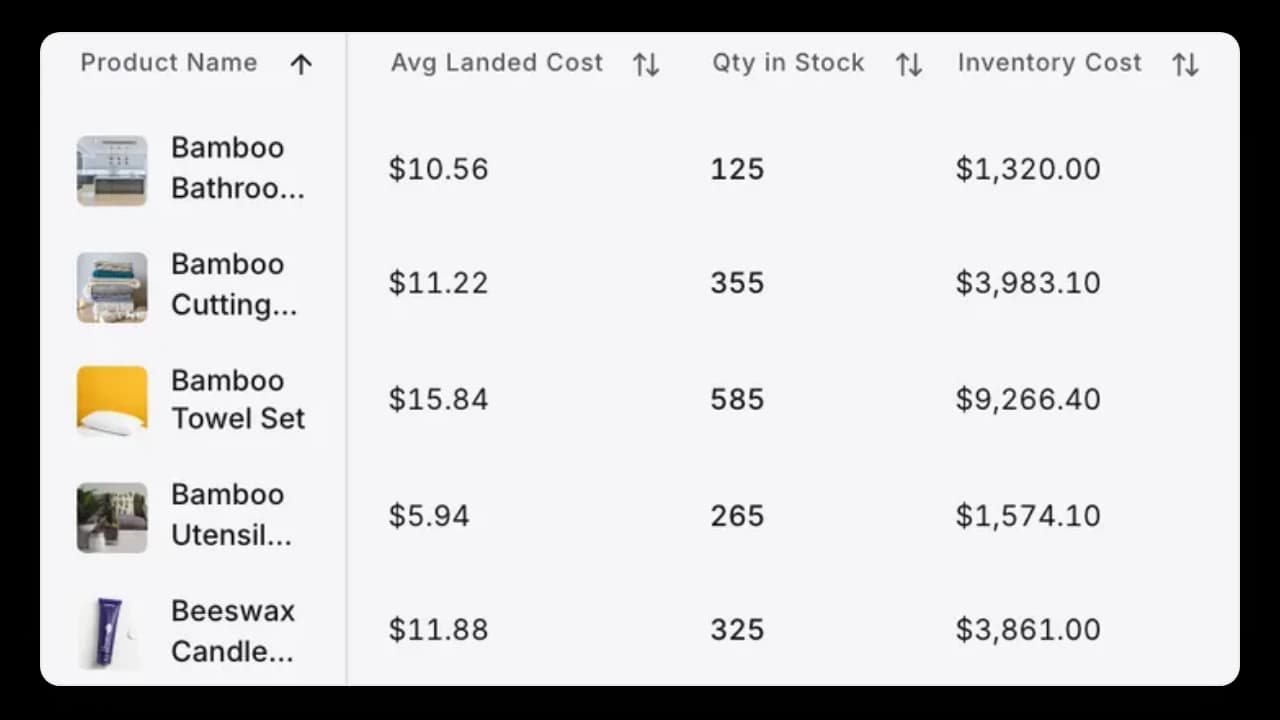
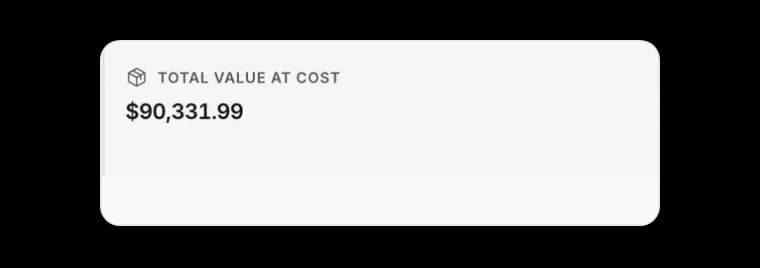
The inventory surface lists each product with its average landed cost, the units in stock, and what that stock is worth at cost. The summary tile above the rows reads 10,113 units across the catalog, $90,331.99 at cost.
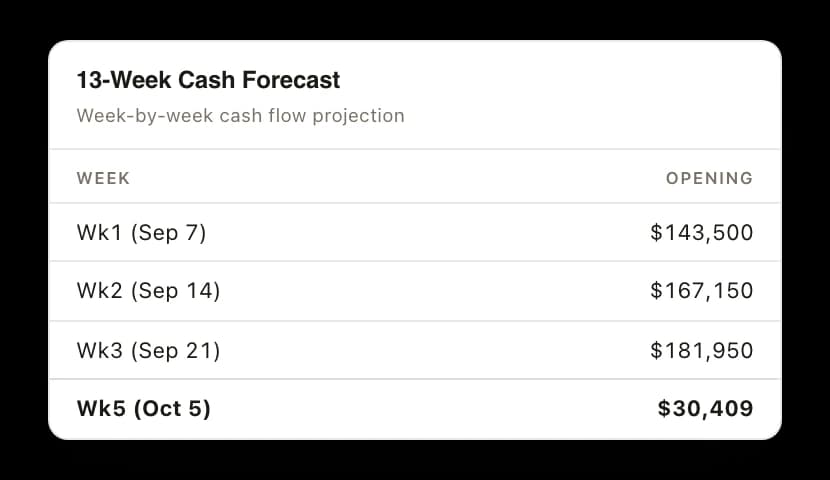
The forecast runs thirteen weeks ahead, with the weekly opening balance floating over the chart: $143,500 at the start of the window, then $167,150, then $181,950.
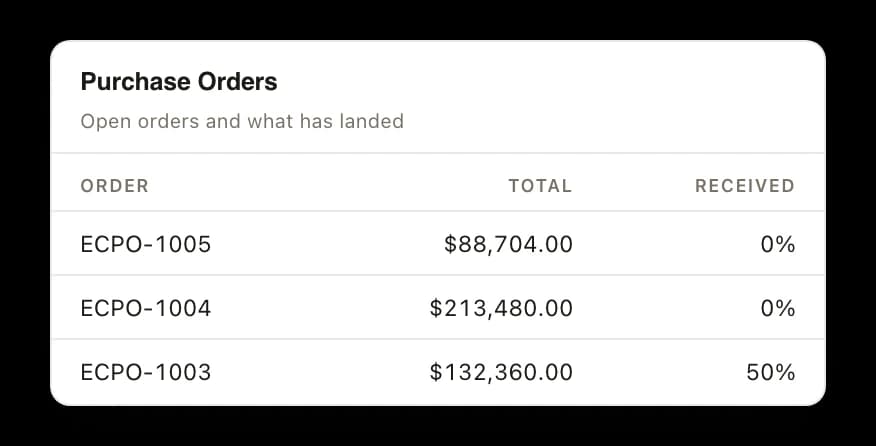
The purchase order register lists every open order with its vendor, its total, and the share received so far: ECPO-1005 at $88,704.00 with nothing landed yet, and ECPO-1003 at $132,360.00 half received, alongside the container above.
Every SKU carries its landed cost, so inventory on hand has a dollar value rather than a unit count. Futureproof reports units in stock, value at cost, and value at retail, drawn from the same ledger that produces your financials. The purchase order register adds what is committed but not yet received.
Futureproof does not tell you what to order. It tells you whether you can afford it. Margo prices a run against your projected cash on each payment date, net of the operating costs and ad spend already committed, and says how many units that cash covers. The order stays your call.
Amazon and eBay connect directly. Shopify support is in beta, and TikTok Shop is coming soon. Once a channel is connected, orders, fees, and payouts sync into your books, and the stock behind them is valued at cost in the same ledger.
Those tools plan stock. They do not know your bank. Futureproof answers the other half: what a run costs landed, what your cash position looks like on each payment date, and how many units that cash covers. It also replaces the hours. A restock tool is software somebody on your team operates every week. Futureproof keeps the books underneath it and brings the decision to you.
Your numbers. Your answers. Smarter moves.
Connect your channels, your bank, and your suppliers, and the next container stops being a guess with a wire attached to it.
Starting at $1,000/month for all six agents, with a monthly review call with a human financial specialist included. No per-seat fees, no modules.