


 FP&A
FP&AI price the hire, and the month it lands in.
A forecast is only worth having if it is current when the decision arrives. I rebuild yours on the entries posted to your general ledger, project the cash week by week, and price the move you are considering against the runway you said you would not go below.
The plan, the actuals,and what it does to cash.
Where the forecast starts, what I record against it, and what reaches you before a commitment.
The closed and posted entries on your general ledger, the balances across your connected bank accounts and credit cards, the bills already scheduled, the invoices still open and when each customer tends to pay them, and the hiring plan with a cost behind every role.
A projected cash position for the weeks and months ahead, frozen at the start of each week so it can be checked against what actually happened. The scenarios you ask for sit beside the base case rather than overwriting it, and nothing I model touches an entry that has already posted.
The answer to a question you were about to spend a weekend on. Can this role be afforded, what does the price change do, how far does the cut actually get you, and what the month just did against the budget you set for it.
Five things rebuild themselveson their own schedule.
The forecast does not wait to be opened. It is rebuilt against what posted, and when something crosses a line that matters, the note arrives rather than waiting to be discovered.
- Daily
I project the cash
I refresh how each customer actually pays, walk your open invoices and scheduled bills forward, and project the closing cash position across the weeks ahead, dropping projections the ledger has already overtaken.
- Weekly
I freeze last week's call
I keep the projection I made at the start of the week and fill in what actually happened beside it, so the forecast can be judged against reality instead of quietly replaced with a better looking one.
- Every Monday
I check the raise timing
I work backward from your runway to the last sensible date to start raising, and if that date has moved inside the window I put the note in your inbox. The check reads and writes nothing else.
- Monthly
I compare plan to actual
Every category, the budget against what actually posted, with the overruns named in the month they happen rather than discovered at the end of the quarter.
- Monthly
I price the hiring plan
I compare the roles you planned to hire against the people actually on payroll and price the gap, so the plan and the payroll file stop drifting apart without anyone noticing.
The months behind you,and the months ahead.
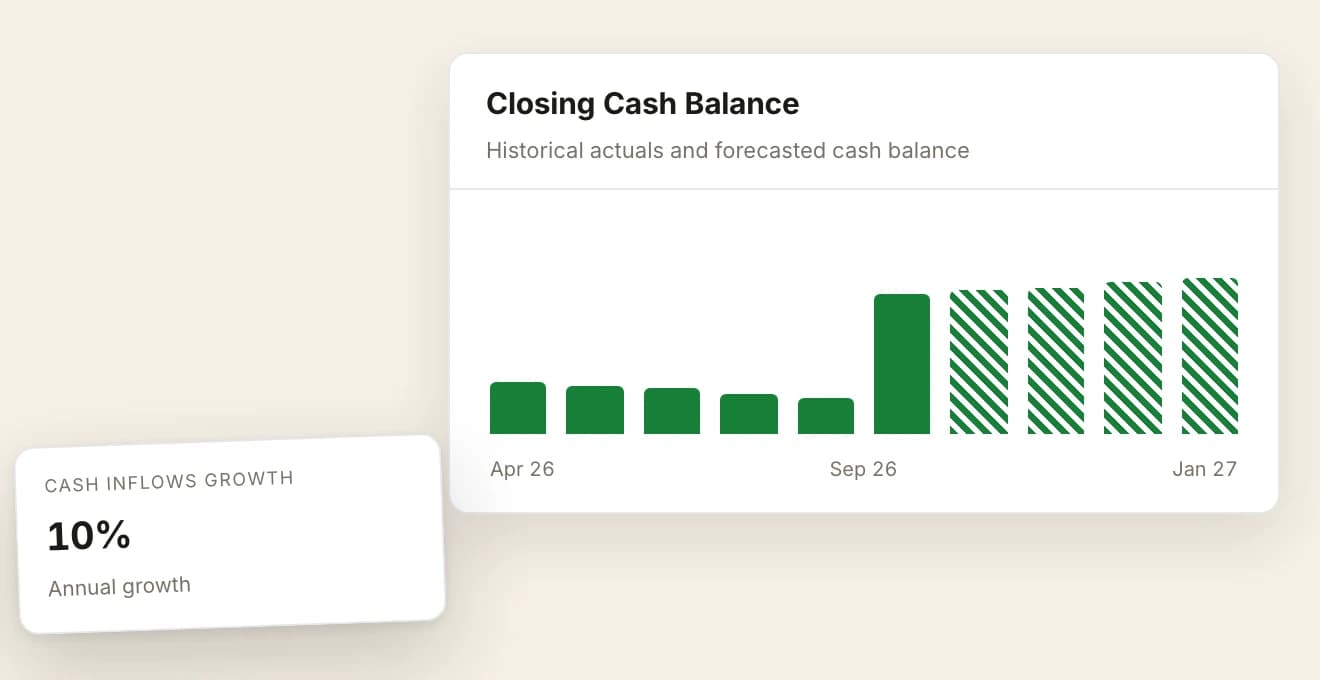
Closed months and projected months on the same axis, so the join between them is visible rather than implied.

The closing cash surface: the months already closed drawn solid, the months still forecast drawn hatched, and a forecast you can edit by hand where you know better.
I build the cases.The plan waits on you.
Modeling is cheap and committing is not, so I do as much of the first as you want and none of the second.
- Ask before you commitAsk what two engineers in the third quarter do to the runway, what a price increase is worth, or how far a cut actually gets you. I need one thing from you first, which is the minimum runway you are unwilling to go below. I ask for it rather than assuming a number on your behalf.
- I flag the date in advanceWhen the runway crosses into the window where a raise has to start, when a category runs past its budget, or when the hiring plan and the payroll file no longer agree, the note arrives while there is still time to act on it.
- Nothing enters the plan aloneA scenario stays a scenario until you choose the one you are going to run. The raise-timing check is read-only and lands in your inbox, so I never contact an investor, never change a budget, and never move a posted entry.

Where the forecast startsand who it reaches.
A forecast is only as good as the books under it, and only as useful as the people who act on it.


What founders ask firstabout the forecast.
Margo is the financial planning agent on the Futureproof finance team. Margo recomputes burn and runway from the entries posted to your general ledger, projects the cash position forward week by week, prices hiring and pricing decisions as scenarios, and compares each month against the budget it was given.
Margo works from the cash balance across the connected accounts and the burn measured on posted entries rather than on a bank export, then carries that forward against the bills already scheduled and the invoices expected to be collected. The figure is recomputed after the night's entries post.
Yes. Scenarios sit beside the base case rather than replacing it, so a role, a start date, and a salary can be compared against a different combination of the three. Margo asks for the minimum runway the founder is willing to hold, because affordability has no answer without it.
No. Margo works backward from the runway to the last sensible date to start a raise and leaves a note in the inbox when that date moves into range. The check is read-only, it contacts nobody, and the decision to start raising stays with the founder.
The projection made at the start of each week is frozen and kept, and the actuals are filled in beside it once the week closes. Forecast accuracy is therefore measurable rather than assumed, and a forecast that keeps missing in one direction is visible.

See the months ahead
Stop guessing at the hire,start pricing it.
Connect your bank accounts, your credit cards, and Stripe, and I will build the forecast on your own books. Fourteen days is long enough to test a decision against it.
Starting at $1,000/month for all six agents, with a monthly review call with a human financial specialist included. No per-seat fees, no modules.