


 AR Agent
I invoice on time, and I do the chasing.
Receivables are the part of finance that goes quiet when founders get busy, and quiet receivables are cash sitting in somebody else's account. I raise the invoice from the terms you signed, age it every day, apply the payment when it lands, and draft the follow-up on whatever is late.
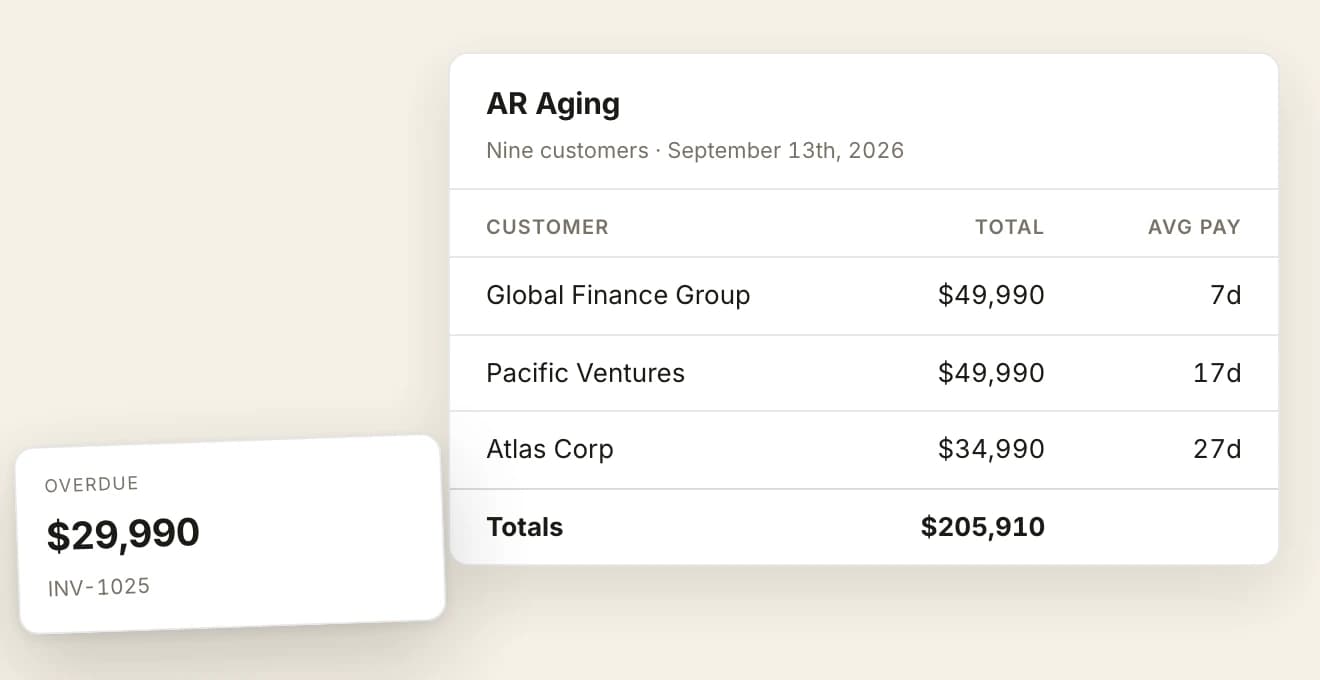
The money owed to you,without a reminder.
What comes in on the receivables side, what I write down against it, and what reaches you.
Your signed order forms and contracts, your Stripe subscriptions and charges, and the deposits arriving in the bank accounts and credit cards you connected through Plaid. I read each customer's own history as well, including how long they actually take to pay rather than how long the terms say they should.
Invoices raised against the terms they came from, cash applied to the invoice it settles, each receivable aged by how far past terms it has gone, and a reserve proposed against the balances that have stopped looking collectible.
An aging that is current, the follow-ups already drafted for the accounts that are late, and the short list of customers where the next move is a decision rather than another reminder.
The five I work throughwhile the office is empty.
None of this waits for you to remember it. Each job is scheduled, and the only thing that reaches you is the part that needs a person.
- Daily
I sweep the receivables
I walk every open invoice, age it, mark what has gone past terms, and line up the follow-up each account is due so nothing drifts quietly into a second month.
- Daily
I apply the cash
Payments that arrived get matched to the invoices they settle. The aging reflects what has been paid rather than what has been promised, and the gaps I cannot match come to you.
- Daily
I tie receipts to the bank
Every payment recorded against an invoice gets traced back to a deposit in your bank account. Nothing counts as collected until the money is actually there.
- Monthly, on the first
I reconcile to the ledger
The receivables subledger has to agree with the control account on the general ledger. I reconcile the two and report the difference rather than letting it build up over quarters.
- Quarterly
I review the reserve
I look at what has aged beyond realistic collection and propose a reserve against it, so the receivable on your balance sheet is a number you could defend in diligence.
Everyone who owes you,aged to the day.
One screen for the whole receivable: who is current, who is late, and how late.
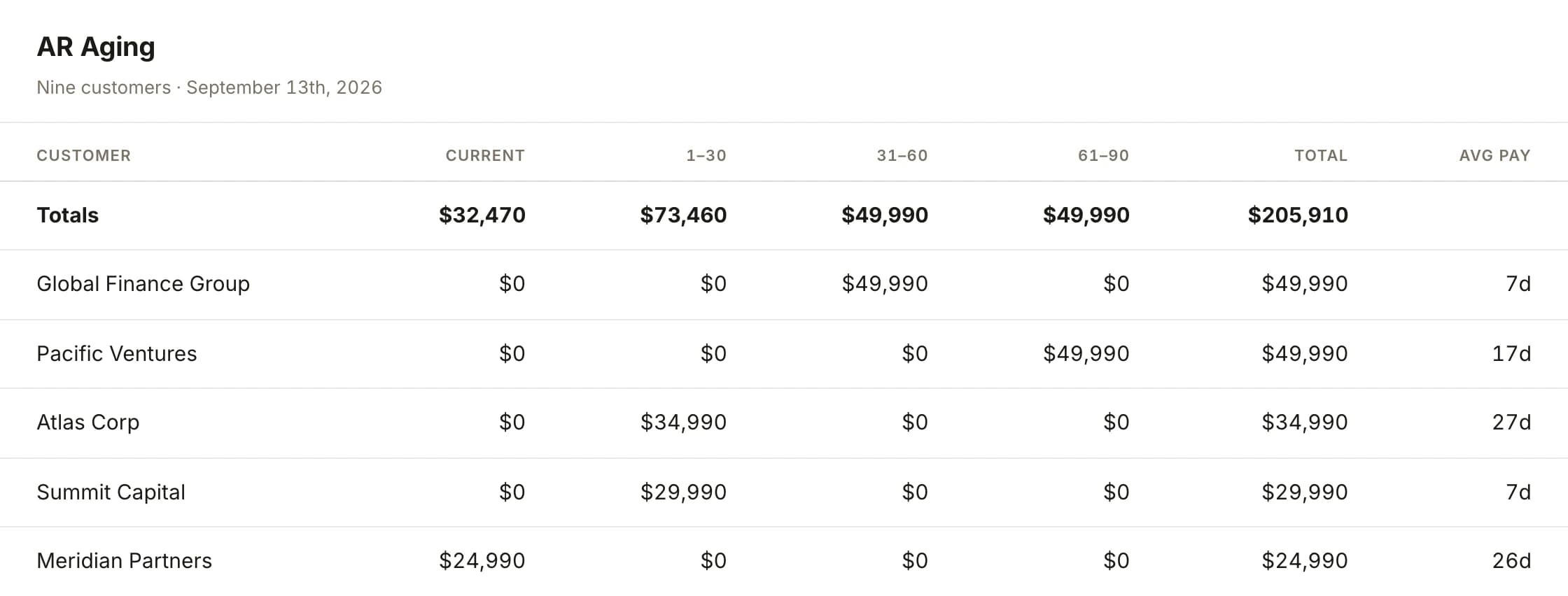
The receivables surface: every customer aged bucket by bucket, with the total owed and the average days that customer actually takes to pay.
I do the follow-up.The relationship stays yours.
Collections is the one finance job where tone matters as much as timing, so the drafting is mine and the decision is yours.
- Ask who is late and whyAsk what is outstanding, which customers slip every quarter, how long your average invoice really takes to clear, and what you can expect to collect in the weeks ahead. The answers come off the invoices and the deposits, not an estimate.
- I flag the accounts at riskWhen a customer's pattern changes, when a balance ages past the point where it usually gets paid, or when a payment cannot be matched to anything open, I bring it to you with what I know about the account.
- Nothing goes out unreadEvery message that carries your name is drafted for you first. You set the cadence and the tone, you approve the escalation, and writing a balance off is your call rather than mine. I do not collect money and I do not touch the bank.

Where the cash goesonce it lands.
Three lanes take what I collect and do something different with it.


What founders want to knowabout the chasing.
Remi is the accounts receivable agent on the Futureproof finance team. Remi raises invoices from signed contracts and subscriptions, ages every open receivable daily, applies incoming payments to the invoices they settle, drafts the follow-up on overdue balances, and reconciles the receivables subledger to the general ledger each month.
No. Remi drafts the follow-up and leaves it for approval. The founder sets the cadence and the tone and approves anything that escalates, so no message goes to a customer under the company name without a person reading it first.
Upload the signed order form and Remi reads the terms out of it: the purchase order number, the billing contact, the payment terms, and the line items. Remi drafts the invoice from those terms rather than from a template, so the invoice matches the agreement that was actually signed.
The failed charge is posted to the receivables ledger, the invoice stays open and continues to age, and Remi drafts a recovery message for the accounts that need a human touch. When the payment eventually clears, Remi applies it to the right invoice.
Yes. Remi measures how long each customer takes to pay rather than assuming the stated terms, and that pattern feeds both the follow-up order and the collections forecast the cash projection is built on.

Get paid sooner
Stop chasing invoices,start collecting.
Connect Stripe, your bank accounts, and your credit cards, and I will run the follow-up from the first week. Fourteen days is long enough to watch the aging move.
Starting at $1,000/month for all six agents, with a monthly review call with a human financial specialist included. No per-seat fees, no modules.