


Caught early
A bill that needs a look is flagged for your review while it is still open, beside its due date.

 Supplier Accountant
Every open bill, freight, duty and broker fees included, lined up by due date against the cash you have. Forward the bills, and I capture and code each one. Payables is my lane on Futureproof's AI finance team, in the same books as your stock and your cash.
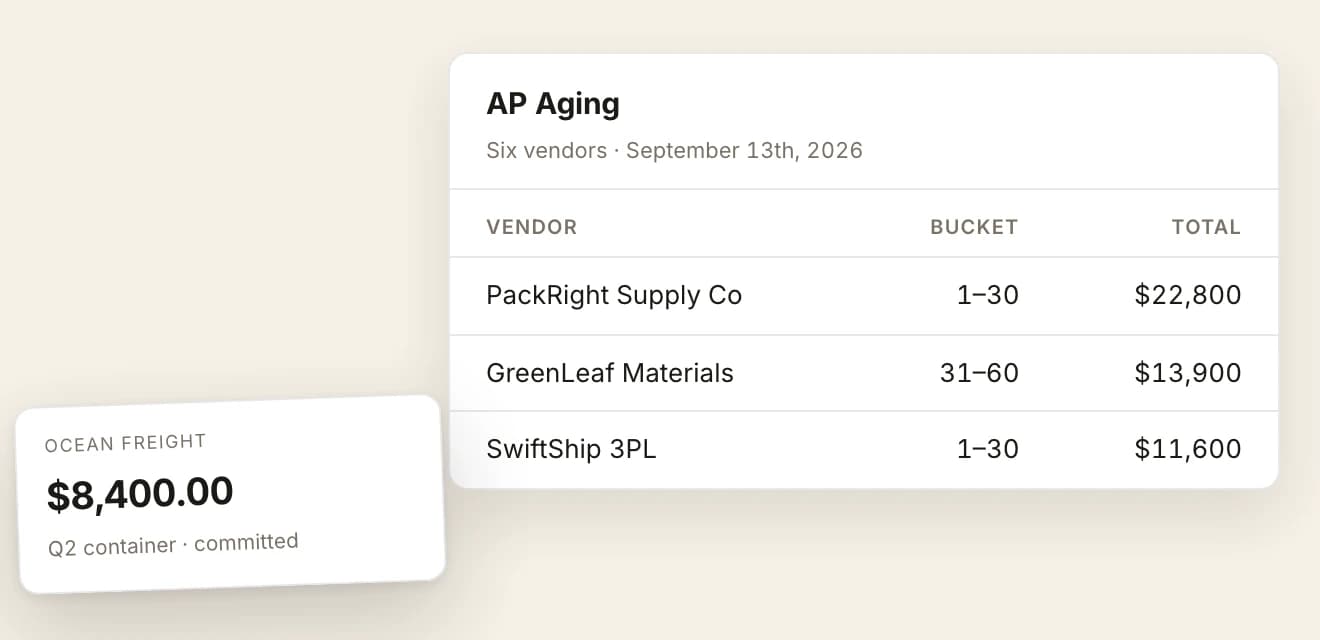
Everything on the payables side of your brand passes through here: what comes in, what I write down, and what I put in front of you to decide.
Supplier invoices, freight and duty bills, broker fees, co-packer and 3PL bills, and the receiving records behind them, forwarded in or uploaded. Every bank account and credit card you connect, so a bill can be checked against the cash that would pay it.
Each inbound cost captured and coded, with freight, duty and broker fees spread across the units they cover, so what a unit cost to land sits in one ledger beside the product.
What is due and when, set against the cash you have, the bills flagged for your review and why, and the landed cost per unit that your margin and your cost of goods sold are built on.
Payables goes wrong quietly: a bill that never got coded, a container whose freight never reached the product, a supplier paid early in a week that could not afford it. Overnight I capture and code what arrived, and line up what is due against the cash on hand.
Anything approaching its terms is raised while there is still time to move it, so a due date is something you decide about, not something you discover.
A bill that needs a look is flagged for your review, beside its due date.
Each week I line up what falls due against the cash on hand, so you decide what to pay and when, from your own bank.
What one unit cost to land, with freight, duty and broker fees in it, and the date each payment on the order is due.
From one container of 9,600 units
Landed cost$9.50Factory price (FOB)$6.80
Order total$65,280.00
I line up what you owe and when it is due, against the cash in your bank. Your suppliers, your terms and the payment stay with you.

A bill that needs a look is flagged for your review while it is still open, beside its due date.
Ask what is still owed on an order, and you get the order total, what you have paid and the balance still to come.
You decide what to pay and when, and pay it from your own bank; I show what is owed, when it is due and your cash beside it.
Landed cost is the number everything downstream is priced against, which is why it is produced once and read everywhere.


Theo captures and codes the bills for product cost, freight, duty, broker fees, and 3PL receiving. The platform spreads the landing costs across the units they cover, by unit, by value, or by weight, and holds the cost per unit in the ledger. Once you approve the landed cost, Vic books cost of goods sold from it as each unit sells.
The order carries the estimate until the actual bill arrives, and then the landed cost is actualized against what was charged. The share on units still in stock goes to inventory, and the share on units already sold goes to cost of goods sold in the month the bill is entered, so the product carries its true cost and the margin behind it moves with it.
No. Theo shows what is owed to each supplier, when it is due, and how it sits against the cash on hand, and flags any bill that needs your review. You decide what to pay and when, and pay it from your own bank.
Each bill is captured, coded and set against its due date and your cash, so you can take it up with the supplier before you decide what to pay.

Your costs, on the unit
A walkthrough of the whole platform, then a talk about how you run your month.