


Checked monthly, spent weekly
You open a spreadsheet, pull bank balances, subtract expenses, divide. The number is outdated by the time you finish. Every candidate, every test, every subscription needs an answer this week, not next month.

Runway gets checked once a month, in a spreadsheet that is stale before it is finished, while the decisions arrive weekly. Futureproof builds your books in its own general ledger, your system of record, and Margo recomputes net burn and runway on that ledger every night. The answer is ready before the decision is.
A balance, a slope, and where they meet zero
Burn rate is the cash a company consumes each month after collections, and runway is how many months the current balance covers at that rate. Both answer one question, how much can be spent now. Both go stale the moment they are rebuilt by hand from last month's bank exports and a column of guesses.
You open a spreadsheet, pull bank balances, subtract expenses, divide. The number is outdated by the time you finish. Every candidate, every test, every subscription needs an answer this week, not next month.
The strong candidate, the promising channel test, the new tool. You hesitate, not because the move is wrong, but because you cannot tell whether you have eight months of runway or five. The hesitation costs more than the spend would have.
Cash is not a countdown. It is a budget for growth. The founders reaching the next hire first know exactly how much they can deploy, and that visibility should not be reserved for companies that already employ a finance team.
Setup is one sitting. After that the ledger does the arithmetic overnight, so the cash position behind a commitment is already current when you go to use it.
Bank accounts, credit cards, and Stripe connect through Plaid in one sitting, and your transaction history imports into the general ledger that burn is measured from.
Overnight Vic codes each inflow and outflow to an account on your chart and reconciles what cleared, so the balance the math starts from is a posted balance.
Margo reruns gross burn, net burn, and months of runway on the fresh ledger, and projects the cash position forward across the months ahead.
Margo brings you the number and you approve, adjust, or decline. Nothing is committed on your behalf, and every action lands on the audit trail.
Three questions a founder asks before a commitment, each answered on the surfaces that already carry the answer rather than in a model rebuilt every quarter.
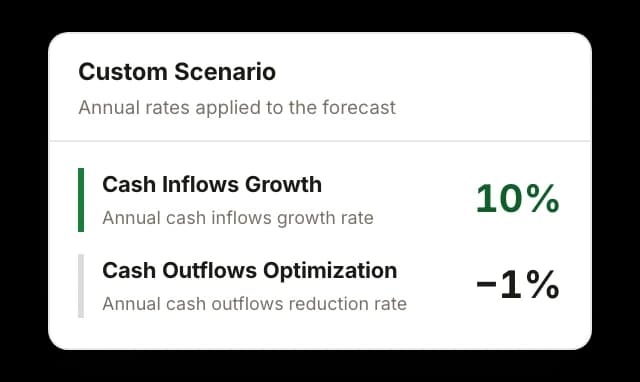
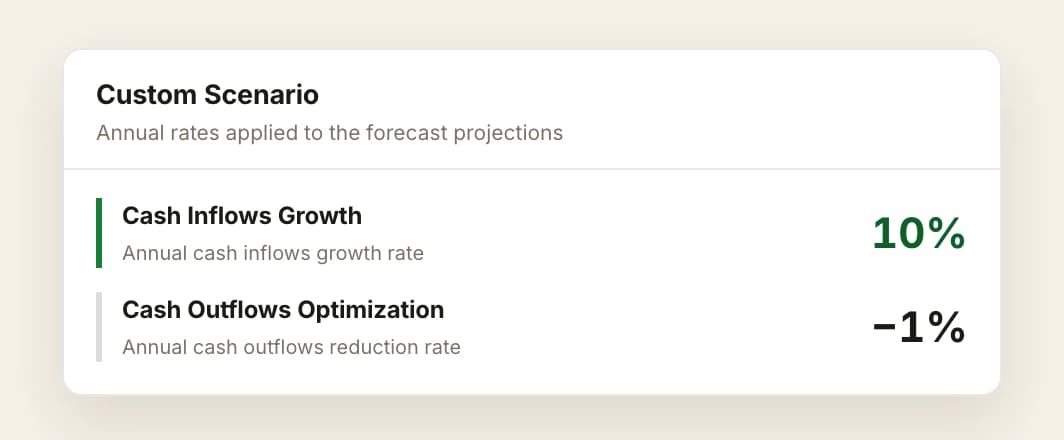
Set the two annual rates the projection runs on and read the result: cash inflows growth at 10 percent here, and a reduction rate on cash outflows at minus 1 percent. They are converted to monthly rates and applied to the forecast. Changing an assumption changes nothing that has already posted.
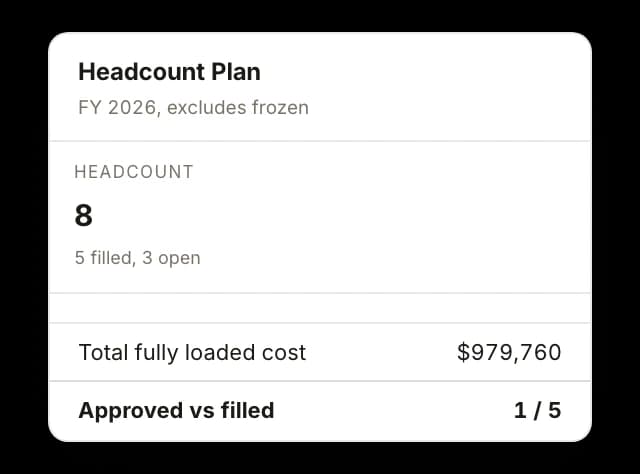
The hiring plan carries eight budgeted roles, five filled and three open, at $979,760 of fully loaded annual cost, with one of five approved roles filled so far. Margo prices what is still open against your cash and your burn, measured against the minimum runway you are willing to hold.
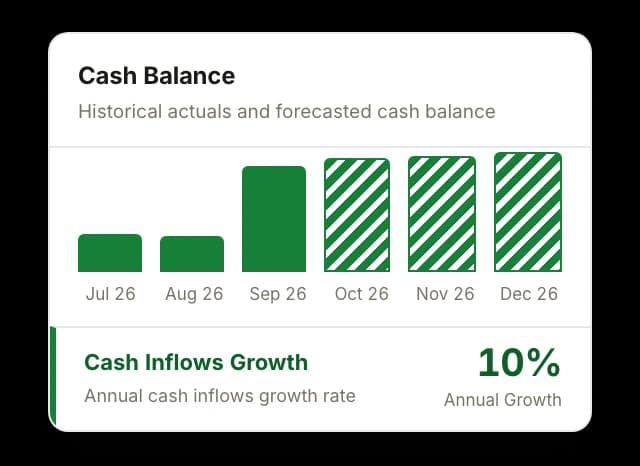
Every month that has closed and every month still ahead sit on one chart, the closed ones solid and the ones ahead hatched, so the join between what happened and what is projected is visible rather than implied. Nobody reconciles a history file against a forecast file to find it.

Vic codes every bank, card, and Stripe movement to your chart of accounts as it posts and reconciles the accounts nightly, so burn is computed from entries rather than from a bank export.

Theo captures vendor bills, codes them to the period they belong to, and schedules them against the cash that funds them, so burn reflects what you have committed and not only what has cleared.

Margo reruns burn and runway on the posted ledger, projects cash forward, and compares scenarios side by side so a hire, a price change, or a cut carries a number before you decide.
Closing cash month by month, the thirteen weeks in front of it, and the controls underneath both.
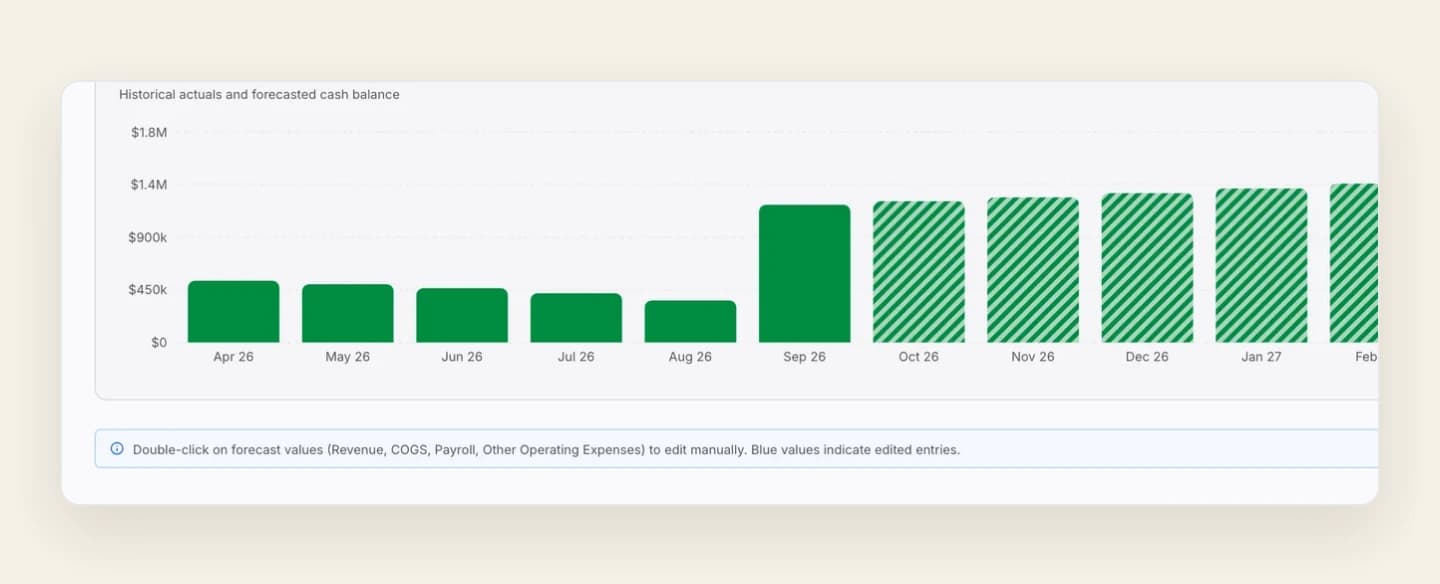
Historical actuals and forecasted cash balance on one chart. Solid bars run April through September 2026, hatched forecast bars from October 2026 through September 2027, on an axis marked at zero, $450 thousand, $900 thousand, $1.4 million and $1.8 million.
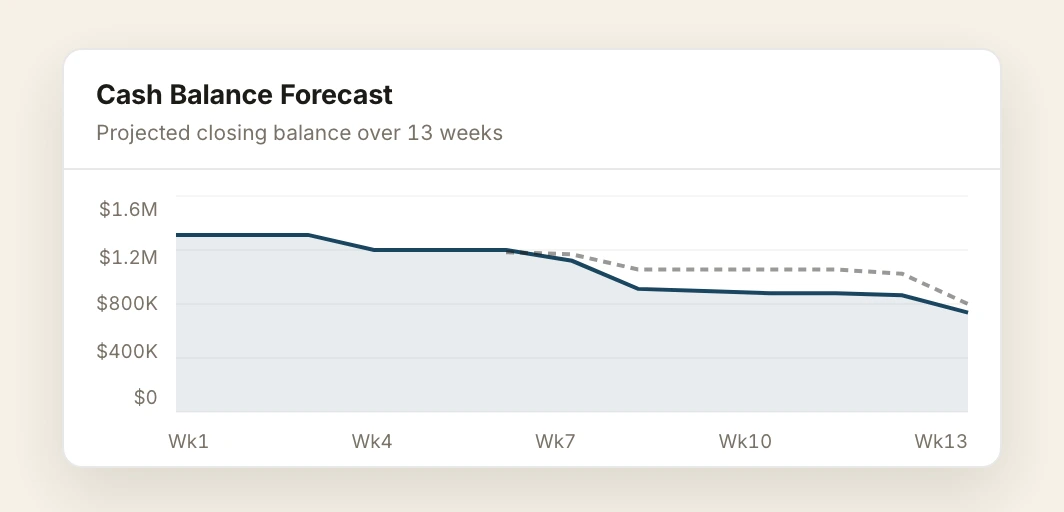
Cash Balance Forecast: the projected closing balance across week one to week thirteen, with a shaded band around the base case and a dashed scenario line running above it from week six, on an axis marked at zero, $400 thousand, $800 thousand, $1.2 million and $1.6 million.
Custom Scenario: annual rates for cash inflows growth and cash outflows optimization, converted to monthly rates and applied to the projections. The inflows slider runs from minus 50 percent to 200 percent, and the rate can be typed in directly instead.
Connect your bank accounts, your credit cards, and Stripe once through Plaid. Futureproof builds your books from that data and keeps them as your system of record, then calculates net burn from that general ledger. Every inflow and outflow is coded and posted overnight, so the number is current rather than rebuilt by hand from last month's exports.
The forecast is built from your posted transactions and your revenue trend, and it is recomputed as spending and revenue change. That is what lets you model the next hire or the next marketing test against real numbers instead of assumptions. It is a projection, not a promise, and the assumptions behind it stay yours to change.
Margo rechecks fundraise timing every week against the runway on your books. When the projection crosses into the window where a raise should begin, she surfaces it in your inbox roughly thirty days ahead, with the runway figure behind it. She does not contact investors or act outside the product.
Yes. Give Margo the salary and the start date and she prices the role against your cash and your burn, then measures the result against the minimum runway you are willing to hold. If you have not set that minimum she asks for it rather than assuming one. The offer is yours to make or decline.
It depends on your stage and your runway target. Most pre-seed and seed companies aim to hold at least twelve to eighteen months. Recomputing burn every night is what lets you spend the budget you have and still know when to top up the round.
Your numbers. Your answers. Smarter moves.
Connect your accounts and stop opening the spreadsheet with dread. The next hire, the next test, and the next round all get decided on a number that was current this morning.
Starting at $1,000/month for all six agents, with a monthly review call with a human financial specialist included. No per-seat fees, no modules.