


Find the channels and SKUs that grow your margin. Bet bigger on them.
Six AI agents work one ledger that replaces your accounting software. Your channels, your suppliers, your bank, and your ad spend post to the same books every night, so the margin number and the accounting stop being two different systems. You approve what moves.

Revenue is up.Margin is a guess.The winners stay hidden.So every bet is the same size.
Five dashboards, no answer
Amazon has its fee reports. Your store has its payouts. Wholesale lives in your inbox. Which channel grew margin this month is a question you answer by hand, if you answer it at all.
Top sellers, bottom margin
Once referral fees, fulfillment, freight, returns, and ad spend come off, your best products by revenue can be your worst by margin. You cannot see which, so you fund all of them evenly.
Slow books cap growth
You built a brand people love. The brands outgrowing you do not have better products. They have better visibility into where their money goes, and that should not require a finance department.
Your money arrives from everywhere you sell and everywhere you spend.It lands in one ledger.
Setup is one sitting. Coming from QuickBooks, a one-click migration brings your history across, and other systems migrate over with file exports.
- Amazon
Orders, referral and FBA fees, refunds, and settlement deposits post as they land.
- eBay
Orders, fees, and payouts arrive the same way, with no export in between.
- ShopifyBeta
Store orders, discounts, and payouts come across the same connector.
- TikTok ShopComing soon
Shop orders and fees join the same ledger when the connector ships.
- Meta Ads
Spend arrives by campaign and sits against the channel revenue it supported, so margin after ads is a figure instead of two exports side by side.
- Google Ads
Search and shopping spend posts to the books by campaign, coded to paid search rather than to one marketing line.
- TikTok Ads
Campaign spend lands in the same period as the orders it ran against, so a channel carries its own ad cost.
- eBay Ads
Promoted Listings spend comes across with your eBay connection rather than as a second one to set up.


What the agents did this week.None of it waited for you.
A worked example with sample figures. On your account every line comes from your own channels, your own suppliers, and your own bank.
- Mon 02:14
 Vic
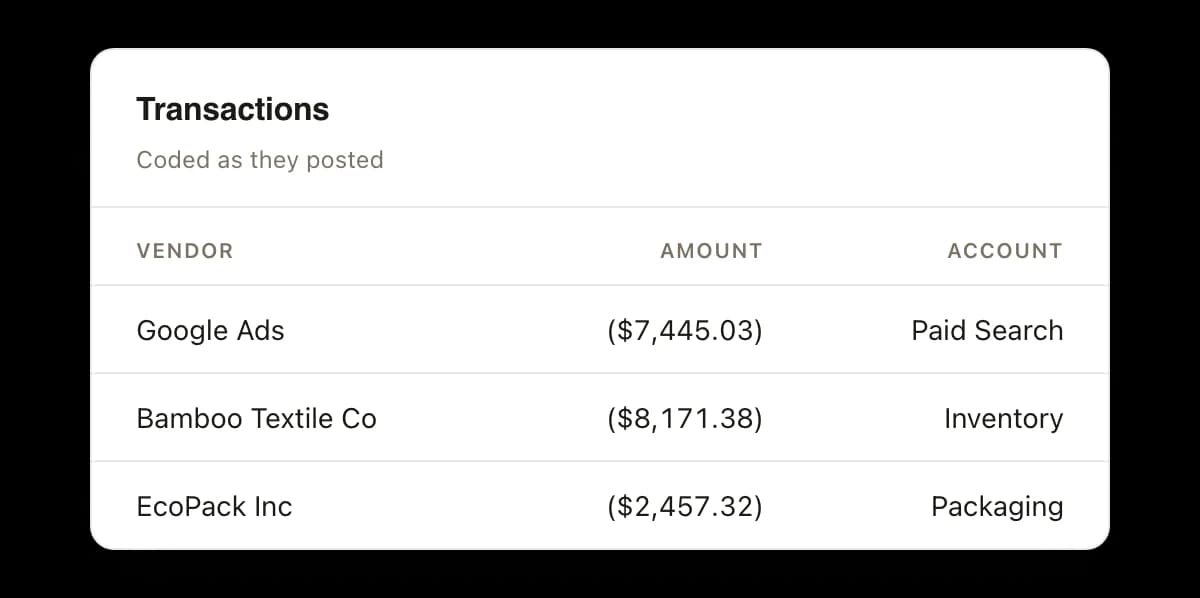
VicSplit Friday's marketplace settlement into $28,107.50 of referral fees and $18,700.40 of FBA fees, each coded to its own account.
- Mon 06:40
 Theo
TheoAllocated $8,400.00 of ocean freight, $3,150.00 of import duty, and $640.00 of customs broker fees across the units on one container.
- Tue 03:08Vic
Coded 171 bank and card lines as they posted, each to the account it belongs to rather than to a catch-all.
- Tue 09:05
 Remi
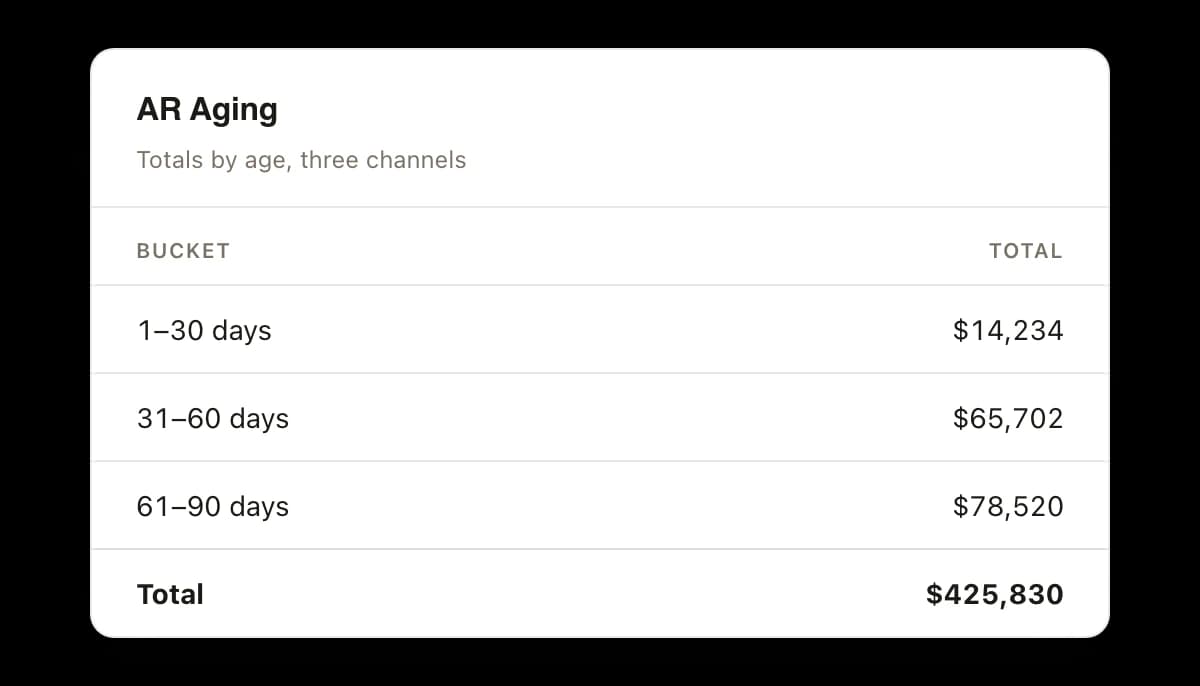
RemiAged what is still owed across Amazon, the store, and eBay, and drafted this week's reminders for the accounts running late.
- Tue 21:30
 Margo
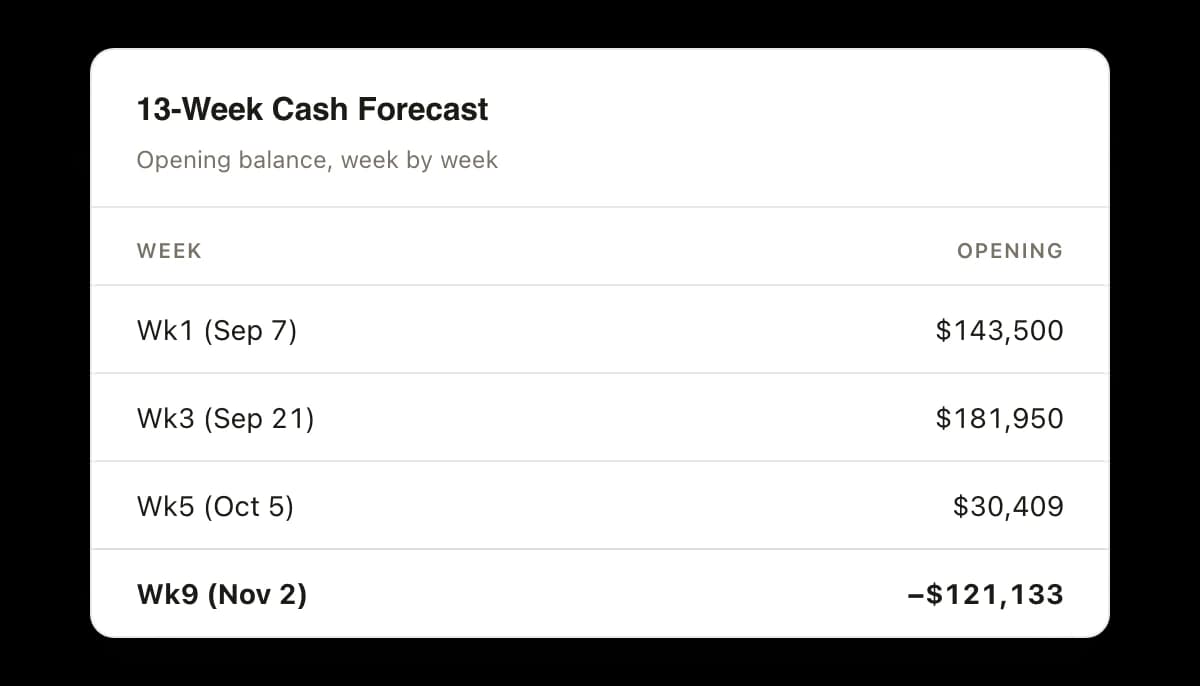
MargoReran the reorder scan against the cash plan and flagged the first week the opening balance turns negative.
- Wed 07:12
 Hugo
HugoChecked the referral fee rate each marketplace charged this week against the rate it should have charged, line by line.
- Thu 08:20Theo
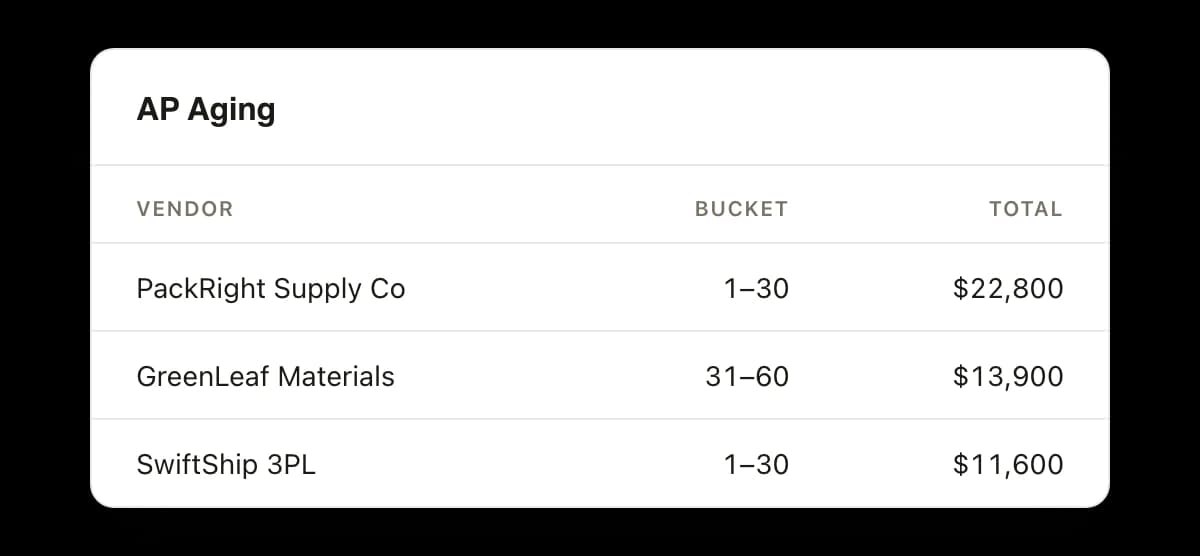
Scheduled the balance due on purchase order ECPO-1003 against the cash on hand and left it in the queue for your approval.
- Fri 11:40
 Nia
NiaRefreshed the diligence room with the closed month and recorded which documents each visitor opened.
Everything a finance team would do.Six lanes, no gaps between them.
Six named specialists, each owning one lane, each able to show you the entries behind anything they tell you.

Vic
Your books close every day, so month end is already done when the month ends.

Remi
Money owed to you gets invoiced, chased, and applied without you opening a spreadsheet.

Theo
Supplier bills arrive, get coded, and wait in a queue you approve, never one that pays itself.

Margo
Cash is planned thirteen weeks out, against your reorder cycle and your season.

Hugo
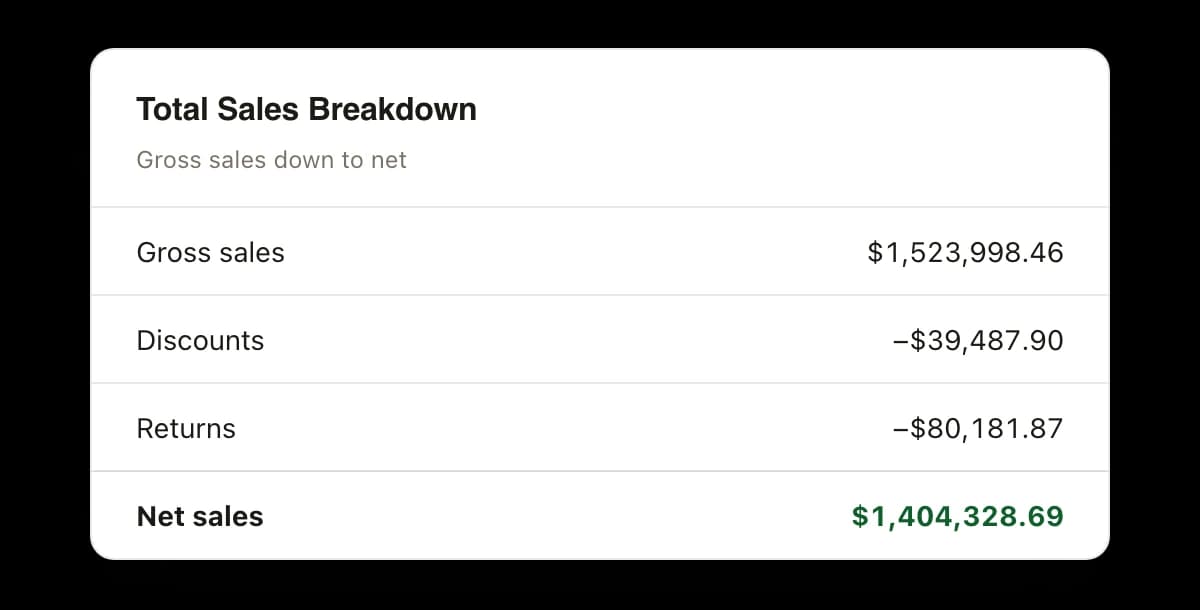
What you gave away in discounts and took back in returns comes off before anyone calls it revenue.

Nia
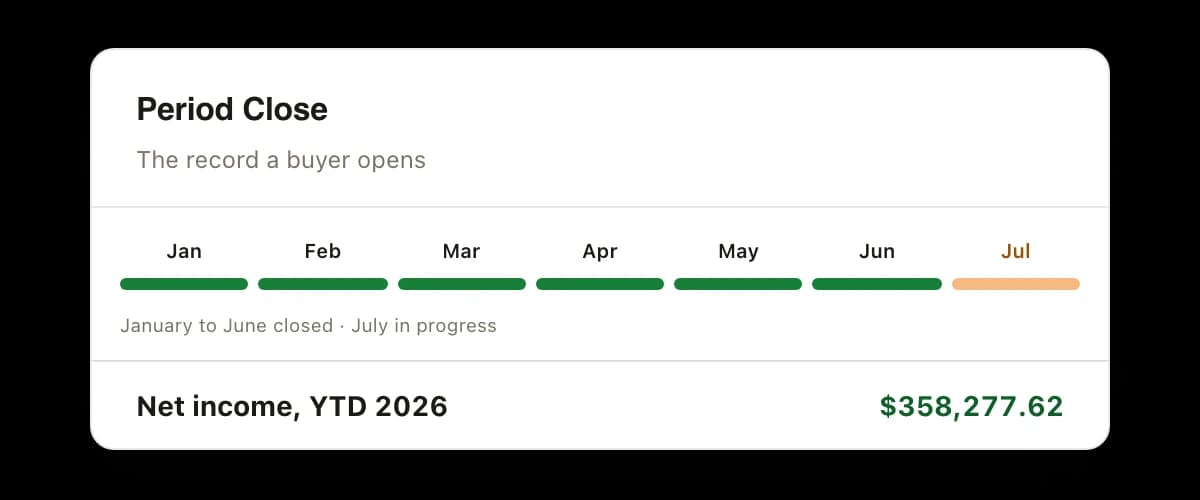
Your numbers, your documents, and your history stay in the shape a buyer asks for.
Four surfaces you will actually open.All four read the same ledger.
Real surfaces in the product, drawn from posted entries rather than an export of them, so a number you disagree with can be opened line by line.
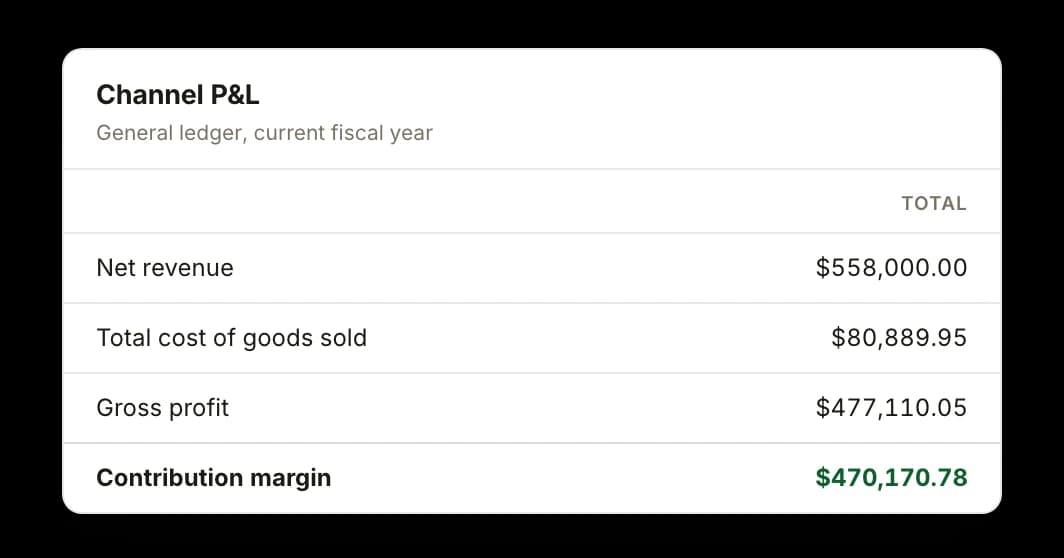
Channel P&L
One statement built from every channel, reading down from net revenue through cost of goods sold to the contribution margin underneath it, all of it from the ledger rather than from a channel report.
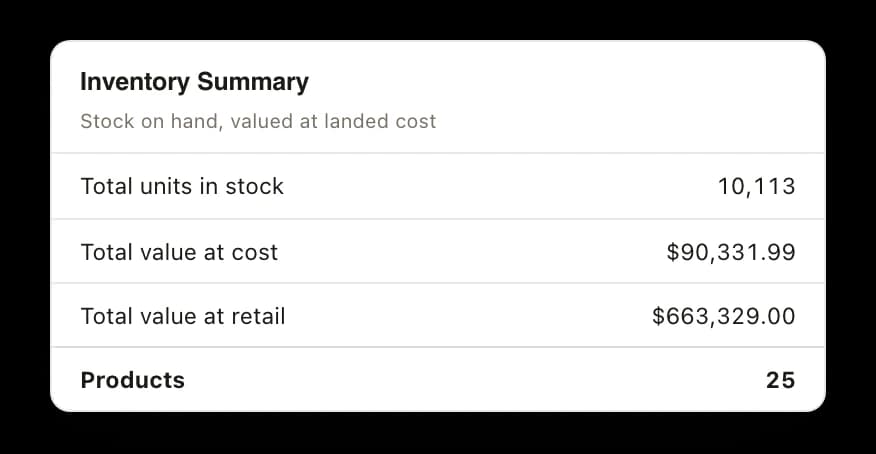
Inventory, valued at cost
The catalog totals what is standing on the shelf: units in stock, and what those units are worth at cost, so the shelf reads as a cash figure instead of a count.
Payouts reconciled
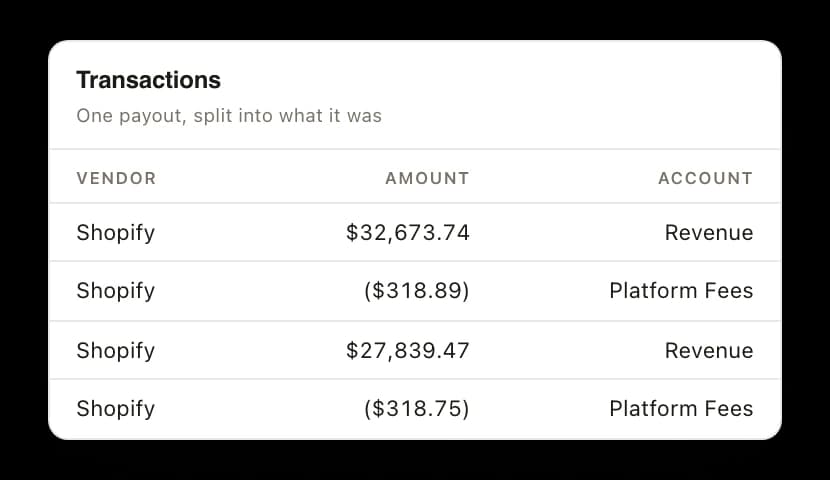
A payout does not post as one deposit. The revenue lands on its own line and the platform fee comes out on another, so a fee change reads as a line item instead of as a smaller number in the bank.
Margin per SKU
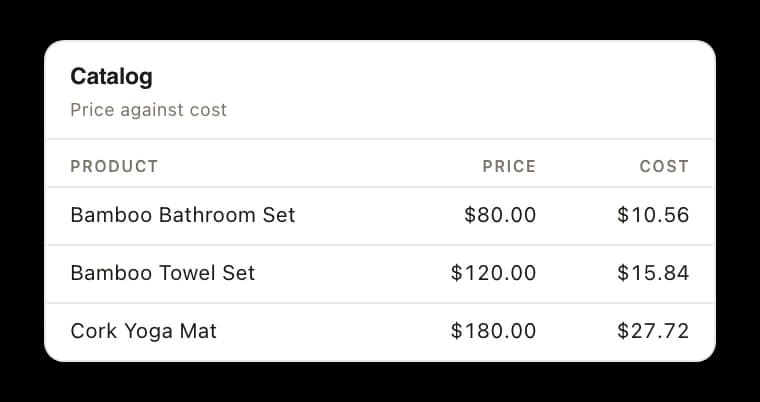
Each product shows the price it sells at, the unit cost behind it, and the average landed cost beside that, so the margin on a unit is a column you can sort rather than a calculation you redo.
Eight places this shows up in your week.Start wherever it costs you most.
Each one is a page about the job, the surface behind it, and the agent who owns it.
The other ways to get this done.And what each one leaves you holding.
Brands compare us against people and services, because that is what this work costs today.
| Futureproof | A bookkeeper | A fractional CFO | Spreadsheets | |
|---|---|---|---|---|
| Marketplace payouts reconciled | Deposits matched to the orders, fees, and refunds behind them, every night. | Usually booked as one lump deposit, weeks after it landed. | Reads the result; reconciling was never their job. | A settlement report exported and summed by hand. |
| Landed cost per unit | Freight, duty, and broker fees allocated across the units on the order. | Often parked in a freight account, away from the product it belongs to. | Reviews the number you hand them. | A cost estimate you last updated six months ago. |
| Margin by channel and SKU | Contribution margin per channel and per SKU, traceable to the entries under it. | Revenue and cost of goods, not margin by product. | Built once for a review, then out of date. | As accurate as the last export you pasted in. |
| A cash plan you can reorder against | Rebuilt from posted entries every night, with your reorder cycle in the model. | Backward looking by design. | A model they maintain, on their schedule. | A model you maintain, on top of running the brand. |
| An answer the same day you ask | The number is posted overnight and waiting when you open your laptop. | An email, then a wait for the next close. | The next scheduled call. | An evening rebuilding the tab. |
| What it takes from you | One monthly fee for all six lanes, with a specialist review call included. | A salary or an hourly rate, covering one lane of the work. | A retainer for advice, with the bookkeeping still to buy separately. | Your own hours, every week, on work that is not the brand. |
Everything else operators want to know.Answered before you ask.
Dashboards estimate; a ledger knows. Futureproof books every order, fee, refund, and payout, so profit per channel and per SKU is accounting-grade, and your books are done as a side effect.
Amazon and eBay connect directly. Shopify is in beta. TikTok Shop and Walmart are coming soon. Once a channel is connected, orders, fees, and payouts post into your books.
Deposits are matched back to the orders, fees, and refunds behind them automatically, so what hits the bank ties back to what you actually sold, and a fee change is caught the week it happens.
Pricing starts at $1,000/month for all six agents and the ledger, with a monthly review call with a human financial specialist included. No per-seat fees, no modules. Larger or more complex businesses are scoped individually, so those are priced on a call.
Your CPA stays for taxes and gets cleaner books to work from. The daily bookkeeping is Vic's job, and a human financial specialist reviews everything with you each month.
Your numbers, every morning
Put the next dollar where the margin is.Hire your AI finance team.
Connect your channels, your bank, and your suppliers, and the agents get to work on your books.
Every plan includes a monthly review call with a human financial specialist. Larger or more complex brands are scoped on a call.