


 AR Agent
I collect the money you are owed. Wholesale and marketplace.
Retailers pay on terms, marketplaces pay on a cycle, and both of them slip. I invoice, age, and follow up on one side, match settlements and reserves on the other, and apply every deposit to the invoice it clears.
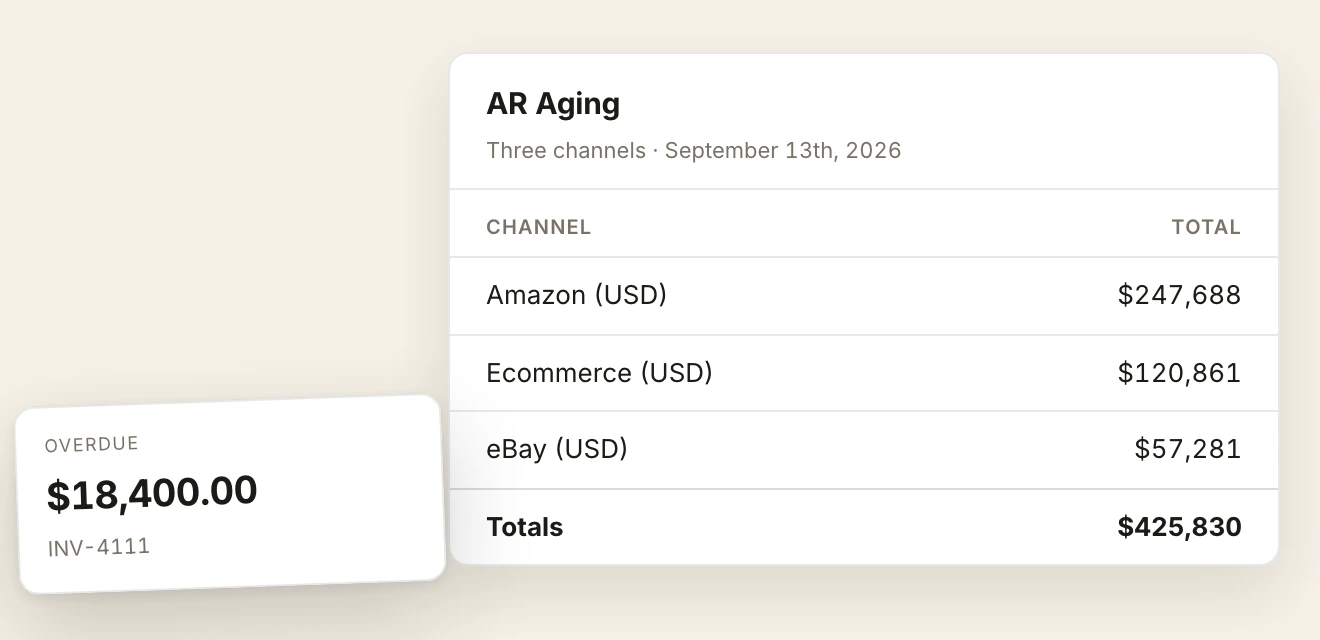
I read what is owed.Then I go after it.
Money owed to you arrives from two directions, and both of them need chasing. This is what comes in, what I record, and what lands on your desk.
Wholesale invoices and the terms on them, settlements and reserves from Amazon and eBay and from Shopify in beta, and every bank account and credit card you connect, so a deposit can be matched to what it settles.
Payments applied to the invoices they clear, settlements split into the revenue, fees, and refunds inside them, and receivables aged by channel in one ledger rather than in a side spreadsheet.
Who owes you what and for how long, the follow-up drafted for each late account in the tone you set, and the deposits I could not match to anything.
Collections runwithout the awkward email.
Collections runs on a schedule here. Overnight I age every open invoice, apply the deposits that landed, check marketplace settlements against what was promised, and draft the follow-ups for accounts that have gone past their terms, so the chasing is done before you start the day.
- Every morning
Receivables aged
Every open invoice moves into its aging bucket by channel and by retailer, and the accounts that crossed their terms overnight get a follow-up drafted in the tone you set.
- Every day
Deposits applied
Payments that landed in your bank accounts are applied to the invoices they clear, so an account that has paid stops appearing on the list of people to chase.
- Every six hours
Payouts matched
Marketplace deposits are matched back to the orders, fees, and refunds inside them, which is what turns a single number in the bank into something you can check.
- Every Monday
Settlements checked
The week of settlements is compared against what each channel was expected to pay, and a hold, a reserve, or a short deposit is raised with the reason beside it.
- First of the month
Receivables tied out
What the aging says you are owed is tied back to what the ledger says, so the number you quote a lender or a buyer is the number in the books.
Everything you are owed,aged by channel.
One table for the money outstanding, split by the channel it is owed on and by how long it has been sitting there.
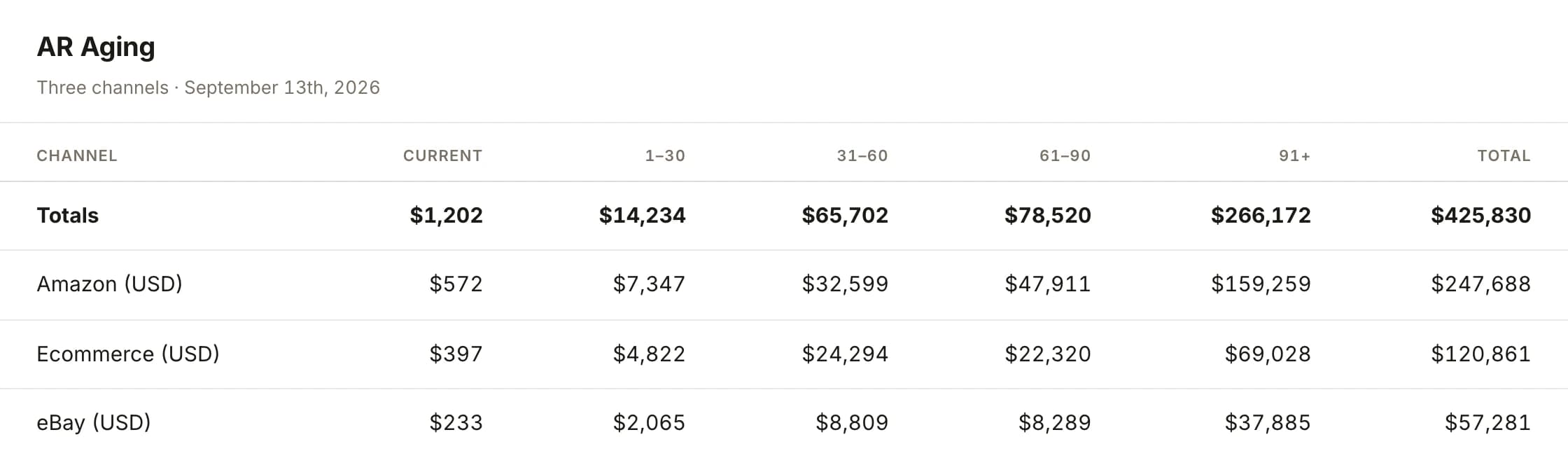
Receivables aged by channel and by bucket, so late money carries a name and an age rather than a total.
I do the chasing.You set the tone.
You decide how each relationship is handled once. I hold every account to it and tell you the day one slips.
- Ask meAsk how a retailer actually pays rather than how their terms read, and I show the history: what they owe now, how late they usually run, and what is sitting past its due date.
- I flagA short settlement, a new reserve, a chargeback, or an account that has quietly moved from slow to late gets raised the day it happens, matched to the order or invoice behind it.
- You approveYou set the cadence and the tone, and each reminder goes out on the rule you approved. I do not decide who gets credit terms, and I never take a payment or move money; the money moves through your bank.

Cash arrives on my side.Three agents use it.
What I collect and what I am still waiting on feed the close, the cash plan, and the record a buyer eventually tests.


Everything else operators askabout getting paid.
They behave differently, so Remi runs both. Wholesale is invoice based, with Net 30 or Net 60 terms and a named person to follow up with. Marketplace money arrives on a settlement cycle with fees and reserves taken out first. Remi ages both in one view, so what a brand is owed is a single number rather than two half answers.
The operator sets the cadence and the tone once, per account if the relationships differ, and Remi drafts every follow-up against that rule. A strategic account can stay gentle while a chronically late one gets a firmer note, and nothing goes out on a schedule the owner did not approve.
Yes. Each settlement is checked against what the channel was expected to pay, and a hold, a reserve, or a short deposit is raised with the reason beside it. Because the reserve is recorded rather than netted quietly into the deposit, the money being held is visible instead of missing.
No. Remi matches deposits and settlements to the invoices they clear and applies them in the ledger. The money itself moves through the brand's own bank and payment providers, never through an agent, and credit terms stay the owner's decision.
We never sell your data, and we share it only with the vetted service providers that run the platform, never with other customers and never with advertisers. Access inside your account is limited to the people you invite.

Your cash, collected
Let the money come in.Stop chasing it.
Connect your channels, your bank accounts, and your credit cards, and the first aging run happens the same night.
Starting at $1,000/month for all six agents, with a monthly review call with a human financial specialist included. No per-seat fees, no modules.