


Caught early
When a product's unit cost drifts from what the cash plan uses, you hear about it before the next order is priced on the old number.

 Cash Planner
Money leaves on the deposit, stock sells months later, and the payout lands later still. I am the planner on Futureproof's AI finance team, and the cash plan I build runs on the same books as your P&L.
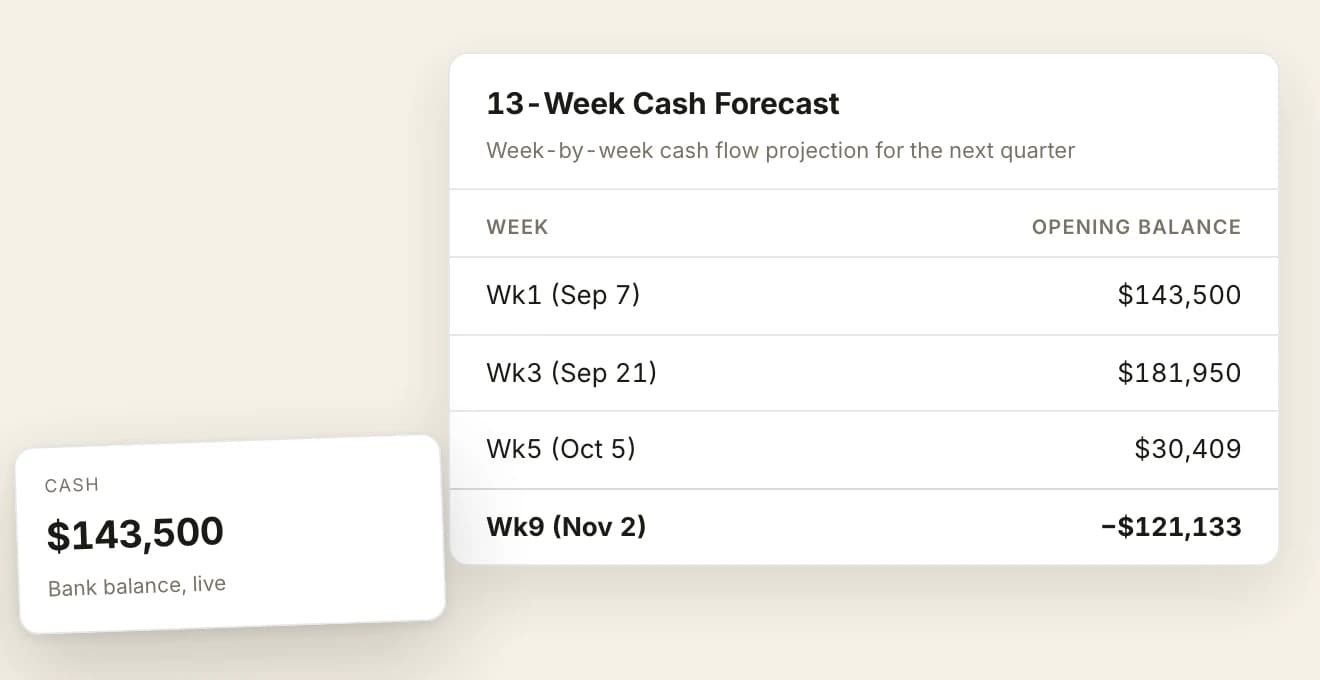
A forecast is only as honest as what it starts from. This is what comes in, what I record, and what I put in front of you.
Yesterday's posted entries, every bank account and credit card you connect, the supplier payments you have decided to make, the supplier bills already raised for orders on the water, and the payouts Amazon and Shopify still owe you.
A cash plan rebuilt nightly: the balance you open each week with, the money committed against it, and the payouts expected before it.
The week the balance goes tight, the cash a reorder or a production run takes out and the date it leaves, and the assumptions I used, so you can argue with any of them.
A cash plan goes stale the day it is built. Every night I rebuild yours from your bank balances and what the books posted, lay the supplier payments and expected payouts on top, and carry the balance forward week by week, so the plan you open in the morning is the plan as of last night.
The weeks ahead are rebuilt from the bank balance and the posted entries, with the committed outgoings and the money still coming in carried into each week.
Each order you are weighing is priced against the balance on the day its deposit would clear, so you see whether the cash covers it before you go to the supplier. A production run is priced the same way.
What you expected and what the books recorded are put side by side. When the month moves away from the plan, I propose a new one.
One plan with the opening balance on every week, the commitments underneath it, and the week that dips marked.
Cash at the start$412,000
Week 7Lowest with the reorder$173,120
Room above the minimum$23,120
My job is to make the arithmetic honest and early. What you do with it stays yours.

When a product's unit cost drifts from what the cash plan uses, you hear about it before the next order is priced on the old number.
Ask whether you can afford the next container, and you get the deposit, the balance and your lowest week with both paid.
You decide whether and when to place the order with your supplier; I never move money or place an order.
A forecast that starts from a guess is a guess. Mine starts from the bank balance, the payments you have decided on, and money already owed to you.


The supplier payments you have decided to make, the supplier bills already raised for orders on the water, and the payouts Amazon and Shopify still owe you sit in the same plan. When a reorder or a production run is on the table, the deposit and the balance land on the weeks they will clear, so the cost of a buy is visible against the balance before the wire goes out.
A spreadsheet is accurate on the day it is built and drifts every day after. Margo rebuilds the plan nightly from your bank balances and the posted entries underneath them, so the opening balance, the committed payments, and the money still owed are current. The output is also dated: the week the balance turns has a date on it.
No. Margo answers the cash half of the question: what a purchase order takes out, when it leaves, and whether the projected balance covers it on that date. How deep to go on a product stays your call, made with the margin and sell-through the rest of the team reports.
The plan shows you. Every figure traces back to the bank, to posted entries, or to an assumption you can see and change, so a product with little sales history is planned on numbers you can check and adjust before you rely on them.

Your cash, weeks ahead
A walkthrough of the whole platform, then a talk about how you run your month.