




Your books close six weeks after the month ends.

Service providers
Know which clients actually make you money.
Futureproof is an AI finance team for firms that bill by client or project. Four agents close your books daily, chase your invoices, and show true margin by client after billable hours and everything you pass through.
Sound familiar?
You are running the firm onsix-week-old books.
You think the Lumen & Oak account is profitable. You are not sure.
Your P&L says $180K last month. $90K of it was client ad spend, tool subscriptions and contractor invoices passing through.
Invoices go out late, the follow-up goes out later, and the firm floats its clients for sixty days.
The right finance team for the right business model
Futureproof is your books,and the team that does them.
Futureproof is not another dashboard reading your accounting data. It is the general ledger itself, your system of record. It replaces your accounting software, and the agents do the daily work inside it, so your books never wait on you, a bookkeeper, or a month-end scramble.
And it is shaped around how a service firm's money actually moves: recurring agreements and project work, client ad spend, tool subscriptions and contractor costs flowing through your accounts, margins that live or die on billable hours. Clean books, collected invoices, paid bills, and a straight answer to which clients make you money.

Vic
Bookkeeper
Categorizes and reconciles every transaction daily. Client ad spend, subscriptions bought for a client and contractor costs post to clearing, never into service revenue.

Remi
Invoices & Collections
Gets every invoice out the door on schedule, drafts the reminder at each stage of the follow-up, and knows who owes you what before you ask.

Theo
Bills & Payments
Captures bills, preps payment runs for your approval, and keeps payables visible.

Margo
Forecasting & Margins
Client profitability, margin analysis, and cash flow forecasting.
The bookkeeper math
You are paying more each monthfor less of the work.
| What you have now | What it costs | What you get |
|---|---|---|
| Part-time bookkeeper | $800 to $1,500/mo | Books weeks late, no analysis |
| Outsourced firm | $1,000 to $3,000/mo | A monthly PDF and an invoice |
| Futureproof for service firms | From $300/mo | Books closed daily, plus invoicing, bill pay, margin by client, and cash forecasting |
Vic reconciles every day. Remi chases invoices while you sleep. Margo tells you which clients need repricing. Your bookkeeper does none of that.
Client profitability
Every firm has a client that feels bigbut bleeds margin.
Transactions are tagged by client as they land, so agreement fees, project invoices and hard costs sit against the account they belong to. Ambiguous items never post without your approval. Drop in a monthly hours export from your time tracker, your project tool or a spreadsheet, and your team's time lands on the right clients too, so margin by client is a live number that includes labor rather than a quarterly reconstruction. Margo pairs it with cash: next month's position from open invoices and payment timing.
When a platform reprices, a contractor rate moves, or an engagement quietly absorbs more hours than it was scoped for, the squeeze shows up in that client's margin the same week, not at renewal.
Lumen & Oak looks like your biggest client. It is your third most profitable. You would know that by Tuesday, not by tax season.
Getting paid
The work is done. The invoice is not out.Remi fixes that.
Most service firms do a poor job getting invoices out the door and a worse one following up on them, so the firm ends up financing its own clients. Remi sends the invoices on schedule, chases the late ones on a cadence, and keeps you from ever having to be the one who asks.
Invoices leave on schedule
Retainer and agreement invoices go out on the day they are due to go out, without anyone remembering to raise them. Project invoices are drafted for your review, so nothing waits on a month-end scramble.
Remi chases every late one
A reminder before the due date, one on the day, then at 7, 14 and 30 days overdue, each drafted by Remi in your voice and staged for your approval. Sent on business days, inside the hours you set, and paused the moment a payment lands.
You always know who owes you
Remi reviews your receivables every morning: what is aging, who is slipping, which client is quietly becoming a collections problem. Margo folds the payment timing into next month's cash position.
You approve the reminders from your inbox each morning. Remi never emails a client on her own, and she never forgets one either.
Costs that pass through
What you pass through does notbelong in your margin.
You pass $100K a month through your accounts: ad spend run for clients, software and tools bought on their behalf, contractor and freelancer work, all billed on to the client. QuickBooks has no real answer for this. Its billable expense feature books these costs into the same revenue lines as your services, so your top line looks inflated and your margin looks like 8 percent when your service margin is really 45. The workaround is hiring a specialist bookkeeper to hand-build a custom chart of accounts with clearing accounts and separate income lines. That is the state of the art, and you are paying $1,500 a month for it.
Because Futureproof owns the ledger, it can fix this at the source. A bill marked pass-through posts to a client clearing account, and the rebill invoice credits it back, so only your fee reaches revenue and your service margin holds.
| What your books say now | 8% margin |
|---|---|
| Revenue | $121,600 |
| Passing through to clients | $100,000 |
| Operating costs | $11,900 |
| Net | $9,700 |
Inflated top line, buried margin.
| What's actually true | 45% service margin |
|---|---|
| Service revenue | $21,600 |
| Client pass-through costs | Tracked separately |
| Operating costs | $11,900 |
| Net | $9,700 |
Same month, correct books.
And because Futureproof handles revenue recognition, a client's annual prepaid agreement does not fake a great month. Revenue lands when it is earned. Futureproof also keeps two sets of books automatically: accrual for running the firm, cash basis for tax time. You see real margins all year; your CPA gets clean cash-basis books in April.
Who this is for
Three kinds of firm,one way to read the numbers.
The work is billed by client or by project in all three, and the clients are SaaS companies and ecommerce brands. What changes is what passes through, and how the money arrives.
Media spend is not your revenue
You bill a client for the ad budget, it lands in the same bank account as your fee, and the P&L reads like a bigger business than you run.
- Client media books to pass-through, not service revenue
- Margin by client after the spend passes through
- Retainers carried into the 13-week cash forecast
Fixed bid against real hours
A project is quoted once and staffed for months. Whether it made money depends on hours nobody totals until the engagement is over.
- Hours import and land on the project they were worked on
- Budget against actual hours while the work is live
- Contractor cost sits with the project, not in overhead
A book of clients, one set of books
Retainers start and stop, engagements overlap, and the question is always which clients are carrying the practice this quarter.
- Every transaction tagged to the client it belongs to
- Margin by client and by engagement, side by side
- Retainer inflows and their notice windows in the forecast
In the product
Hours, contracts and receivables,in one ledger.
Time
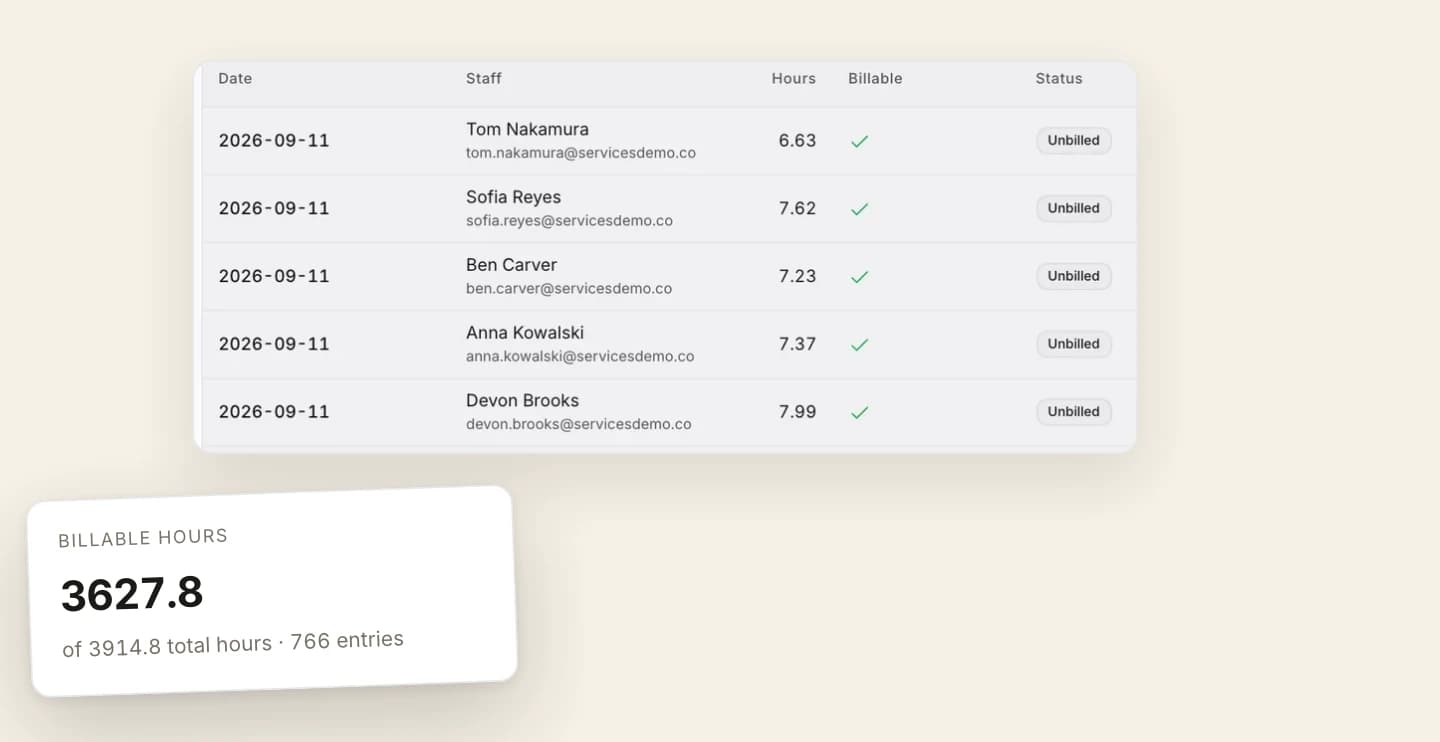
766 entries imported in batches, 3,627.8 of 3,914.8 hours billable and still unbilled.
Contracts
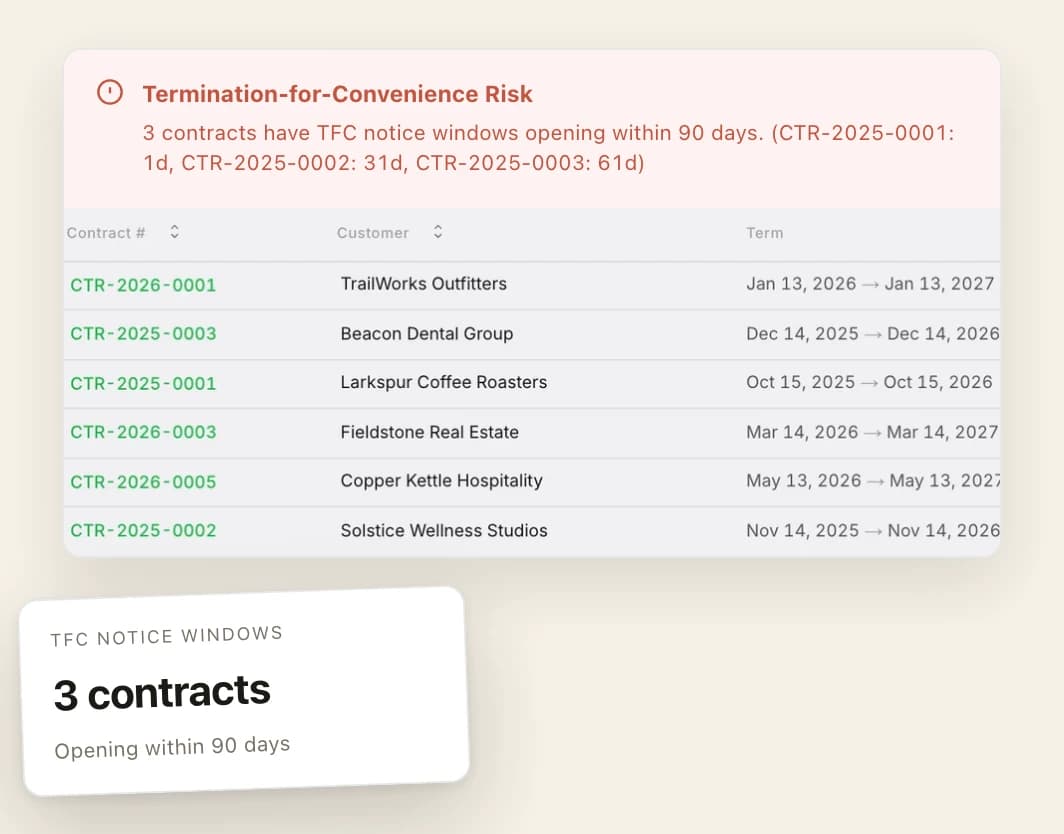
Notice windows surface before they open. Here, three inside the next ninety days.
AR Aging
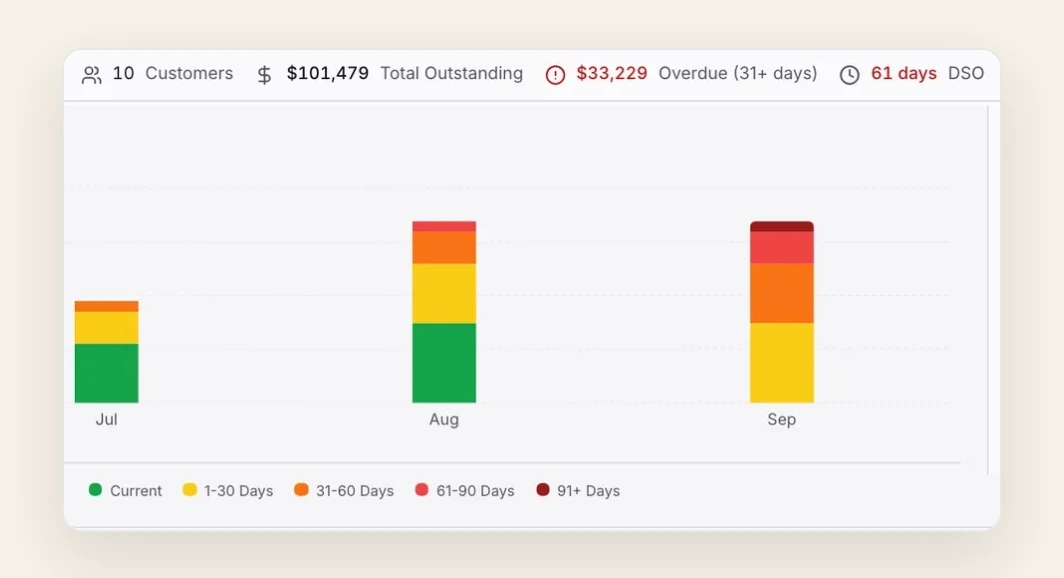
$101,479 outstanding, $33,229 of it past thirty days, and DSO sitting at 61 days.
How it works
Connect the bank and QuickBooks.The agents take over.
01
Connect QuickBooks and your bank
Connect in one sitting. Your history migrates in and is reconciled against your prior books before the agents start, and then Futureproof becomes your books.
02
The agents get to work
Daily reconciliation, invoice follow-up, client tagging, and pass-through costs kept out of revenue.
03
One dashboard
Margin by client, cash position, and what happened while you slept.
Pricing
Four agents on your books, from $300 a month.
Firms under $1M in annual revenue start at $300 per month, with no per-seat fees and no modules.
Your monthly statementDaily reconciliation, tagged by clientIncluded
Invoices, collections, and billsIncluded
13-week cash forecast with retainer inflowsIncluded
Margin by client and projectIncluded
Total, monthlystarting at $300.00
Starting price for firms under $1M in revenue. No per-seat fees, no modules, nothing metered.
FAQ
Questions firm owners ask,answered.
Pricing starts at $300 per month for firms under $1M in annual revenue: all four agents, the ledger, no per-seat fees and no modules.
That's your call. Vic does the daily categorization and reconciliation your bookkeeper does monthly. Once that work is already done every day, the overlap is the part you are paying for twice. Some keep a bookkeeper for quarterly review and let the agents do the daily work. Either way, you stop running the firm on three-week-old books.
Yes, as the starting point. You connect QuickBooks and your bank, your history migrates in, and Futureproof becomes your general ledger from there. QuickBooks is where your books came from, not the system you keep paying for.
Most service firms do. Every client's margin reflects everything tagged to them: agreement fees, project invoices, billable hours, and everything passed through on their behalf. A client whose scope has crept shows up in their margin number instead of hiding in a blended average. Projects sit under the client, so you can open one engagement and read its hours, invoices and costs without leaving that client's margin.
Futureproof maintains accrual books for operations and cash-basis books for tax, both kept current all year. Your CPA gets clean cash-basis financials at filing time instead of a year-end conversion scramble. Most service firms file cash basis but need accrual to understand the business; today that means paying for a conversion or living with one distorted view. Here you get both, always in sync.
Yes. Retainer and agreement invoices go out automatically on their schedule, and project invoices are drafted for your review. Remi then follows up on every unpaid one: a reminder before the due date, one on the day, and again at 7, 14 and 30 days overdue, each drafted in your voice and staged for your approval. Reminders go out on business days inside the hours you set, and pause the moment a payment lands. You stop being the one who has to ask.
Your data is encrypted in transit (TLS) and at rest (AES-256), hosted on SOC 2 compliant infrastructure with strict access controls. Bank connections are read-only, through the same connection providers your bank already uses.
Your Numbers. Your Answers. Smarter Moves.
Stop guessing which clientsare worth the hours.
Fourteen days inside your own ledger. Connect the bank, import a month of hours, and read margin by client before you decide anything.
Books closed daily, not monthlyMargin by client and by projectHours land on the right clientAccrual and cash books, always in sync