


 Investor Manager
I draft the update, you press send.
Investor work is quiet for eleven months and then decides a round in ten days. I keep the ownership record as issued, the data room current, and the monthly update drafted from a closed month, so the ask arrives with the evidence already assembled.
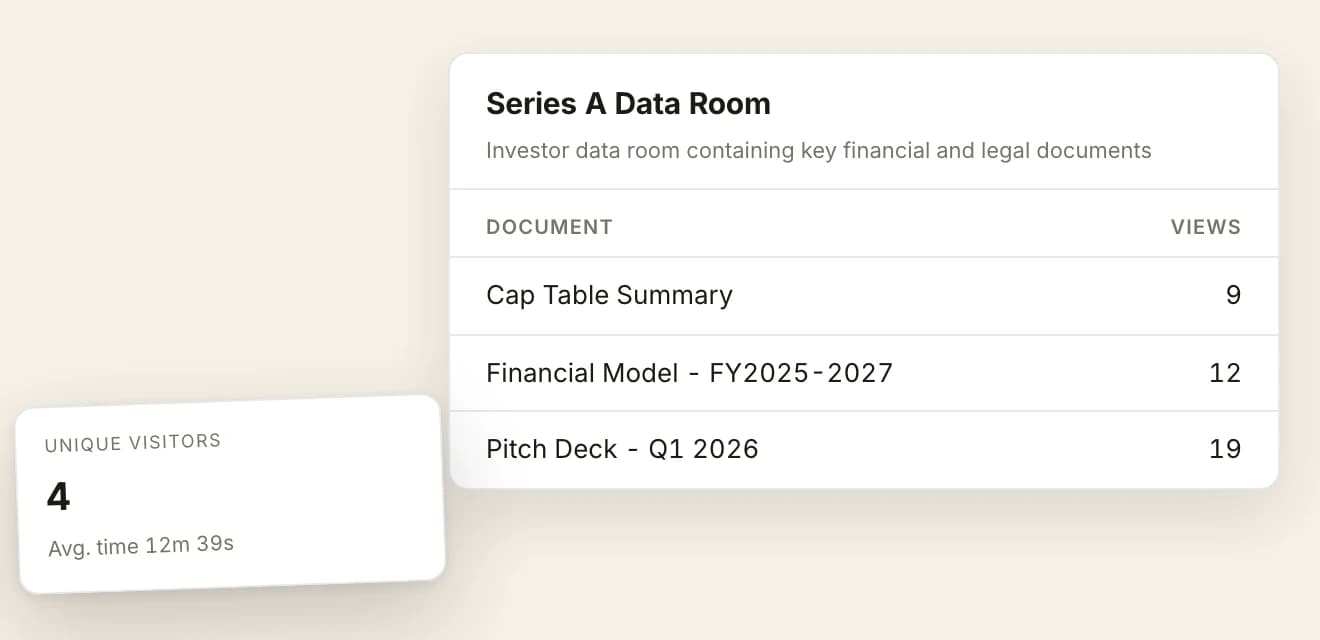
What investors receive,and who opened it.
What I take in, what I keep on the record, and what reaches you before a meeting does.
The closed period from your books, the burn and runway behind it, the revenue metrics once they have been checked against the ledger, your ownership as issued, and every document in the data room together with the record of who opened it and for how long.
Ownership as issued rather than as remembered. Shares, SAFEs, option grants, and the pool they come out of, each recorded on the equity ledger with the conversion arithmetic worked through, so the number you quote in diligence is the number on your own books.
A drafted update waiting for your narrative. A board deck built from the month that just closed. A dilution scenario at whatever cap you name. And a data room that was already current on the afternoon somebody asked for it.
Five quiet jobsbetween board meetings.
Most of the cost of fundraising is the assembly, and assembly is exactly the part that can happen on a schedule while nothing is going on.
- Monthly, on the first
I draft the month's update
I build the update from the closed period and leave it in your inbox as a draft. Sending is a separate action that only you take, so a scheduled run cannot email your investors.
- Daily
I report the day in the room
Where the daily digest is turned on, I gather the last twenty-four hours of visitor activity in the data room and send you the summary.
- Every Monday
I recap the room's week
The busiest days, the visits themselves, and the documents drawing the most attention across the last seven days, which is usually a better read on interest than the meeting was.
- Every five minutes
I send the view notice
Once a visitor's session has gone quiet I send you the view: how long they spent, which documents they opened, and how far through each one they got.
- On upload
I make documents readable
Office files added to the room are converted for viewing inside it, so an investor reads the document in the room instead of downloading a copy you can no longer see.
The room they read,document by document.
What is in the room, who has been in it, and what you have chosen to let them see.
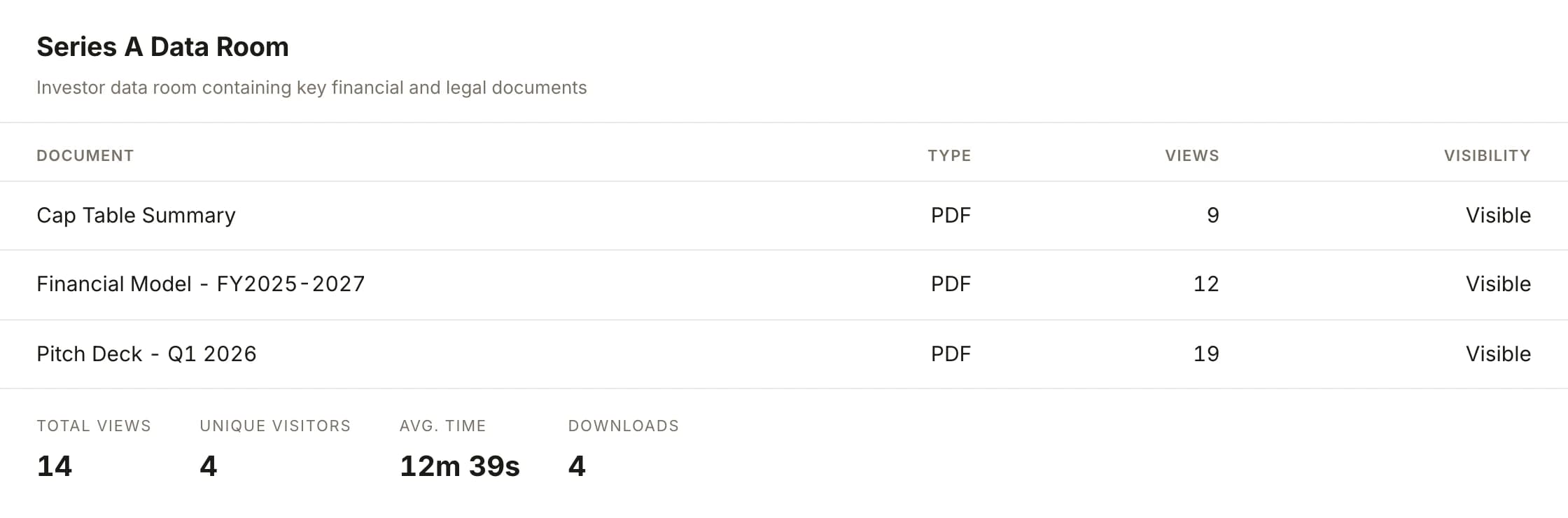
The data room surface: each document with its type, its views and the visibility you set, above the room totals for views, visitors, average time and downloads.
I do the assembly.Nothing leaves without you.
Everything investor-facing is drafted, held, and released by you. That is the whole arrangement.
- Ask what the round costsAsk what a SAFE converts to at a given cap, what a new round does to your ownership, what is left in the option pool, or how the proceeds of an exit would be split. The answers come off your own equity ledger rather than a spreadsheet somebody rebuilt last year.
- I flag before diligence doesAn ownership record that no longer adds up, a document the room is missing, an update sitting in draft past the day you meant to send it. These surface while they are still small problems.
- I draft and never publishThe update does not send, the deck does not leave, and no document opens to anyone until you say so. Two things I do not do at all: I do not handle the signing or the storage of your equity documents, and I do not give your employees a self-service portal for their vesting schedules. Those stay wherever you keep them today.

Where my numbers come frombefore they go out.
I write almost nothing of my own. Three lanes produce the figures, and I assemble what they hand me.


What founders ask earlyabout investors.
Nia is the investor relations agent on the Futureproof finance team. Nia keeps the cap table of record, models what a SAFE conversion or a new round does to ownership, maintains the data room and reports who has been in it, and drafts the monthly investor update and the board deck from the closed period.
No. Nia assembles the update from the closed month and leaves it in the inbox as a draft. Sending is a separate action taken by the founder, so a scheduled run can never email investors on its own.
Yes. Give Nia a valuation cap and Nia works through how the outstanding SAFEs convert and what the resulting ownership looks like, including the option pool. Scenarios sit beside the current record rather than overwriting it.
Nia does not handle the signing or the storage of equity documents, and does not provide employees with a self-service portal for their vesting schedules. Companies that need either of those keep the tool they use for it and run the two alongside each other.
The financial statements from the closed period, the cap table, and the corporate and contract documents a diligence request asks for. Each file has its own visibility and download settings, Office files are converted so they can be read inside the room, and the founder is notified when a visitor opens one.

Be ready before you need to be
Stop assembling the round,start running it.
Connect your bank accounts, your credit cards, and Stripe, and I will keep the record and the room current from the first week. Fourteen days is long enough to see what an investor would see.
Starting at $1,000/month for all six agents, with a monthly review call with a human financial specialist included. No per-seat fees, no modules.