


 AP Agent
I schedule every payment. I never send one.
Bills arrive from a dozen places and get paid in the order people ask loudest. I capture them all, code each one to the account and period it belongs to, and build the run against the cash you actually have. The payment itself leaves your bank when you execute it, never when I decide.
Everything you owe,and what is still open.
What arrives on the payables side, what I write down, and what is waiting for your approval.
Vendor bills, forwarded to your bills inbox or uploaded as files. Contracts and the terms inside them. The recurring charges on your credit cards, including the ones nobody remembers signing up for. Card spend from Ramp arrives beside the bank feed, coded to the account it belongs to.
Each bill coded to the account and the period it belongs to, so a cost lands in the month it was incurred rather than the month it was paid. Goods and services received but not yet billed get accrued. Card charges get matched to their receipts, and a payment schedule is set against the cash available to fund it.
A pay run built and waiting: the vendor, the amount, the due date, and what the run does to your runway. Alongside it, the renewals coming up, the duplicates I caught, and the vendors still missing a W-9.
Five standing jobsbefore the week ends.
Payables is mostly a timing problem, and timing problems are solved by work that happens on schedule rather than work that happens when somebody remembers.
- Daily
I sweep the payables
I pick up the bills that arrived, read the vendor, amount, date, and terms off each one, code it, and put anything that needs a decision into your approval queue.
- Daily
I scan what is coming due
I look ahead at the bills approaching their due date and surface the ones worth acting on early, including the ones where paying sooner is cheaper than paying on time.
- Daily
I chase the receipts
Card charges without a receipt against them are a month-end problem you meet three weeks late. I find them while the purchase is still recent and put the expense report together.
- Every Friday
I build the pay run
I assemble the week's run with each vendor, amount, and due date, priced against your cash and what it does to your runway. It sits there until you approve it and pay it yourself.
- Monthly
I reconcile the cards
Every company credit card statement gets tied back to the charges posted against it, so card spend is reconciled the same way the bank accounts are rather than trusted.
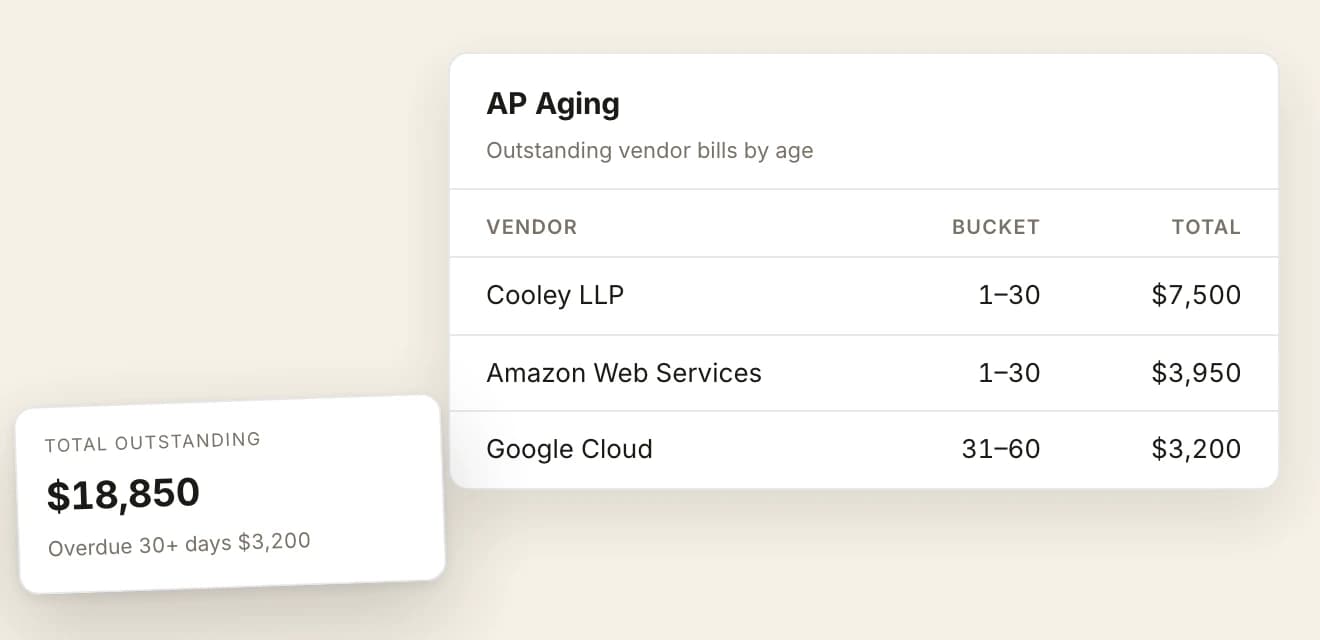
What is outstanding,by vendor and by age.
The payables side of the ledger on one screen, with the bills behind each total.
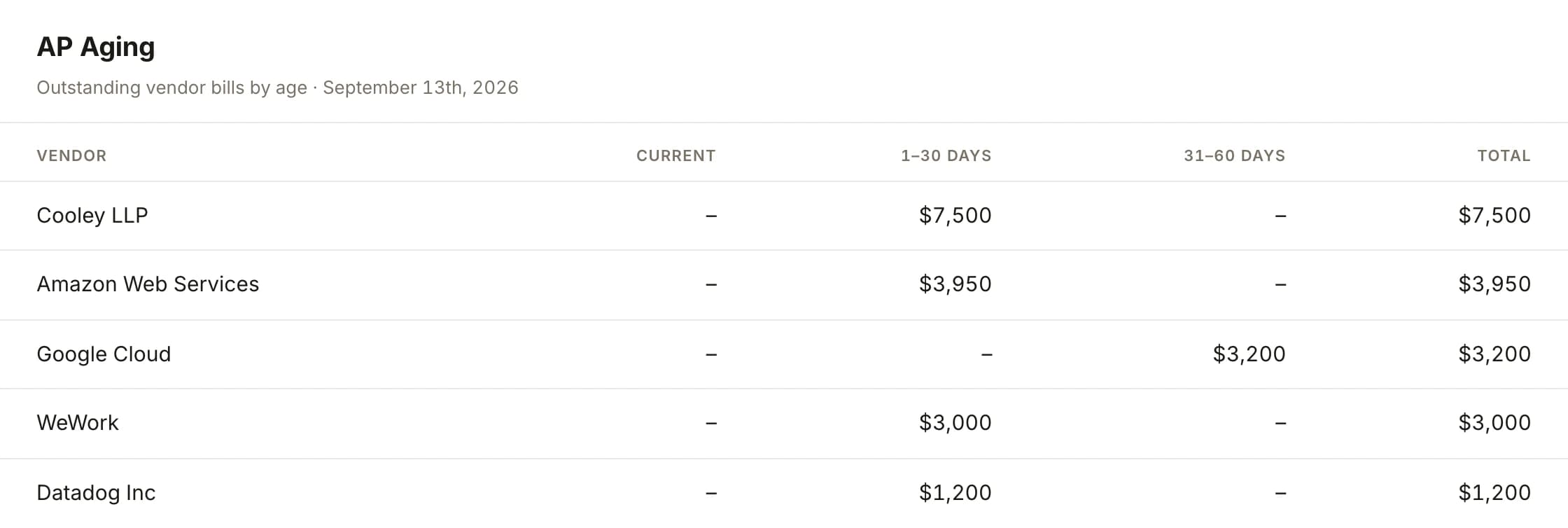
The payables surface: every vendor bill aged into its bucket, so what is current and what has run past thirty days read off the same table.
I prepare the run.The bank stays yours.
Everything up to the payment is mine. The payment itself is a thing only you do, by design.
- Ask what a vendor costs youAsk what you owe and when, what a vendor has cost over the year, which renewals are coming, and where the spend is concentrated in a few suppliers. The answers come off the bills themselves.
- I flag before it renewsAnnual renewals get surfaced ahead of the renewal date with the year's spend beside them, so cancelling or renegotiating is still possible. I do the same for duplicate bills, amounts that do not fit the vendor's pattern, and contractors missing a W-9.
- I never move moneyI connect through Plaid, which lets me see what has been paid and catch duplicates, and that is the limit of it. I do not hold banking credentials and I do not execute payments. You approve the run and you send it from your own bank.

Where a bill goesbefore the money is due.
A scheduled bill is a committed cost, and three other lanes need to know about it before it is paid.


The questions I getabout paying vendors.
Theo is the accounts payable agent on the Futureproof finance team. Theo captures vendor bills by email or upload, codes each one to the right account and period, reconciles company card spend, accrues what has been received but not yet billed, and builds the weekly pay run against available cash.
No. Theo schedules payments and never sends them. The pay run arrives with the vendor, the amount, the due date, and the effect on runway, and the founder executes the payment from the company bank account. Theo connects through Plaid to see what has cleared and to catch duplicates, and holds no banking credentials.
Theo reads the recurring charges across the connected bank accounts and credit cards, groups them by vendor, records what each one costs over the year, and surfaces renewals ahead of the renewal date so a subscription can be cancelled or renegotiated rather than renewed by default.
Yes. Each contractor invoice is matched against the agreement it belongs to and queued for approval on that contractor's own terms. Theo also flags which vendors are missing a W-9 and prepares the annual 1099 work rather than leaving it to January.
Every pay run Theo prepares shows what it does to the cash position and the months of runway behind it. A large annual bill that would move that number meaningfully is surfaced before it is scheduled, with alternatives such as monthly billing, rather than after the money is gone.

Control the outflow
Stop paying on pressure,start timing it.
Connect your bank accounts and your credit cards, forward your bills to the inbox, and I will have a pay run ready for you. Fourteen days is long enough to see the timing change.
Starting at $1,000/month for all six agents, with a monthly review call with a human financial specialist included. No per-seat fees, no modules.