


Payouts do not match orders
Your marketplace deposits a lump sum every two weeks. Inside that deposit are product sales, fees, refunds, and adjustments all netted together. Matching that number to actual orders is close to impossible by hand.

Your marketplace deposits a lump sum every two weeks. Inside it are product sales, referral fees, fulfillment charges, storage, advertising, refunds, and adjustments, all netted into one number that matches nothing in your books. Futureproof is one ledger that replaces your accounting software: Vic splits every payout, codes every fee, and books the cost of goods behind each sale.
One deposit, taken apart
Automated seller bookkeeping is the work of turning marketplace settlements into books: every payout split into the sales, fees, refunds, and adjustments inside it, then coded to one ledger that replaces your accounting software. Done by hand it is a fortnightly export, a pivot table, and a total nobody can tie back to an order.
Your marketplace deposits a lump sum every two weeks. Inside that deposit are product sales, fees, refunds, and adjustments all netted together. Matching that number to actual orders is close to impossible by hand.
A single settlement can carry thousands of line items across dozens of transaction types. Referral fees, fulfillment charges, storage, and advertising deductions are all buried in a report that was never designed for human eyes.
A customer returns a product three weeks after purchase. The refund hits your next settlement, but the original sale was booked last month. Your revenue stays wrong until someone traces the connection by hand.
Setup is one sitting. After that the agents work the settlements every night, so the month you are in is already coded when you go to look at it.
Channels, your own store, bank accounts, and credit cards connect in one sitting, so every deposit and every card charge lands in the same set of books.
Theo captures factory invoices, freight, duty, and copacker bills and codes them against the run they belong to, so the cost basis behind each sale is real landed cost.
Product revenue, referral fees, fulfillment, storage, advertising, refunds, and reimbursements each get their own line, checked back against the deposit before anything posts.
An unmatched deposit, a refund with no order, a fee that changed tier: Vic raises it with the evidence attached and drafts the correction. You approve, adjust, or decline.
Three questions the books answer once every line is coded, from the account a row lands in to what the period actually sold.
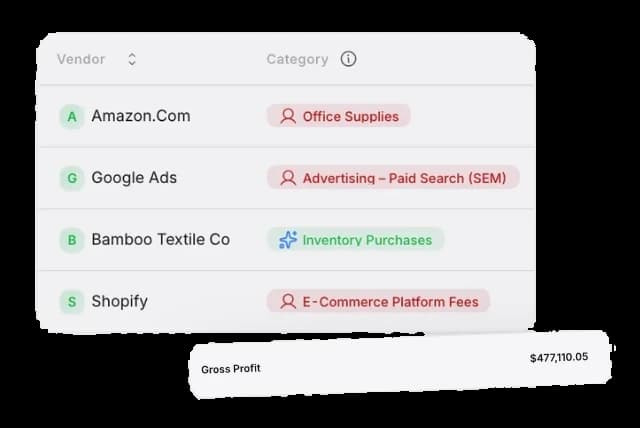
A category is only worth having if it carries into the financials. Every coded row feeds an account on the statement, so the inventory purchase, the platform fee, and the advertising charge each land in the line that gets read at month end rather than in a tag that stops at the transaction list.
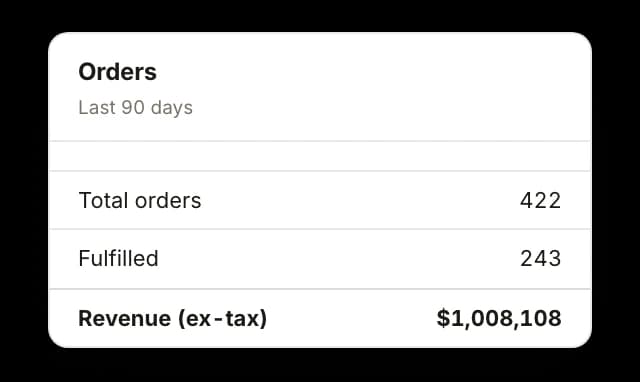
Revenue is counted against the orders that produced it rather than against the deposit that arrives two weeks later. A period covers what it sold, orders still awaiting fulfillment are held back, and the revenue line stops shifting every time a payout schedule does.
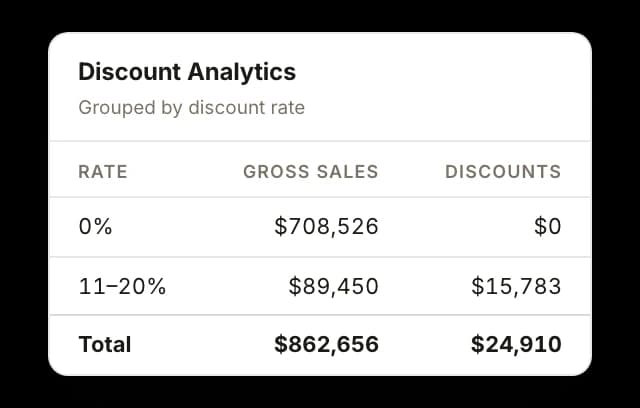
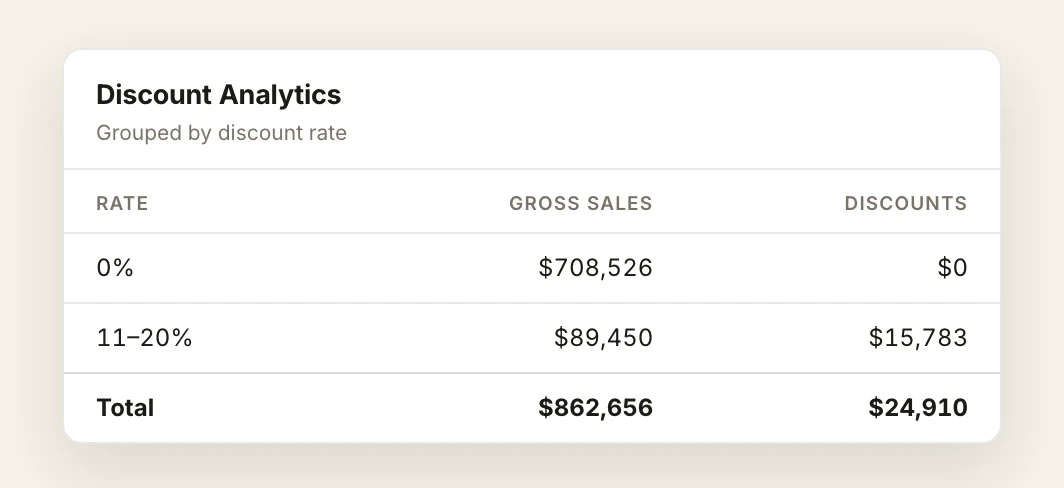
Promotions are grouped by the rate they ran at, so the sales that went out at full price sit beside the sales that went out at eleven to twenty percent off, with the dollars given up against each band. A code that felt cheap to run reads as the margin it took.

Vic splits each settlement into its events, codes them, balances the lines back to the deposit, and closes the day. Anything that does not reconcile is brought to you with the source row attached.

Theo codes supplier invoices, freight, duty, and insurance against the run they belong to and allocates them per unit, so the cost of goods sitting under a sale is landed cost rather than a factory quote.

Hugo reports fees by type and by channel and decomposes a margin move into price, discount, refund, unit cost, fee, and volume, so you know which part of the stack took the money.
The register the payouts are coded in, the orders behind them, and what discounting gave back.
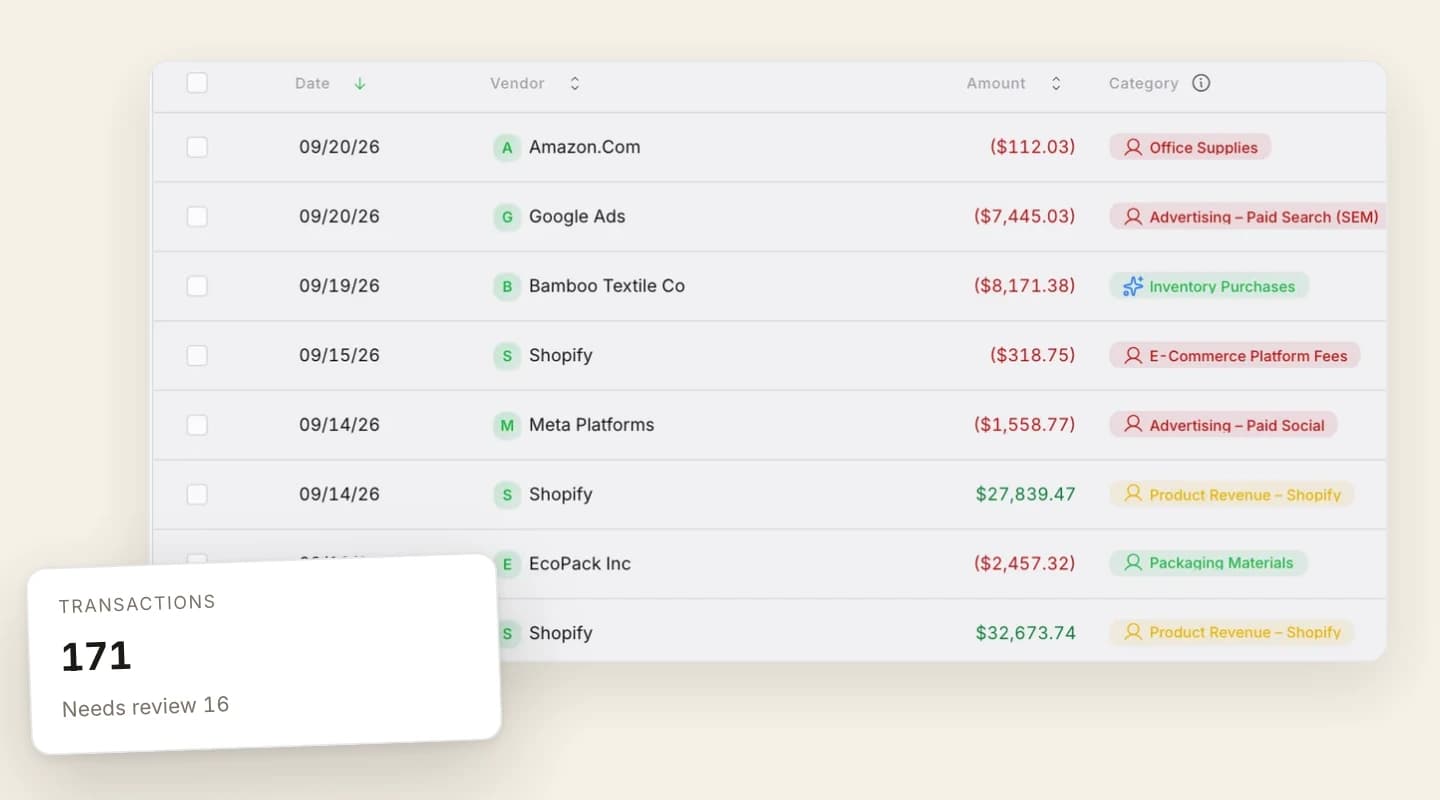
Every bank charge, card charge, and channel deposit lands in one register carrying the category it was coded to and the account it came from. Of 171 transactions in this window, 16 are held for review, so the handful that need a person are separated from the ones that do not.
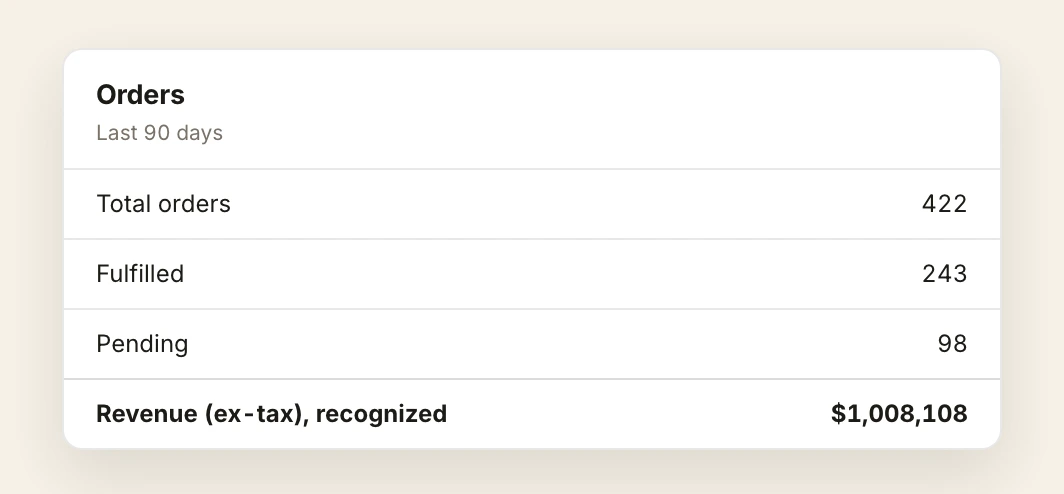
Across the last 90 days, 243 orders are fulfilled at a 57.6% fulfillment rate and 98 are pending and marked as needing attention, with $82,002 of revenue deferred until the rest ship.
Across 315 orders, $862,656 of gross sales gave up $24,910, leaving $804,216 of net sales after tax and $726,271 of contribution profit at a 90.3% gross margin.
Each payout is taken apart into the events inside it: gross sales, referral and fulfillment fees, storage, advertising, refunds, chargebacks, sales tax, reserves, and adjustments. Every event keeps the source row it came from, and the lines are checked back against the deposit before anything posts to your ledger.
Yes. An Amazon settlement bundles dozens of transaction types into a single deposit. That deposit is split into referral fees, FBA fulfillment and storage charges, advertising deducted at source, refunds, and product revenue, each posted as its own line, so the books show what actually happened inside the payout.
Refunds and chargebacks arrive in the settlement as their own event types, each linked back to the order that produced it. A refund landing in a later period than its sale is raised as an exception with both records attached, and Vic drafts the correction for you to approve.
Amazon and eBay connect directly. Shopify is in beta, and TikTok Shop is coming soon. You can start on a 14-day trial and connect your channels in the first sitting.
Your numbers. Your answers. Smarter moves.
Every deposit split into its parts, every fee coded, every refund traced back to the order it came from, in the ledger your financials are built on.
Starting at $1,000/month for all six agents, with a monthly review call with a human financial specialist included. No per-seat fees, no modules.