


The cap table is a sheet
Ownership lives in a spreadsheet nobody fully trusts. Model a new round in it and the dilution math is never certain, so you negotiate the most expensive number of your year against a formula you cannot check.

A raise turns on two artifacts: what the round leaves you owning, and what an investor can read tonight. Futureproof models SAFEs, priced rounds, and option pools against your recorded ownership, and builds the data room from the general ledger that is your system of record.
One round, followed to ownership
Two cases compared side by side
Founder ownership before and after
What a pool refresh takes, and from whom
Fundraising readiness is the distance between an investor asking a question and your answer arriving with evidence behind it. For most startups that distance runs to weeks, because the cap table sits in a spreadsheet, the statements sit in a drive folder, and the metrics sit in a fourth tool that disagrees with all three.
Ownership lives in a spreadsheet nobody fully trusts. Model a new round in it and the dilution math is never certain, so you negotiate the most expensive number of your year against a formula you cannot check.
Ownership in one tool, statements in a drive, metrics in a third, legal documents in a fourth. An investor gets four links and assembles a version of your company that none of you would recognize.
By the time the retention table is built and the statements are refreshed, the conversation that prompted them has cooled. How fast you answer gets read as how well you run the company.
Setup is one sitting. After that the ownership record and the statements in the room come from the books the agents post every night, so a diligence request is a link rather than a project.
Founders, employees, advisors, SAFEs, convertible notes, and the option pool go in once, each instrument carrying its own valuation cap, discount, and terms.
Nia runs the terms on the table against that record: how each instrument converts, what a pool refresh takes, and what you own the morning after the close.
Statements, metrics, and documents go into a data room you organize, with visibility and download rights set per document and per investor.
Send a link scoped to one investor, then read the engagement: who opened the room, which documents held their attention, and what they downloaded.
Three things an investor does inside your data room, each answered by the room itself rather than by the email you write after the call.
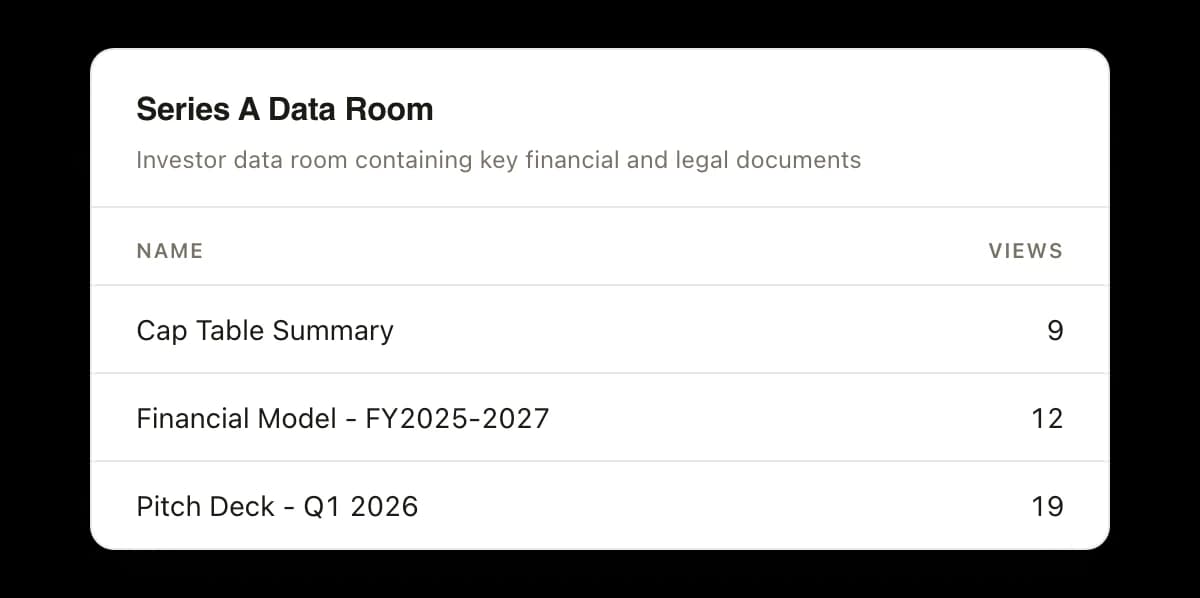
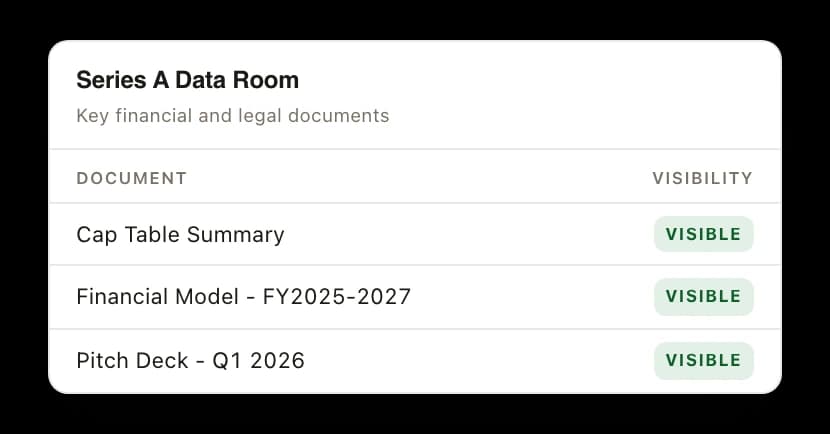
Each document carries its type, its size, its view count, and whether it is visible and downloadable: a cap table summary at 9 views, a financial model at 12, a pitch deck at 19. Visibility is set per document and per investor, and access stays revocable.
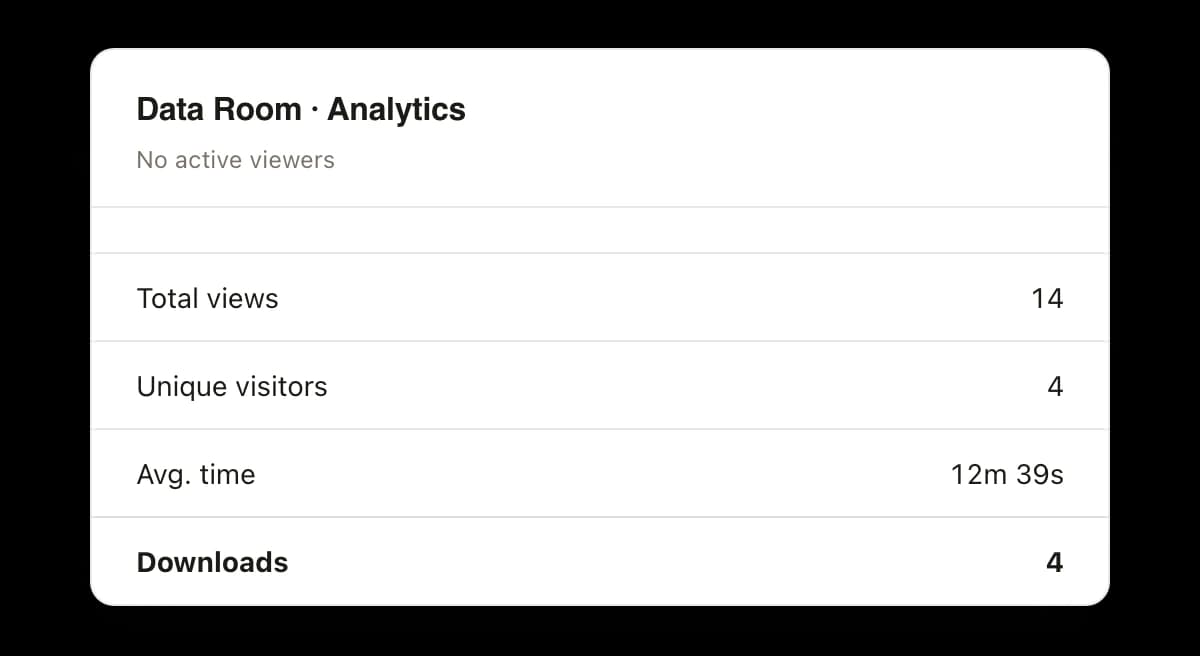
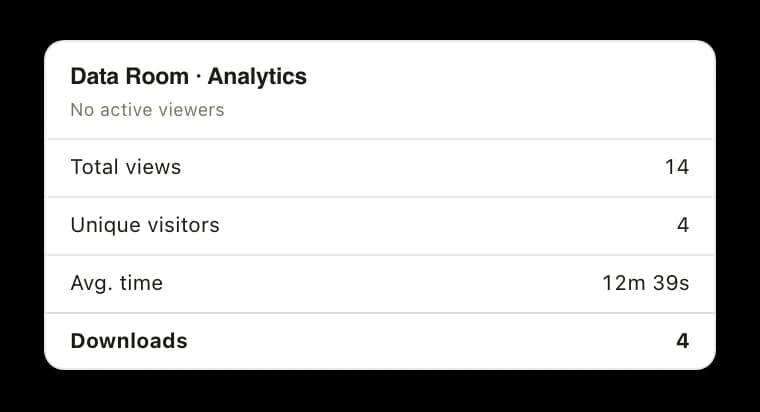
The same room reports 14 total views from 4 unique visitors, 12 minutes 39 seconds of average time, and 4 downloads. You know which investor has done the work before the next call, and which one has not opened the file.
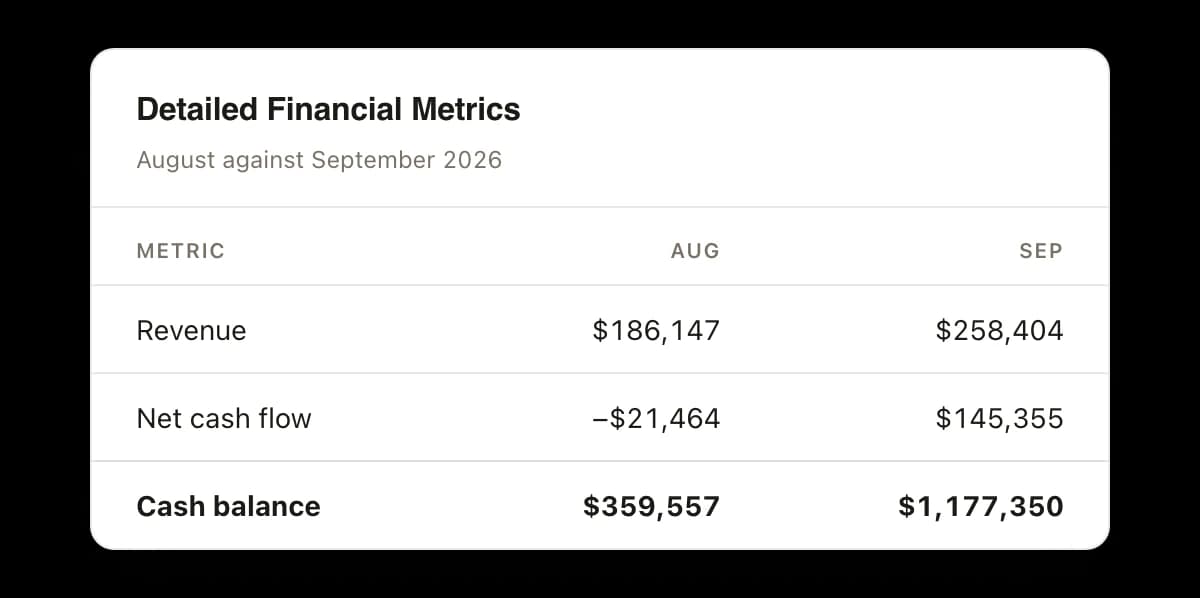
The financial picture in the room comes from the ledger your books post to: revenue of $186,147 in August against $258,404 in September, net cash flow moving from minus $21,464 to $145,355, and a cash balance of $359,557 rising to $1,177,350.

Nia keeps the cap table, the instruments, and the option pool current, models the round you are offered, and drafts the monthly investor update and the quarterly board deck. Sending and downloading stay your call.

Hugo calculates MRR, ARR, net revenue retention, churn, LTV, and customer acquisition cost from your billing data, so the growth story in the room carries the same figures as the statements beside it.

Margo prices the round against your plan: how long the new money lasts at the hiring you intend, and what the burn has to be for the next milestone to land before the money does.
Ownership as recorded, one instrument being added, the document index, and the log of who read it.
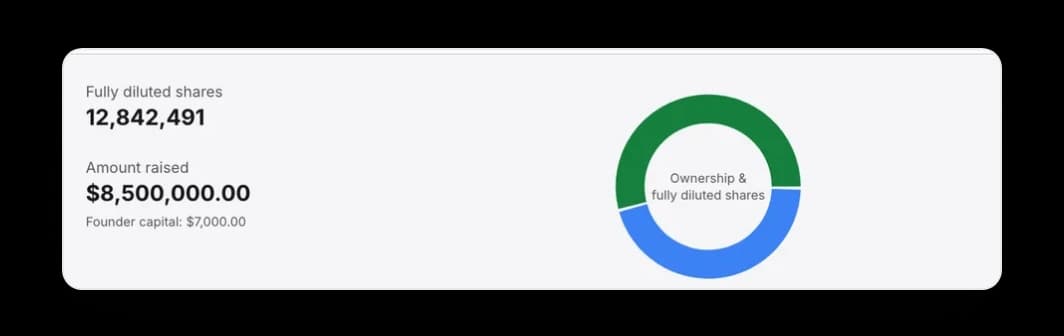
The cap table reads 5 shareholders, 12,842,491 fully diluted shares issued, $8,500,000 of investor capital, and 2 share classes, with founder capital of $7,000.00 under the amount raised. Authorized shares stand at 10,000,000 with none available, and the option pool is not configured yet.
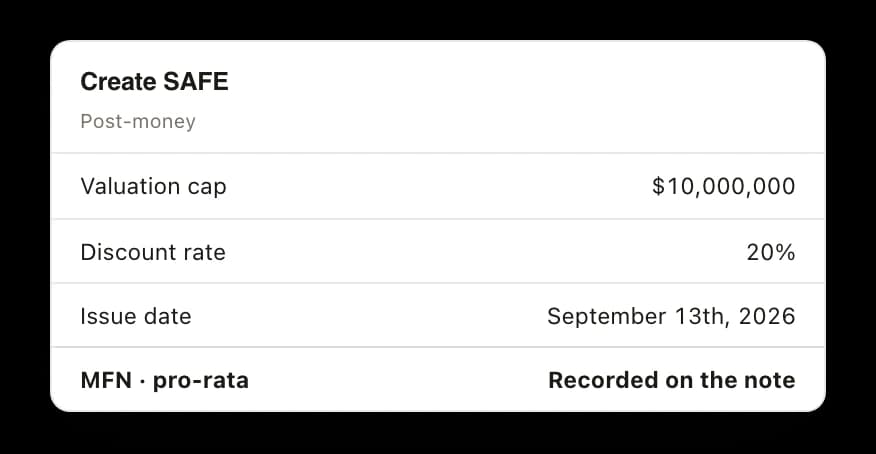
A SAFE is recorded as post-money or pre-money, with its valuation cap, its discount rate, its issue date, and any MFN clause or pro-rata rights written on the note itself rather than remembered from the email thread it arrived in.
Nothing here is assembled for the occasion. The ownership record, the instrument you just added, the document index, and the engagement log all sit on the same account your books post to.
Yes. Post-money SAFEs, pre-money SAFEs, convertible notes, priced rounds, and option pool changes are all modeled against your recorded cap table. Each instrument carries its own valuation cap, discount, and terms, so you can see how it converts at the round in front of you and what founder ownership looks like after.
Your financial statements, metrics, and documents live in a room you share by link. You set what each investor can see and download, access stays revocable, and the room records who opened it, which documents they spent time in, and what they took away.
The statements and metrics come from the same general ledger your books post to, so they carry the numbers you run the company on rather than an export from a month ago. You decide when an updated statement goes into the room, so nothing changes in front of an investor without you.
Nia drafts both from your books, the monthly investor update and the quarterly board deck, with the metrics and statements already in place. You read them, edit them, and decide what gets sent or downloaded. Nothing reaches an investor before you release it.
No. The bookkeeping and the fundraising surfaces are the same system. Vic categorizes and reconciles your transactions as they post, and the cap table, the data room, and the statements are all built on that ledger, so getting ready to raise is the same work as keeping the books.
Your numbers. Your answers. Smarter moves.
Record the ownership, connect the accounts, and the next diligence request is a link you send the same afternoon.
Starting at $1,000/month for all six agents, with a monthly review call with a human financial specialist included. No per-seat fees, no modules.