


 AP Agent
I land every cost on the unit. Then I time the payment.
A factory quote is not what a unit costs you. Freight, duty, and broker fees land on the order they belong to and get spread across the units on it, and the bills behind them sit in a queue timed to your cash rather than to whoever emails loudest.
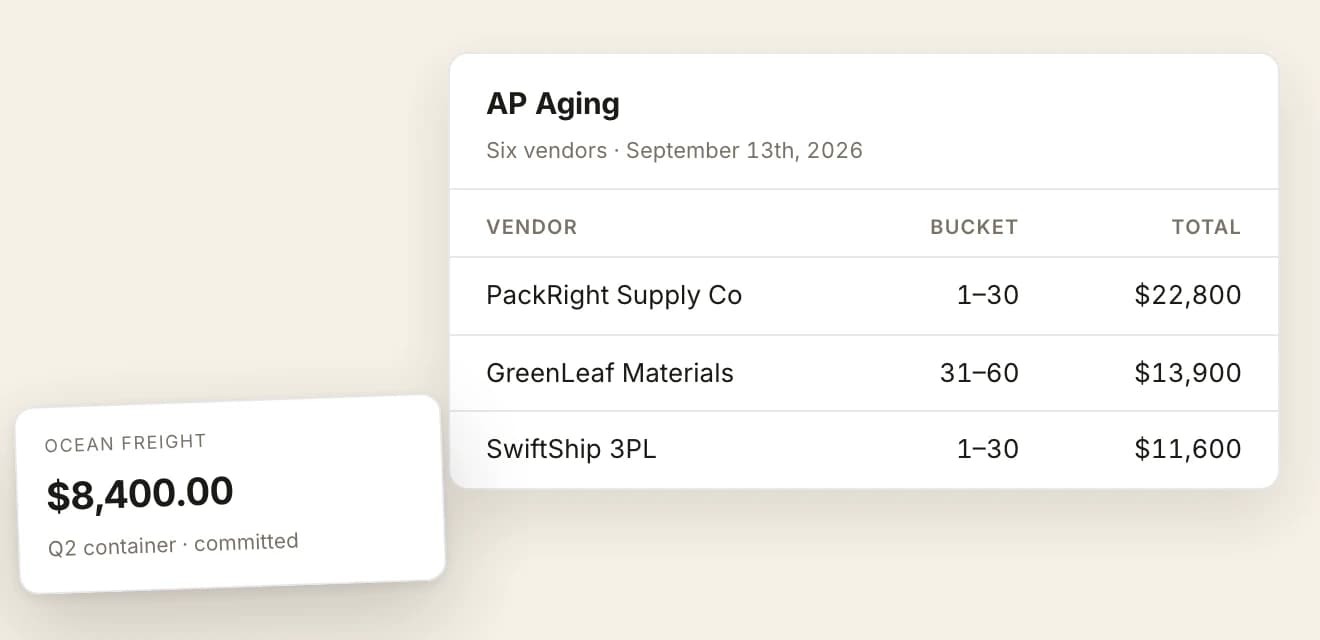
I read what you owe.and price it per unit.
Everything on the payables side of your brand passes through here: what comes in, what I write down, and what I put in front of you to release.
Supplier invoices, freight and duty bills, broker fees, and the receiving records behind them, forwarded in or uploaded. Every bank account and credit card you connect, so a bill can be checked against the cash that funds it.
Each inbound cost coded against the order it belongs to and allocated across the units on that order, so what a unit cost to land sits in one ledger rather than in a freight account far from the product.
A pay run assembled against the cash you have, the bills that failed their match and why, and the landed cost per unit that your margin and your cost of goods sold are built on.
Payables get handledbefore anyone chases you.
Payables goes wrong quietly: a bill that never got coded, a container whose freight never reached the product, a supplier paid early in a week that could not afford it. Overnight I code what arrived, match it against the order and the receipt, and line up what is due next.
- Every morning
Bills coming due
Anything approaching its terms is raised while there is still time to move it, so a due date is something you decide about rather than something you discover.
- Every day
Bills coded and queued
Supplier invoices that arrived are coded to the account and the order they belong to, and land in a queue you approve rather than one that pays itself.
- Once a day
The three-way match
The order, the receiving record, and the supplier invoice have to agree. Where the quantities or the prices differ, I hold the bill and show you the three numbers side by side.
- Every Friday
The pay run, assembled
I put together the week of payments against the cash on hand and hand it to you. I schedule and I flag; the payment itself leaves your bank on your instruction.
- Early each month
Received, not yet billed
Stock you have taken in but not been invoiced for is accrued, so a month does not look cheap simply because a supplier was slow to send the paperwork.
Every supplier bill,in its own bucket.
What you owe, by supplier and by age. This is the table a pay run gets built from, and the one a late bill cannot hide in.
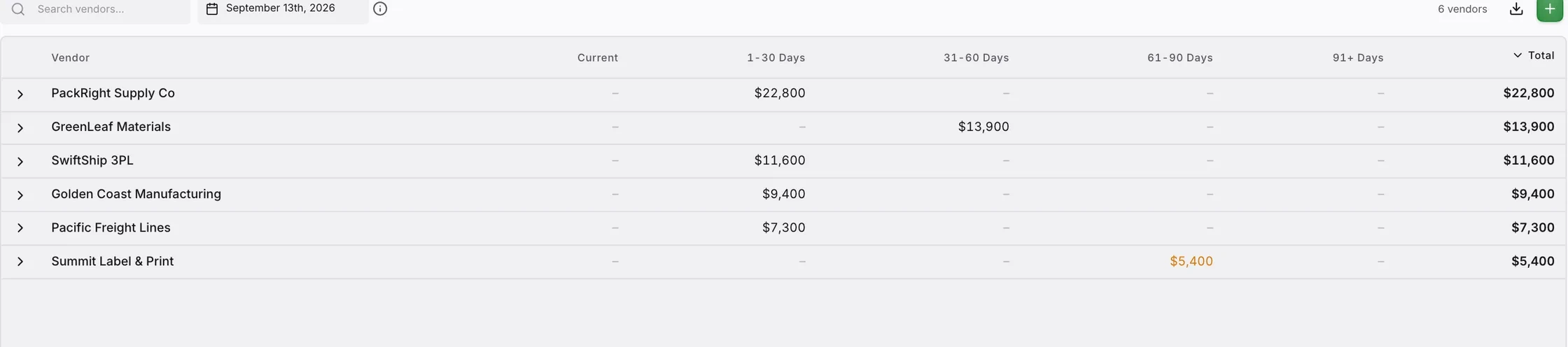
Payables aged by supplier, with every bill sitting in the bucket its own terms put it in.
I schedule the payment.You release it.
The work on this side is arithmetic and timing. The relationships, the terms, and the release stay with you.
- Ask meAsk what this production run actually costs landed, and I show the product cost, the freight, the duty, and the broker fees spread across the units, rather than the number on the factory quote.
- I flagA bill that does not match its order or its receipt, a duty charge that arrived bigger than the estimate, or a payment sitting in a week your balance does not cover gets raised before it is paid.
- You approveI schedule payments and I never send one. I do not negotiate your supplier terms, and I do not book cost of goods sold; I produce the landed cost that Vic books from once you approve it.

Cost lands on my side.Three agents carry it on.
Landed cost is the number everything downstream is priced against, which is why it is produced once and read everywhere.


Everything else operators askabout landed cost.
Theo takes the costs that arrive with an order, product cost, freight, duty, broker fees, and inbound handling, and allocates them across the units on that order, by unit, by value, or by weight. The result is a cost per unit held in the ledger, which is what margin and cost of goods sold are then priced against rather than a quarterly estimate.
The order carries the estimate until the actual bill arrives, and then the landed cost is actualized against what was really charged. The difference lands on the order it belongs to rather than in a freight account on its own, so the product carries its true cost and the margin behind it moves with it.
No. Theo assembles the pay run against the cash on hand, schedules what is due, and holds anything that fails its match. The payment itself leaves the brand's own bank on the owner's instruction. Scheduling and flagging is the whole of the job; sending is not.
The purchase order, the receiving record, and the supplier invoice have to agree. Where the quantities or the prices differ, Theo holds the bill out of the pay run and shows the three numbers side by side, so a short shipment or a price increase is caught before the money is committed rather than after.
We never sell your data, and we share it only with the vetted service providers that run the platform, never with other customers and never with advertisers. Access inside your account is limited to the people you invite.

Your costs, on the unit
Know what a unit costsbefore the container ships.
Connect your suppliers, your bank accounts, and your credit cards, and the next inbound cost lands on the order it belongs to.
Starting at $1,000/month for all six agents, with a monthly review call with a human financial specialist included. No per-seat fees, no modules.