


Five sources, one deck
The night before the board call you are pulling figures from billing, from the bank, and from three spreadsheets. The weekend that belonged to product goes to slides that are already stale by the time the meeting starts.

The startups that command better terms are not the ones with prettier decks. They are the ones whose net revenue retention is already on screen when the question lands. Futureproof calculates the investor set from your bank and billing data, on the general ledger that is your system of record.
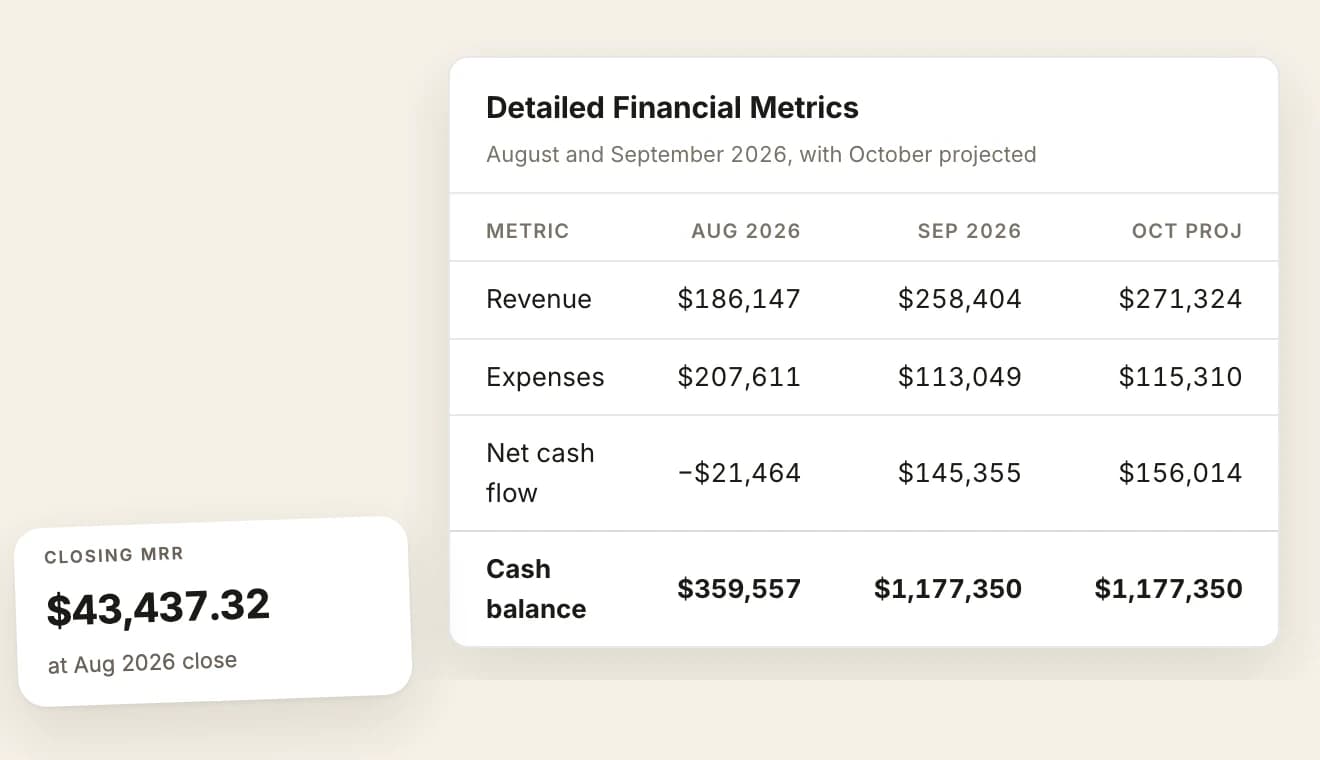
Investor-ready metrics are the figures a fund or a board prices a company on: recurring revenue, net revenue retention, churn, what a customer is worth against what it cost to win, burn, and runway. They arrive late because the billing system, the bank, and the spreadsheet each hold a piece, and nobody reconciles the three until the night before the meeting.
The night before the board call you are pulling figures from billing, from the bank, and from three spreadsheets. The weekend that belonged to product goes to slides that are already stale by the time the meeting starts.
An investor asks for net revenue retention by cohort and you promise to send it. The question was the moment. A follow-up email two days later is not the same thing as an answer.
The dashboard reports one recurring revenue number, the spreadsheet another, the P&L a third. A founder who cannot explain the gap is asking an investor to take the growth story on faith.
Setup is one sitting. Every figure afterwards is calculated on the same ledger your books post to, so a board question is answered with numbers that reconcile to the statements behind them.
Your bank and your billing system connect once, and your revenue and spend history imports into the ledger your books live on.
Vic categorizes and reconciles the day's transactions, so the revenue and spend behind every metric are posted entries rather than estimates.
Recurring revenue and its annual run rate, net revenue retention, logo and revenue churn, lifetime value, acquisition cost, burn multiple, and gross margin.
Hugo assembles the investor view and drafts the monthly update. You read it, edit it, and decide what reaches an investor.
Every fund asks a version of these three. Each one is answered from your own postings, with the arithmetic that produced it visible underneath.
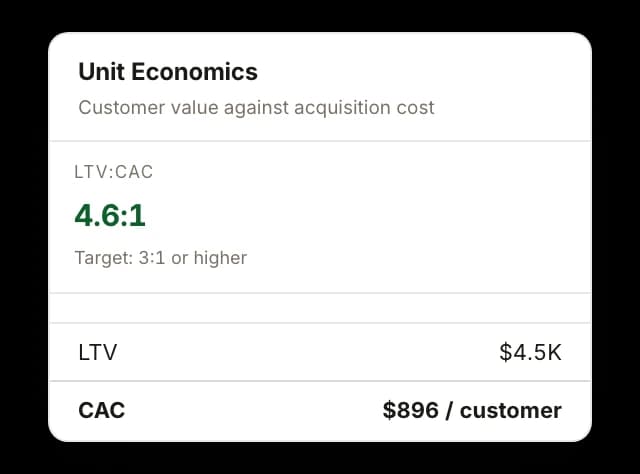
Lifetime value of $4.5K against a customer acquisition cost of $896 gives a ratio of 4.6 to 1, read against the 3 to 1 an investor treats as healthy. Both sides are calculated from your own spend rather than an industry benchmark, so the ratio survives the second question.
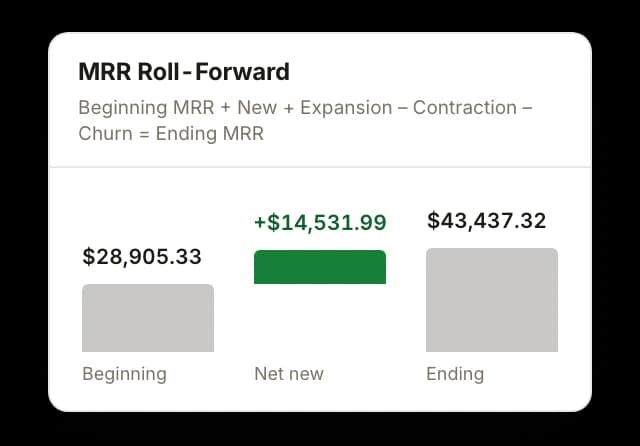
Recurring revenue is read from $28,905.33 at the opening of the window to $43,437.32 at its close, a net gain of $14,531.99. An investor pricing on trajectory gets the path rather than one good month held up on its own.
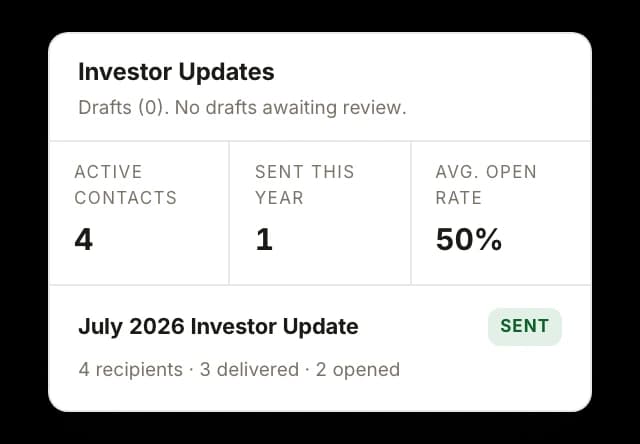
The July 2026 update went to 4 recipients, 3 delivered and 2 opened, and that record stays with the update. Nia drafts it and you approve it, so what an investor received is on file rather than in somebody's sent folder.

Hugo calculates the investor set from your billing data, reconciles the revenue behind it to the general ledger, and brings you a weekly read on what moved and which accounts are at risk.

Nia drafts the monthly investor update and the quarterly board deck from the same figures, with recipients, deliveries, and opens recorded against each send. You approve before anything goes out.

Vic categorizes and reconciles daily and brings you the exceptions. When an investor asks where a number came from, the answer is a posted entry rather than a formula in a sheet.
Recurring revenue and its annual run rate, committed recurring revenue, net revenue retention, logo and revenue churn, average contract value, lifetime value, customer acquisition cost and the ratio between them, burn multiple, magic number, the Rule of 40, gross margin, burn rate, and runway. Each one is calculated from your bank and billing data on the general ledger your books post to.
A metrics tool reads your billing system and stops there. Futureproof keeps your books, so every metric resolves to a posted entry and sits beside the burn rate and runway drawn from the same ledger. The growth figure and the cash figure cannot disagree with each other.
The agents categorize and reconcile your transactions nightly, so the metric set reflects the books as of the last close of business rather than the last export somebody remembered to run.
Most early-stage startups do not. Hugo calculates the set and brings you a weekly read on what moved, Nia drafts the investor update and the board deck for your approval, and a human financial specialist reviews the books with you every month.
Your numbers. Your answers. Smarter moves.
Connect your bank and your billing, and the figures a fund prices you on are ready before the question arrives.
Starting at $1,000/month for all six agents, with a monthly review call with a human financial specialist included. No per-seat fees, no modules.