


 RevOps Analyst
I know where MRR came from, and where it went.
New, expansion, contraction, churn. Most companies can quote the total and cannot explain the movement, because the total comes from one tool and the books come from another. I compute the whole set from the entries on your general ledger, so the metric and the income statement are the same story told twice.
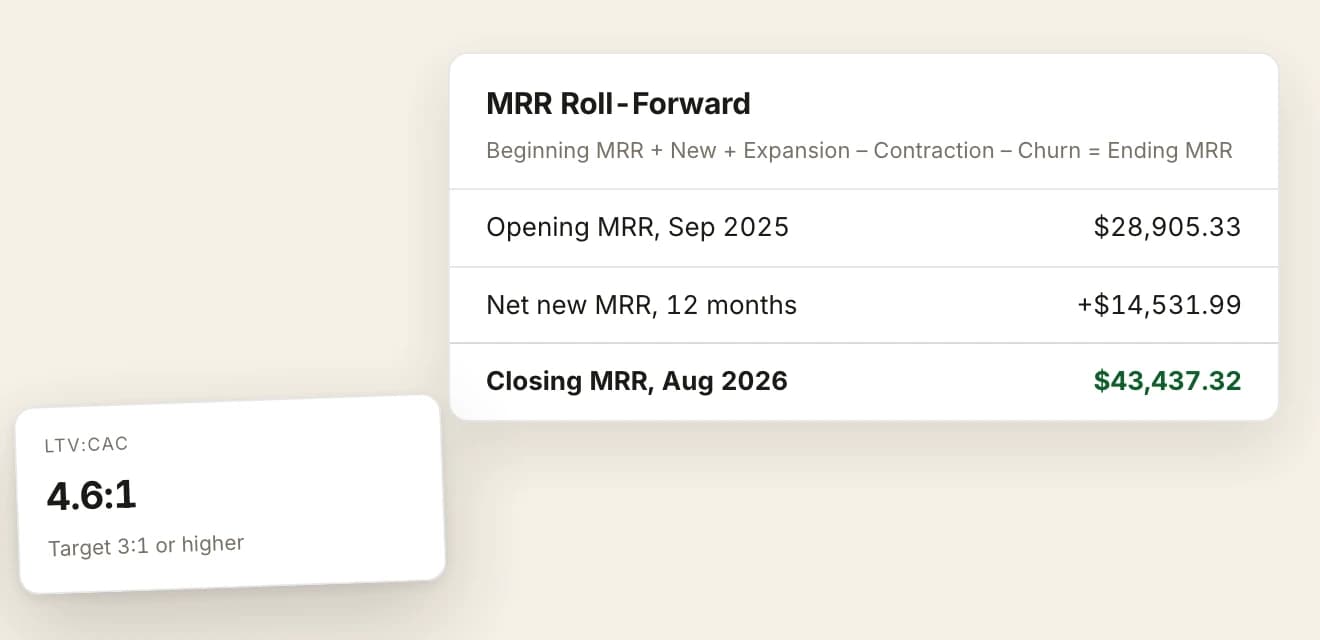
Every number I report,and what sits under it.
Where the metrics come from, what I record, and what arrives without you asking.
The recognized revenue posted to your general ledger, your Stripe subscriptions and the plan each customer sits on, the invoices raised against contract terms, and the acquisition spend recorded against the accounts it brought in.
The movement behind the total: opening recurring revenue, what was new, what expanded, what contracted, what churned, and the closing figure those four produce. Retention by cohort and by plan, payback by channel, and the customers behind each of the biggest moves.
A weekly read on what moved and why, a ranked list of the accounts most likely to leave, and a monthly set that has already been checked against the ledger before anyone outside the company sees it.
The five that run themselveswith the reason attached.
A number with no explanation behind it starts an argument. Each of these jobs produces a figure and the movement that caused it, which is the part a founder can act on.
- Tuesday to Friday
I rank churn risk
I sort the accounts most likely to leave by how confident the signal is, and tell you which ones climbed the list since the last run along with what changed about them.
- Every Monday
I break down the week's MRR
New, expansion, contraction, and churn, with the customers behind the largest moves named and a short list of what is worth doing about them this week.
- Monthly, on the first
I tie metrics to the ledger
Before anything goes near an investor I check the revenue metrics against the general ledger, then draft the month's narrative for you to edit rather than leaving you a blank page.
- Daily
I check MRR against schedule
The recurring revenue I report and the recognition schedule on your books have to agree to the cent. I compare them every day and report the difference rather than quietly picking a side.
- Daily
I clean the subscription data
Cancelled and expired subscriptions with billing periods still running forward will flatter recurring revenue for months. I find them and report them so the number is not propped up by stale records.
Recurring revenue,movement by movement.
Opening to closing, with each component of the change on its own line.
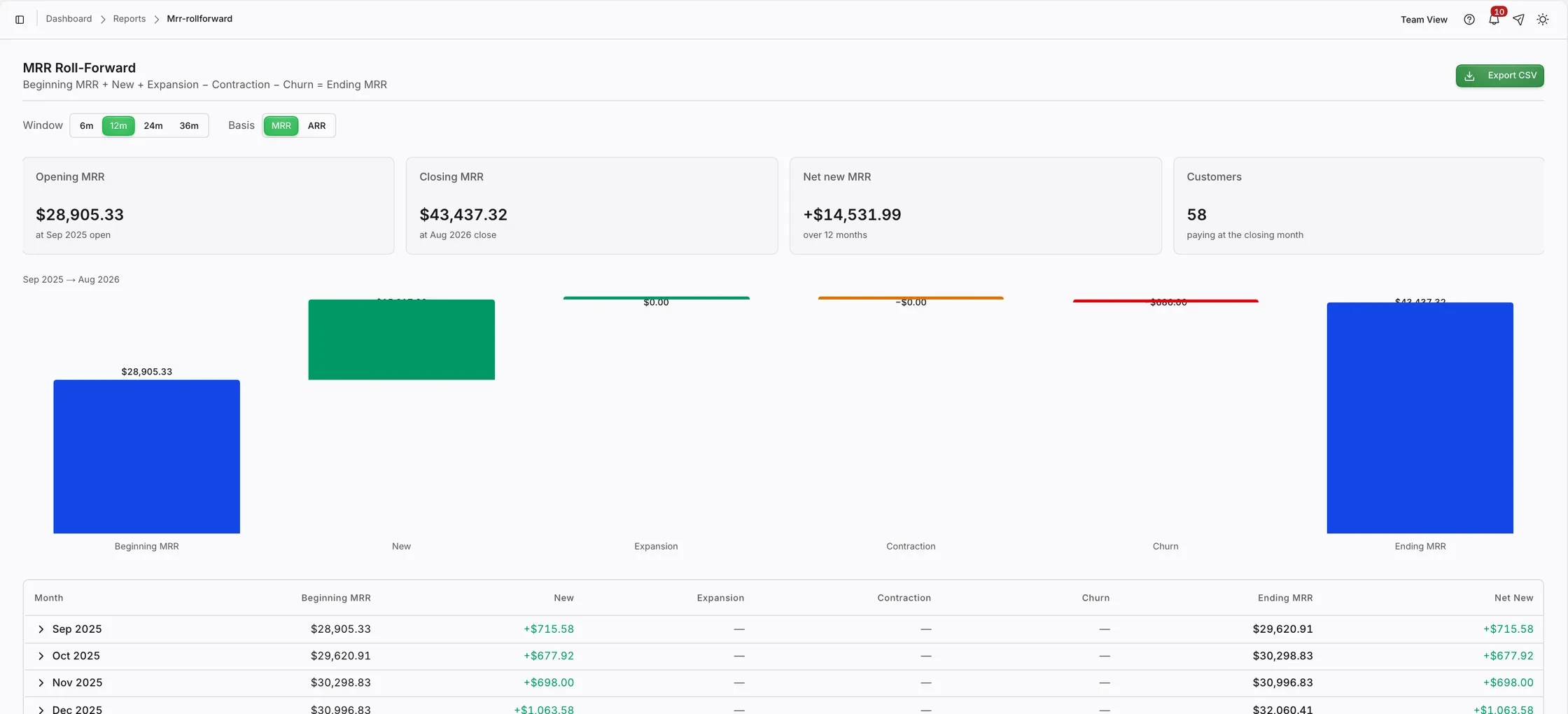
The roll-forward surface: opening and closing recurring revenue, the net new between them, the customers paying at the close, and the month by month table underneath.
I do the arithmetic.The pricing stays yours.
I will tell you which plan is leaking and which cohort compounds. What you charge, and where you change it, is not my decision.
- Ask for the cut you needRetention by signup cohort or by plan, lifetime value against acquisition cost, where the recurring revenue is concentrated, how much is lost to discounting, and which channel pays its acquisition cost back soonest.
- I flag a break in the trendWhen a cohort's retention breaks its trend, when contraction concentrates in one plan, or when a single customer becomes a larger share of revenue than is comfortable, I bring it with the accounts behind it.
- You approve the investor readThe monthly set goes through a check against the general ledger and then through you. Nothing reaches a board deck or an investor update that you have not read first, and I do not change a price or a plan in your billing system.

Where the metrics gobefore investors see them.
Three lanes either feed my numbers or carry them onward.


What founders push onabout the metrics.
Hugo is the revenue analyst on the Futureproof finance team. Hugo computes monthly and annual recurring revenue, the movement behind them, retention by cohort and by plan, and payback by acquisition channel, all from the entries posted to the general ledger rather than from a separate dashboard.
From the same books the financial statements come from. Stripe subscriptions, invoices, and bank activity post to the general ledger, and Hugo measures recurring revenue on those posted entries. That is why the metrics reconcile to the income statement instead of disagreeing with it.
Yes. Retention, lifetime value, and the movement in recurring revenue are all available per plan and per signup cohort, so a plan that churns hard can be separated from one that expands, and the retention effort can go where it changes the outcome.
Two ways, both daily. The recurring revenue Hugo reports is compared against the recognition schedule on the books and any difference is reported rather than absorbed, and subscriptions in a cancelled or expired state with billing periods still running forward are found and flagged before they inflate the total.
No. Hugo reads, computes, and explains. Prices, plans, and packaging stay in the founder's hands, and the monthly set is approved by the founder before it reaches a board deck or an investor update.

Know the real numbers
Stop rebuilding the metrics,start reading them.
Connect Stripe, your bank accounts, and your credit cards, and I will compute the full set from your own books. Fourteen days is long enough to check my arithmetic.
Starting at $1,000/month for all six agents, with a monthly review call with a human financial specialist included. No per-seat fees, no modules.