


I flag
A payout that comes in short of its orders is raised with the reason beside it, before it turns into a variance at month end.

 Bookkeeper
Ask why a payout came in under its orders, and I show the fees, refunds, and holds behind the gap, each one an entry you can open. Amazon, eBay, Shopify and wholesale land in one set of books, kept current every day. I am the bookkeeper on Futureproof's AI finance team, and the books I keep are the one ledger your brand runs on.
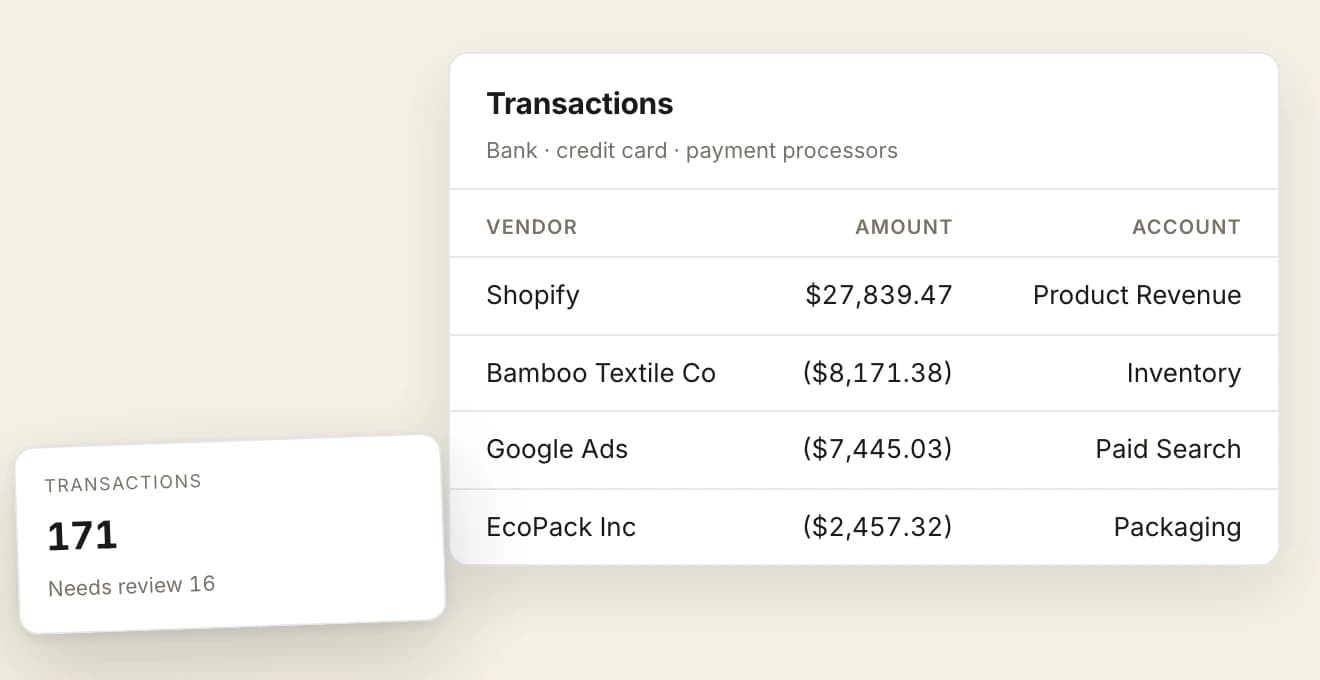
Three things happen on my desk: what arrives from your channels and your accounts, what I write into the ledger, and what I put in front of you.
Orders, refunds, and settlements from Amazon, eBay, and Shopify. Every bank account and credit card you connect. The supplier and 3PL bills behind the stock, and the wholesale invoices behind the buyers.
Revenue on its own line, each fee type on another, refunds and returns against the order they reverse. All of it in one ledger, coded to the account it belongs to.
A posted day, a profit and loss statement built from the posted entries themselves, and a short list of the items I could not tie out, each with the reason beside it.
Between your last order of the day and the moment you open your laptop, I code, match, and post the day's channel activity to one ledger, and anything that does not tie out waits for you with the reason attached.
Each deposit is matched to the orders, fees, refunds, and holds that make it up. Every light payout gets an answer: a line item when I know the cause, an itemized exception when I do not.
Refunds and returns post against the order they reverse, on the day they happen, so a return that lands weeks after the sale still reads against the sale.
I check what would stop the month from closing cleanly, list it, and put it in front of you while there is still time to do something about it.
The account each line landed in is on the row beside it, so a figure you disagree with opens down to the transaction under it.
| Product sales | $48,612.40 |
|---|---|
| Refunds | $2,104.75 |
| Referral fees | $7,291.86 |
| FBA fulfillment fees | $6,695.36 |
| Deposit to your bank | $32,520.43 |
I keep the books current every day and raise what does not add up. You ask what you need and approve the month when it is ready.

A payout that comes in short of its orders is raised with the reason beside it, before it turns into a variance at month end.
Ask why a payout came in light, and you get the refunds and fees behind the gap, each one an entry you can open.
I keep the books current every day and get the month ready; you sign it off, and I never change a price or an order in a channel.
The ledger I keep is the same one the rest of the team reads from, so the margin number and the accounting come from the same posted entries.


Vic splits every marketplace fee onto its own line in the ledger: referral fees, fulfillment fees, storage fees, advertising fees, and removal fees. Because each type is posted separately, you can see referral and fulfillment fees per order, storage and removal fees per account, and a rate change on the line it affects.
Yes. Wholesale invoices with Net 30 and Net 60 terms sit in the same ledger as daily marketplace and store activity. Each buyer payment is matched to the invoice it settles when it lands in the bank, so the two sides of the brand sit in one set of books.
Vic matches each deposit back to the orders, fees, refunds, and holds behind it. A gap from a fee change, a reserve, or a late return posts as an explained line. Anything else lands on your exception list, itemized, the next morning.
Coming from QuickBooks, the migration brings the history across. After that the books live in one ledger that is the accounting software, and your bookkeeper or fractional CFO reviews a posted month instead of rebuilding one in the third week after it ends.

Your books, current every day
A walkthrough of the whole platform, then a talk about how you run your month.