

If you're running a SaaS or subscription business, you already know churn is bad. Losing customers means losing revenue. Simple math.
Except it's not simple at all.
When a customer cancels their subscription, most founders calculate the loss as one month's payment. But that's not what you're actually losing. The real cost of churn is far higher than one payment, and most SaaS founders underestimate it until the replacement bill comes due.
This is where the Rule of 78 becomes useful. Used correctly, it's a quick way to see the cumulative, in-year cash cost of recurring revenue you lose month after month. And once you see it, you'll never think about retention the same way again.
What is the Rule of 78?
The Rule of 78 comes from the lending industry, where it was a sum-of-digits method for allocating precomputed interest across the twelve payments of a one-year loan, weighting the early months more heavily. It has nothing to do with how interest compounds. It's built on one simple identity:
Month 1: 1
Month 2: 2
Month 3: 3
...continuing through...
Month 12: 12
Total: 1 + 2 + 3 + 4 + 5 + 6 + 7 + 8 + 9 + 10 + 11 + 12 = 78
That identity has a genuinely useful reading for subscription businesses. Add $1 of new MRR at the start of every month for a year, and you collect $78 of revenue during that year: the January dollar pays you 12 times, the February dollar 11 times, all the way down to the December dollar paying you once.
The math is symmetric. Lose $1 of MRR at the start of every month for a year, and you forgo $78 of revenue you would otherwise have collected. Any steady monthly churn amount, multiplied by 78, is the cumulative in-year revenue cost of sustaining that churn for twelve months. That cost lands directly on your cash flow. For a complete framework on managing cash flow and other critical startup metrics, see our comprehensive guide on runway, burn rate, and cash flow clarity.
Before we run numbers, keep two different costs separate, because they answer different questions:
- Cumulative foregone revenue is the cash you fail to collect within the year. This is what the Rule of 78 measures.
- Run-rate loss is the hole left in your MRR at the end of the year, which next year's new sales must fill before any of them count as growth.
Churn sends you both bills. Most founders count neither.
How the Rule of 78 Reveals True Churn Cost
Let's look at a concrete example.
Say you have a customer paying $60/month, and customers like them typically stay about 12 months. This one cancels after paying for their first month. On your dashboard, you see -$60 in churned MRR. That feels manageable. You think, "We'll just replace them with a new customer next month."
But here's what you actually lost: the 11 remaining payments they would have made. That's $660 ($60 × 11), not $60. And if your customers actually stay 20 months on average, the number is bigger still. The loss is every payment the customer would have made, minus the ones you already collected.
One more adjustment most founders skip: gross margin. Revenue isn't what funds payroll; gross profit is. At an 80% gross margin, that $660 of lost revenue is $528 of lost gross profit. Still eleven times worse than the dashboard number.
Now here's where it gets worse.
Why Churn Costs More Than Founders Think
If losing one customer means losing $660, that's painful but survivable. The real problem isn't one customer, it's that churn happens every single month.
The Math of Sustained Losses
Let's say you're losing $500 in MRR every month to churn. Maybe that's 10 customers at $50 each, or 5 customers at $100 each. The specific mix doesn't matter; what matters is that you're consistently bleeding $500/month.
To be precise about what this is: constant-dollar churn is a linear problem, not an exponential one. Each month's loss is the same size. But linear losses still stack, and the stack is far bigger than most founders' mental math:
Month 1: You lose $500/month in MRR
- That's 12 payments you won't collect this year: $500 × 12 = $6,000
Month 2: You lose another $500/month in MRR
- That's 11 remaining payments: $500 × 11 = $5,500 more
Month 3: You lose another $500/month in MRR
- That's 10 remaining payments: $500 × 10 = $5,000 more
This pattern continues every single month. Each new wave of churn forgoes payments for all the remaining months in the year.
By month 12, add up all twelve waves:
$6,000 + $5,500 + $5,000 + $4,500 + $4,000 + $3,500 + $3,000 + $2,500 + $2,000 + $1,500 + $1,000 + $500 = $39,000
Or calculate it instantly using the Rule of 78:
$500 × 78 = $39,000
That's the cumulative in-year revenue cost of sustaining $500/month churn for a year. And there's the second bill: at year-end, your MRR is $6,000/month lower than it would have been, a $72,000 hole in run-rate ARR that next year's sales have to fill before you grow at all.
The Symmetry Founders Miss
Here's the part most Rule of 78 articles get wrong: the identity cuts both ways. Add $500 of new MRR every month for a year and you collect exactly $39,000 of new in-year revenue, by the same math. The Rule of 78 doesn't prove that churn beats acquisition. It proves that every recurring dollar, gained or lost, is worth far more than one month's payment.
So why does churn still deserve outsized attention? Three reasons:
- Retained revenue is nearly free. Replacement revenue costs CAC. When you lose $500 of MRR, replacing it means paying full acquisition cost for revenue you already owned. Keeping the customer would have cost a fraction of that.
- Replacement isn't growth. Every new dollar that fills a churn hole is a dollar that doesn't show up as net new ARR. You're spending to stand still.
- Percentage churn scales with your base. This is where churn genuinely compounds, and it deserves its own section.
Where Churn Actually Compounds: Percentage of a Growing Base
Dollar churn is linear. Percentage churn is not, because it's charged against a base you're trying to grow.
At a 3% monthly churn rate, you keep 97% of your revenue base each month. Compound that over a year: 0.97 to the twelfth power is about 0.69. You lose roughly 31% of your revenue base every year before a single new sale. At $100,000 MRR, that's about $31,000 of MRR you must replace annually just to end the year flat. Grow to $200,000 MRR and the same 3% rate costs you twice the dollars. The rate stays constant; the replacement burden grows with everything you build.
That's the honest version of "churn compounds": it's a recurring tax on your future scale, and the bill gets bigger every time you succeed.
It's also why retention is the compounding lever in the other direction. Gross revenue retention measures what you keep before expansion; its ceiling is 100%, and every point below it is base you have to buy back. Net revenue retention adds expansion on top. Above 100%, your existing base grows without a single new logo, and that advantage compounds year after year exactly the way churn does in reverse.
The Real Numbers Get Scary Fast
Let's look at a more realistic scenario for a growing SaaS company:
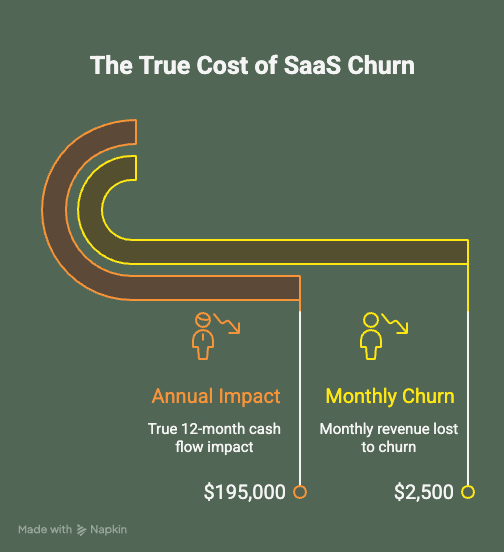
You're at $50,000 MRR with a 5% monthly churn rate, which many founders think is "acceptable." For consistency, note what that rate implies: an average customer lifetime of about 20 months.
Monthly churn: $50,000 × 0.05 = $2,500/month
Cumulative in-year cost if that pace holds: $2,500 × 78 = $195,000 in revenue you won't collect over the next twelve months
Run-rate damage: you exit the year with MRR $30,000/month lower than it would have been, a $360,000 hole in run-rate ARR
For context, $195,000 of foregone revenue is:
- Two senior engineers for a year
- Your entire marketing budget
- 6+ months of runway for an early-stage startup
- The difference between profitability and burning cash
And this assumes your churn rate stays at 5%. If it rises to 7% as you scale (which often happens), the cumulative in-year cost is $273,000. At 10% churn, it's $390,000. To truly understand how churn affects your path to profitability, building a pro forma income statement can help you model how different retention scenarios impact your bottom line.
And remember: replacing that revenue isn't free. Every churned dollar you replace costs acquisition spend that a retained dollar never would.
What Makes Churn Different from Other SaaS Metrics
Churn vs. Customer Acquisition Cost (CAC)
When founders think about profitability, they often focus on CAC. How much does it cost to acquire a new customer? If you're spending $200 to acquire a $60/month customer, revenue payback is about 3.3 months. But only gross profit actually repays CAC, so use the gross-margin-adjusted convention: at an 80% gross margin, payback is $200 ÷ ($60 × 0.80), roughly 4.2 months. Whichever convention you use, say which one it is. The margin-adjusted number is the honest one.
But here's what most founders miss: CAC is a one-time cost. Churn is a recurring loss.
If you acquire 10 customers at $200 each, you've spent $2,000 once. If you lose 10 customers per month at $60 each, that's $600/month of sustained churn: a $46,800 hole in cumulative in-year revenue ($600 × 78), plus the CAC you'll spend replacing every one of them.
This is why high-growth SaaS companies with poor retention eventually hit a wall. They can't acquire customers fast enough, or cheaply enough, to keep paying for revenue they should never have lost.
Churn vs. Monthly Recurring Revenue (MRR)
MRR is a snapshot metric. It tells you how much recurring revenue you have right now. Churn is a velocity metric. It tells you how fast that revenue is disappearing.
Two companies with the same MRR can have completely different trajectories:
Company A: $100,000 MRR, 2% monthly churn
Company B: $100,000 MRR, 5% monthly churn
Company A loses $2,000/month (sustained for a year: $2,000 × 78 = $156,000 of foregone in-year revenue)
Company B loses $5,000/month (sustained for a year: $5,000 × 78 = $390,000)
Company B has a $234,000 larger hole in its collections over the next year from the churn-rate difference alone. That's the cost of multiple engineers, a complete marketing budget, or the difference between profitability and shutdown.
Churn vs. Lifetime Value (LTV)
LTV measures how much revenue a customer generates over their entire relationship with you. But LTV is forward-looking; it's based on assumptions about how long customers will stay.
Churn is reality. It's what's actually happening to your customer base right now.
If your LTV calculations assume customers stay 24 months, but your actual churn data shows they're leaving at 8 months, your unit economics are fiction. You're building a business model on assumptions that don't match reality.
The Rule of 78 forces you to confront actual churn behavior and its true cost, not theoretical customer lifetimes.
What Drives High Churn in SaaS Businesses
Understanding what causes churn is the first step to reducing it. Most SaaS churn falls into three categories:
Product-Market Fit Issues
Customers sign up expecting one thing and get another. Or they sign up before they truly need your solution. This typically shows up as early churn, customers leaving within the first 3 months.
Red flag: High churn in months 1-3, especially if customers aren't engaging with core features.
Onboarding and Activation Failures
Customers want to succeed with your product but can't figure out how to get value from it. They don't understand the features, can't integrate with their workflow, or get stuck without support.
Red flag: Customers who never complete key activation milestones (first project created, first integration connected, first report generated).
Value Erosion Over Time
Customers start strong but gradually use the product less. This happens when products don't evolve with customer needs, when competitors offer better solutions, or when customers outgrow your product's capabilities.
Red flag: Declining usage metrics (logins, feature usage, team members active) 30-60 days before cancellation.
How to Calculate Your True Churn Cost
Here's how to understand what churn is actually costing your business:
Step 1: Calculate Your Monthly Churn in Dollars
Look at your last 3 months of cancellations. Add up the MRR lost each month and find the average.
Example: Month 1: $800, Month 2: $650, Month 3: $750
Average monthly churn: $733
Step 2: Apply the Rule of 78 for the In-Year Cash Cost
Multiply your average monthly churn by 78.
$733 × 78 = $57,174
If your current churn pace holds for the next twelve months, that's the cumulative revenue you won't collect during the year. At an 80% gross margin, it's roughly $45,700 of gross profit that would have funded payroll, product, or runway.
Step 3: Calculate the Run-Rate Hole
Multiply your monthly churn by 12.
$733 × 12 = $8,796
That's how much lower your monthly run rate will be at year-end than it would have been, which is over $105,000 in run-rate ARR terms. Next year's new sales must fill that hole before a single dollar of them counts as growth.
One warning: don't multiply that annualized figure by 78 again. The 78 already accounts for a full year of monthly losses. Applying it twice double-counts and produces numbers no spreadsheet will back up.
Step 4: Calculate Your Churn Opportunity
Now calculate what you'd gain by reducing churn:
If you reduced churn by 25%:
$733 × 0.25 = $183.25 less churn per month
$183.25 × 78 = $14,293.50 of in-year revenue recovered
If you reduced churn by 50%:
$733 × 0.50 = $366.50 less churn per month
$366.50 × 78 = $28,587 of in-year revenue recovered
Suddenly, investing $5,000-$10,000 in retention initiatives doesn't seem expensive. It looks like one of the highest-ROI investments available to you.
Strategies to Reduce SaaS Churn
Once you understand the true cost of churn, the next question is: how do you fix it?
Improve Onboarding and Time-to-Value
The faster customers see value, the less likely they are to churn. Focus on:
- Activation checklists that guide new users to first success
- Onboarding emails that educate and encourage engagement
- In-app guidance that helps users discover key features
- Success milestones that celebrate progress and reinforce value
Target metric: Get 80% of customers to complete core activation within 7 days.
Implement Early Warning Systems
Don't wait for cancellation emails. Identify at-risk customers before they decide to leave:
- Usage monitoring: Flag accounts with declining engagement
- Feature adoption tracking: Identify customers not using key features
- Support ticket patterns: Watch for frustration signals
- Payment failures: Catch billing issues before they become cancellations
Target metric: Identify at-risk customers 30 days before they typically churn.
Build Proactive Retention Workflows
Once you identify at-risk customers, intervene:
- Personal outreach from customer success team
- Educational content showing underutilized features
- Use case recommendations based on similar successful customers
- Discount offers for customers with budget constraints (use sparingly)
Target metric: Re-engage 40% of at-risk customers before they cancel.
Gather and Act on Cancellation Feedback
When customers do cancel, learn why:
- Exit surveys that identify primary cancellation reasons
- Cancellation interviews with high-value customers
- Win-back campaigns for customers who might return later
- Product roadmap input from recurring cancellation themes
Target metric: Get feedback from 60% of churned customers.
Create Expansion Revenue Opportunities
The best defense against churn is making your product more valuable over time:
- Feature expansion that grows with customer needs
- Team-based pricing that increases value as companies scale
- Premium support tiers for customers who need extra help
- Usage-based pricing that aligns cost with value delivered
Target metric: Achieve 110%+ Net Revenue Retention (expansion revenue offsets churn).
When to Prioritize Retention Over Acquisition
Early-stage SaaS companies often face a dilemma: should we focus on acquiring more customers or retaining the ones we have?
The answer depends on your current metrics:
Prioritize Retention When:
- Monthly churn rate exceeds 5%
- Customer lifetime is under 12 months
- CAC payback period is longer than 6 months
- Most customers aren't reaching activation milestones
- NRR (Net Revenue Retention) is below 100%
Prioritize Acquisition When:
- Monthly churn rate is under 3%
- Customer lifetime exceeds 24 months
- Strong product-market fit with clear activation
- Healthy unit economics (LTV:CAC ratio above 3:1)
- NRR is above 110%
Most SaaS companies under $1M ARR should split focus: 70% on retention, 30% on acquisition. Once retention is strong, flip to 30% retention, 70% acquisition.
The Bottom Line on SaaS Churn
Churn isn't just a percentage on your dashboard. Every churned dollar of MRR costs you every future payment that customer would have made. Every month of sustained churn adds to two bills at once: the cash you won't collect this year, and the run-rate hole next year's sales must fill before they count as growth.
And because churn is charged as a percentage of your base, the dollar cost grows as you do. At 3% monthly churn, you're replacing roughly a third of your revenue base every year just to stay flat, and that replacement burden gets heavier with every dollar of scale. Meanwhile, every replacement dollar costs CAC that a retained dollar never would.
But here's the opportunity: retention improvements run the same math in your favor. Cut churn by 25% and the Rule of 78 works for you, recovering tens of thousands in cash flow you can reinvest in product, a key hire, or months of runway.
The companies that scale successfully don't accept churn as inevitable. They treat every lost customer as a recurring cost to eliminate. They invest in retention infrastructure before it becomes a crisis. And they understand that in SaaS, keeping a customer is both far cheaper than finding a new one and worth a year of payments at a time.
Track your churn and see how much cash flow you're leaving on the table. Sign up for a free trial.