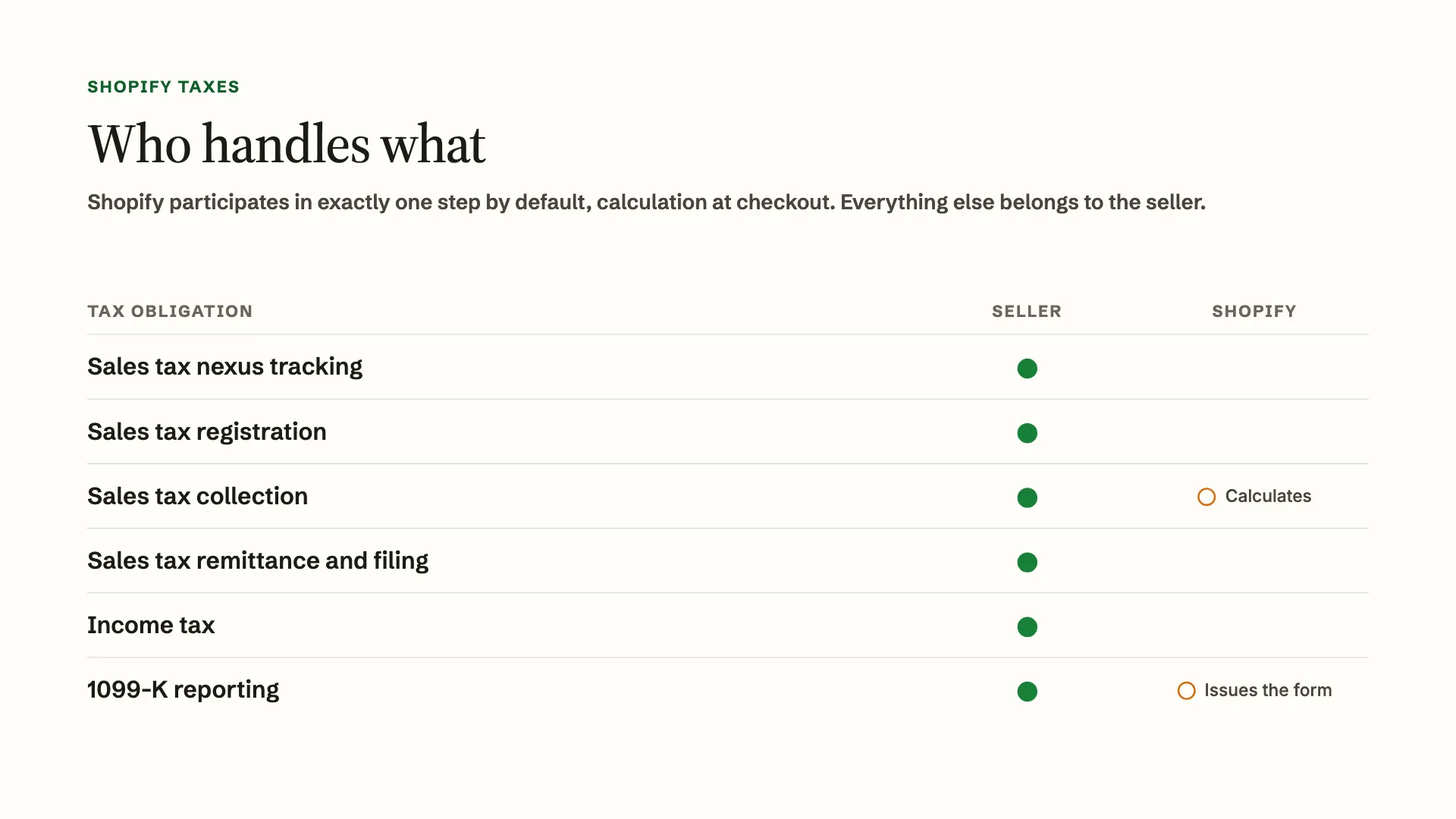



Two years of uncollected tax in two states comes to about $28,300 at state rates alone, all of it on orders from the brand's own Shopify store. The brand is a hypothetical candle company, used as the example throughout. Amazon collects the tax on its marketplace orders and boutiques buy for resale and pay none, so the working assumption inside the brand was that ecommerce sales tax is Amazon's problem. That assumption covered about a third of the business.
What is ecommerce sales tax?
Ecommerce sales tax is the sales tax a state charges on goods sold online and delivered to buyers in that state. A seller must register and collect once it has nexus there, through a physical presence or through sales above the state's economic threshold. A marketplace collects on the orders it facilitates. The brand collects on its own store.
For a brand on three channels, the channels interact: sales on one can push the brand over a line that another channel's sales alone would not. How to set up tax on a Shopify store, and why collected tax is never revenue, are covered in the guide to Shopify taxes.
How sales tax nexus works
Sales tax nexus is the connection with a state that obliges a seller to register, collect and file there. It comes in two kinds.
Physical presence is the older test: an office, employees, or inventory in the state. Inventory is the part brands overlook. Washington lists keeping a stock of inventory in the state as physical presence, and says that includes inventory held by a marketplace facilitator or another third party (Washington Department of Revenue, as of November 2026). A brand whose FBA stock Amazon has placed in a Washington warehouse, or whose 3PL runs a building there, can have nexus in Washington whatever its sales. States word this rule differently, so each state's own guidance decides.
Economic nexus is the newer test. Since the Supreme Court decided South Dakota v. Wayfair on June 21, 2018, a state can require an out-of-state seller with no physical presence to collect once its sales into the state pass a threshold. Each state sets its own, and three details change the answer:
- The amount. Florida, Washington and Arizona each use $100,000, as of November 2026. Other states set the bar higher.
- The period. Florida looks at taxable remote sales in the previous calendar year (Florida Department of Revenue). Washington and Arizona look at the current or the prior year, so a brand can cross the line in October and owe collection soon after, not next January.
- What counts. Washington counts all sales into the state, retail and wholesale, including marketplace and exempt sales. Arizona leaves out sales made through a marketplace facilitator (Arizona Department of Revenue). Some states once counted transactions as well; Washington dropped its 200-transaction test in 2019 (Washington Department of Revenue).
Who collects on each channel, and what counts
A marketplace facilitator is a marketplace that a state makes responsible for collecting and remitting tax on the sales it handles for third-party sellers. All three states here have such a law, and Amazon collects under it as the facilitator. Shopify does not; it is the brand's own store, and the brand is the seller of record.
| Channel | Who collects the tax | Counts toward the brand's threshold? | What the brand files |
|---|---|---|---|
| Amazon and other marketplaces | The marketplace, on the orders it facilitates | Depends on the state: Washington counts them, Arizona does not | Where the brand files, it may still report these sales. Washington requires it, with a deduction for sales the facilitator collected on |
| Shopify store | The brand, once it has nexus in the state | Yes | Registration, collection, returns and payment, state by state |
| Wholesale to boutiques | Nobody, if the buyer has given a valid resale certificate | In some states; Washington counts wholesale sales | Exempt sales on the return in states such as Washington, with the certificate on file |
The middle column is where the surprises come from, so the test runs state by state, on each state's rule, with every channel in the numbers.
A $5M candle brand, state by state
The candle brand sells $5 million a year. Shopify brings in $2.5 million, Amazon $1.75 million, and wholesale to boutiques $750,000. The brand is based in a state with a sales tax and is registered there. It ships from one 3PL in a second state, and Amazon spreads its FBA stock across its own network.
Each column shows one test, the economic threshold, in one state as of November 2026; physical presence and, in some states, transaction counts can also apply:
| Florida | Washington | Arizona | |
|---|---|---|---|
| Shopify sales | $160,000 | $70,000 | $70,000 |
| Amazon sales | $90,000 | $60,000 | $60,000 |
| Threshold | $100,000 | $100,000 | $100,000 |
| What counts | Taxable remote sales | All sales into the state, retail and wholesale, including marketplace and exempt sales | Direct sales only; marketplace sales left out |
| Sales counted | At least $160,000 from Shopify alone | $130,000 | $70,000 |
| Over the threshold? | Yes | Yes | No |
| State rate on Shopify sales | 6% | 6.5% | Under this test |
| Tax not collected, per year | $9,600 | $4,550 | $0 |
| Two years | $19,200 | $9,100 | $0 |
Washington and Arizona get the same figures and opposite answers. In Washington the Amazon sales count, the total is $130,000, and the brand has crossed the line. In Arizona they do not, and $70,000 of direct sales sits well under it. In Florida, Shopify alone clears $100,000.
Two notes on the table. The rates are the state portions only, from each department's own page: Florida's general rate of 6% and Washington's state rate of 6.5% (Washington Department of Revenue). Both states add local taxes on top, which Florida calls discretionary sales surtax, so the real figures are higher. The Washington column assumes no wholesale accounts in Washington; any would add to the $130,000. It also assumes no physical presence: FBA stock in a Washington warehouse would create nexus regardless of the $100,000.
What two years of missed tax costs
The brand did not collect this tax, but in a state where it was required to collect, it still owes it. Washington says so in its guidance to marketplace sellers: the seller is responsible for the correct amount of sales tax even if it did not collect the correct amount from the customer (Washington Department of Revenue, as of November 2026). The customers who bought those candles cannot be billed after the fact, so the money comes out of profit; whether it reduces revenue or is an expense is a policy the CPA sets.
For the candle brand, two years in Florida and Washington comes to $28,300 at the state rates alone, assuming it had to collect for both full years, and before local taxes, interest and penalties. If the brand nets 10 percent, an assumption for this example, its profit for a year is $500,000, and the bill takes about 5.7 percent of it. That is two states. A buyer's diligence can run the same test in every state with a sales tax.
Interest and penalties are why the route to settling matters. Florida and Washington each run a voluntary disclosure program for sellers that find a past liability and come forward, and the Multistate Tax Commission runs a multistate voluntary disclosure program that can take several states in one application. Whether that route fits, and which years it would cover, is a question for a CPA or sales tax specialist, ideally asked before any state sends a letter.
The monthly threshold watch
A threshold is usually crossed in the middle of a year, by a channel nobody was watching. The defence is a monthly count, and it needs four inputs.
- Sales and order counts by ship-to state, from every channel, wholesale invoices included, in one table with one row per state.
- Each state's rule. The amount, the period it measures, and which channels count, as in the rows of the table above. Rules change, so the list carries the date each one was last checked.
- Where the stock sits. The 3PL's warehouses and the states where Amazon has stored the brand's inventory, since stock alone can create nexus.
- The date a line was crossed. Washington expects a seller that was under the threshold the year before to start collecting on the first day of the month that begins at least 30 days after it crosses (Washington Department of Revenue, as of November 2026). The crossing date sets the start date.
Run monthly, the candle brand's Washington row would have shown the count climbing toward $100,000 before it got there. That is the month to raise registration with the CPA, rather than two years later. Whatever tool runs the count, it is only as good as its inputs, so wholesale invoices and every marketplace belong in it.
Wholesale: the certificate is the exemption
A boutique buying candles to resell pays no sales tax on them, because the tax is collected when it sells to its own customer. The exemption is not automatic; it rests on a document. Washington's version is the reseller permit, and its rule is direct: a business buying for resale must give the seller its permit, and if it does not, the seller must charge retail sales tax on the whole purchase (Washington Department of Revenue, as of November 2026). Other states use a resale or exemption certificate, with their own forms and rules.
An auditor asks for these documents. Suppose one in five of the candle brand's boutique accounts never sent a certificate, and those accounts buy about as much as the rest. Then $150,000 of its $750,000 in wholesale sales has no support. In a state where the brand has nexus, an auditor can treat sales without a valid certificate as taxable unless one is produced, and whether a late certificate is accepted depends on the state.
The fix is a rule at account opening: no first wholesale order ships until the certificate is on file and matches the buyer's state, and the CPA confirms which form each state accepts. When a wholesale marketplace sits between the brand and the boutique, its terms say who collects the certificates and who collects the tax. Read them before the first order ships.
What the books should show
Sales tax shows up in four places in the accounts, and each has one job.
- Sales tax payable, by state. Tax the brand collected on its own store is a liability on the balance sheet until it is filed and paid. Keep one account per state, or one account with a state on every line, so each balance ties to its return. After each filing, the balance for that period should return to zero. A balance that grows quarter after quarter is tax collected and never sent.
- Marketplace-collected tax. Amazon's settlement shows the tax the customer paid and the tax Amazon withheld to remit. It runs through a clearing account that should net to zero on each settlement, with differences investigated; where a facilitator law applies, the marketplace, not the brand, owes it, and it is not the brand's revenue. The eBay bookkeeping guide shows the same clearing entry for eBay payouts, the guide to Amazon FBA accounting covers the settlement around it, and the order to cash guide follows the tax line from checkout to the bank.
- Exempt wholesale sales. A report of exempt sales by state, each line tied to a certificate on file. Washington wants exempt sales reported on the return, so the report is also the filing support.
- Taxes the brand pays itself. Some state taxes are the business's own cost, not a tax collected from customers. Once a seller has nexus in Washington, its business and occupation tax applies to the seller's gross receipts, marketplace sales included, and fees paid to the marketplace cannot be deducted (Washington Department of Revenue, as of November 2026). It belongs in expenses.
A chart of accounts built this way keeps the three kinds of tax apart from the start. A past exposure like the candle brand's is accrued once it is probable and reasonably estimable, interest and penalties included, and disclosed if only reasonably possible; the CPA helps size it. Left out of the accounts entirely, it surprises a buyer later.
The mistake: "Amazon handles sales tax"
Amazon brings in the first serious volume, Amazon collects the tax, and "Amazon handles sales tax" becomes the answer to a question nobody asks again. Meanwhile the Shopify store grows into the same states. In a state with a $100,000 threshold, a store doing $2.5 million a year needs only 4 percent of its sales there to cross it.
Transaction bookkeeping does not catch it, because an uncollected tax leaves no transaction to record. It surfaces instead in a buyer's due diligence, a new accountant's question about where the brand is registered, or a cleanup of old records. One of the sellers we have spoken with found a missed nexus liability that way, during a cleanup, in time to avoid a lien.
Where the brand owes, from which date, and how to settle the past are decisions for a CPA or sales tax specialist. What the brand can own is the inputs: sales by state across every channel, where its stock sits, and certificates on file. With those in hand, the adviser can answer from the brand's own records.
Frequently asked questions
Does a brand need to register for sales tax if Amazon collects it?
Often, yes. Amazon collecting tax on its own orders does not settle the brand's position in a state. If the brand has nexus there, through stored inventory or sales on its other channels, it may need to register, collect on its own store and report its marketplace sales. Washington, for example, requires marketplace sellers with nexus to report all their sales. A CPA confirms each state.
Do marketplace sales count toward economic nexus?
It depends on the state. As of November 2026, Washington counts all sales into the state, retail and wholesale, including marketplace and exempt sales, toward its $100,000 threshold, while Arizona leaves marketplace-facilitated sales out of a remote seller's count. The same mix of Shopify and Amazon sales can put a brand over the line in one state and under it in the next.
Does FBA inventory create sales tax nexus?
It can. Stored inventory is a form of physical presence, and physical presence creates nexus without any sales threshold. Washington lists inventory held by a marketplace facilitator or another third party as physical presence. Amazon moves FBA stock between warehouses in different states, so a brand should know where its inventory has been stored and check each state's rule with a sales tax adviser.