Why Most Founder-Led Sales Stacks Are a Mess
Most early-stage founders build their sales stack the same way they build their first product: reactively. A tool gets added when a problem gets loud enough, another when a team member requests it. Before long, there is a patchwork of disconnected software that nobody fully uses and nobody fully trusts.
A well-designed sales tech stack is not about having the most tools. It is about having the right tools in the right sequence, with data flowing between them cleanly. The difference between a founder who closes $500K in ARR with three tools and one who struggles with twelve comes down to architecture, not budget.
This guide breaks down the stack by function, recommends specific tools by stage, and covers the one gap that catches most founders off guard: connecting sales activity to financial planning.
CRM: The System of Record
Everything in a founder-led sales operation should flow through a single CRM. This is not optional. The CRM is not just a contact database; it is the system of record for every deal, every conversation, and every outcome.
For early-stage companies, HubSpot CRM (free tier) or Pipedrive are the most practical starting points. Both offer clean pipeline views, contact tracking, and enough automation to reduce manual logging without requiring a dedicated admin. Salesforce is powerful but introduces configuration overhead that most sub-10-person teams cannot absorb. The time spent configuring Salesforce at the seed stage is better spent on conversations with prospects.
The metric to watch here is CRM hygiene. If deal stages are not being updated, the tool is not working. Founders should establish a weekly review cadence from day one, even if the pipeline has only five deals in it. That discipline compounds as deal volume grows.
One common mistake: treating the CRM as a logging tool rather than a decision-making tool. The pipeline view should answer three questions at a glance. Which deals are progressing? Which deals have stalled? And which deals need the founder's direct attention this week? If the CRM cannot answer those questions without clicking into individual records, the pipeline stages need restructuring. Five to seven stages is the right range for most seed-stage companies. More than that creates ambiguity about where deals actually stand.
Prospecting and Outreach Tools
Founder-led sales typically begins with a defined ICP and a short list of high-value targets. The tools should match that precision rather than optimize for volume.
Apollo.io and Clay are the current standard for prospecting. Both allow founders to build targeted lists using filters like company size, funding stage, tech stack, and job title, then export directly into sequences. Clay has become a favorite for teams that want to personalize outreach at scale without a large SDR team, because its waterfall enrichment model pulls data from dozens of sources to build richer prospect profiles.
For email sequencing, Instantly.ai and Smartlead offer deliverability-focused outbound at a price point appropriate for seed and Series A companies. Both support multi-inbox sending and warmup protocols that protect domain reputation. At early stage, deliverability matters more than features. A well-crafted email that lands in the primary inbox outperforms a sophisticated sequence that hits spam.
LinkedIn Sales Navigator remains valuable for enterprise-adjacent deals where relationship context matters before the first email lands. The cost ($99/month) is justified when average contract values exceed $10,000 and deals require multi-threaded engagement.
A note on sequencing volume: founders often ask how many prospects they should be reaching per week. The answer depends on customer acquisition cost targets and deal size. For SaaS companies with $5,000 to $15,000 ACV, 50 to 100 new prospects per week is a reasonable starting volume at the seed stage. For higher-ACV enterprise sales ($50,000 and above), the number drops to 15 to 25 highly personalized touches. The tools should match the motion. Instantly works well for volume-based outreach. Clay paired with manual follow-up works better for account-based approaches where each prospect receives a custom first line.
Communication and Meeting Infrastructure
Every missed meeting request, delayed demo confirmation, and slow follow-up costs conversion rate. Founders should remove as much friction as possible from scheduling and communication.
Calendly or Cal.com handles scheduling. The routing feature in Calendly is underused by early-stage teams: it can qualify prospects by company size or use case and route them to the right calendar. This saves significant time as deal volume grows past 10 to 15 demos per week.
For video calls, Zoom remains the standard. More importantly, pair it with Fathom or Fireflies.ai to capture call recordings and auto-generate summaries. In founder-led sales, where the founder is often the only salesperson, memory and note-taking should not compete with listening. A single missed detail about a prospect's budget timeline or decision-making process can stall a deal for weeks.
The recordings serve a second purpose as the team scales. When the first sales hire joins, call recordings become the training library. They show how the founder positions the product, handles objections, and closes, without requiring the founder to sit in on every call during onboarding.
Proposal and Contract Execution
The gap between verbal agreement and signed contract kills more deals than most founders realize. Sales cycle length often inflates not because of decision delays but because of execution friction in the final stage.
PandaDoc and DocuSign are the category leaders for proposals and e-signatures. PandaDoc's built-in proposal templates and CRM integrations make it the better choice for companies that need speed and want to track when prospects open and review documents. DocuSign wins on enterprise compliance requirements, which matters for founders selling into regulated industries.
For pricing-heavy deals or products with complex configurations, DealHub or Cacheflow offer CPQ (Configure, Price, Quote) functionality that can shorten deal cycles by removing the back-and-forth on custom pricing. Most seed-stage companies do not need CPQ yet, but founders selling annual contracts above $25,000 with variable pricing should consider it.
The overlooked detail in contract execution is timing. Every day between verbal commitment and signed contract is a day where the deal can unravel. A champion changes roles. A competing vendor gets a last-minute meeting. Budget gets reallocated. Founders who reduce their average proposal-to-signature time from 10 days to 3 days close at materially higher rates, not because the proposal is better, but because momentum is preserved. Pre-built templates, one-click signing, and automated reminders are not nice-to-haves. They directly protect revenue.
Revenue Visibility and Reporting
Founder-led sales becomes a liability when there is no visibility into what is working. The question every founder should answer weekly: where are deals stalling, and why?
HubSpot's reporting dashboards are sufficient for most seed-stage companies. As volume increases, pairing the CRM with a lightweight BI layer (Looker Studio, Metabase, or Coefficient for Google Sheets integration) gives better pipeline coverage visibility without the cost of a full RevOps hire.
Four metrics should be instrumented from day one:
- Lead-to-demo conversion rate
- Demo-to-close rate
- Average sales cycle length
- Average contract value
These four numbers reveal whether the problem lives in prospecting, positioning, or closing. A 40% lead-to-demo rate with a 10% demo-to-close rate points to a positioning or qualification problem, not a prospecting problem. A 60% demo-to-close rate with a 90-day average cycle suggests the product sells well but the deal process has too much friction.
These metrics also feed directly into a more accurate revenue forecast, which becomes important the moment a founder begins planning headcount or fundraising conversations. Understanding which financial metrics Series A investors evaluate helps founders align their sales reporting with what matters during diligence. Investors expect founders to speak fluently about unit economics, and sales metrics are the leading indicators that drive those numbers.
Connecting Sales Activity to Financial Planning
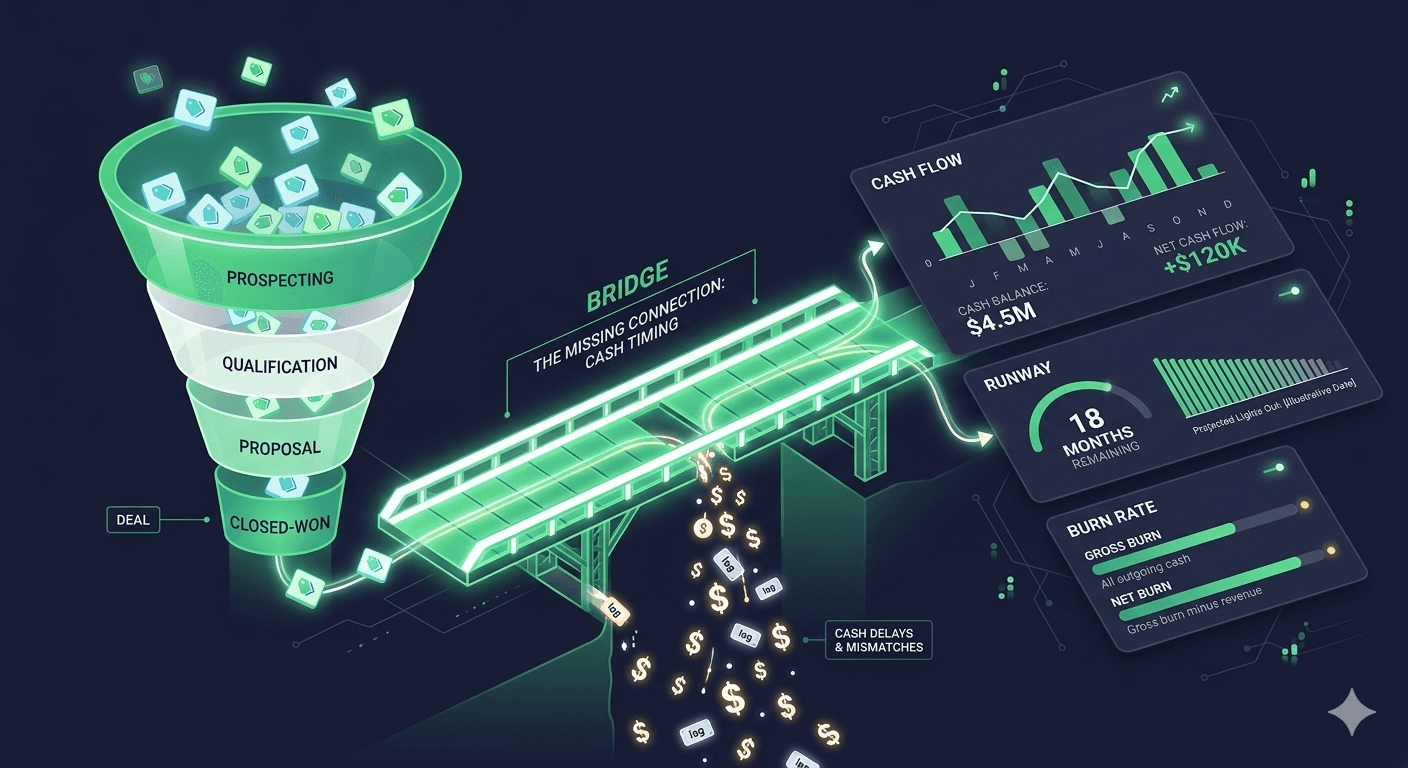
One gap catches founders off guard consistently: there is no connection between sales activity and financial planning. A strong quarter in the pipeline means nothing if the timing of cash collection is not modeled alongside it.
Consider a SaaS founder who closes $200,000 in new annual contracts during Q2. That sounds like a strong quarter. But if 60% of those contracts are billed monthly, the actual cash collected in Q2 might be closer to $50,000. The rest arrives over the following nine months. Without modeling that timing, the founder's burn rate assumptions and runway projections are disconnected from reality.
As deal velocity increases, founders need a clear view of how closed-won contracts translate to revenue recognition, cash timing, and burn impact. This is where financial tools connect the dots. Futureproof gives founders a real-time view of how their sales trajectory affects runway, headcount capacity, and fundraising timing, all in one place alongside their bookkeeping and cap table.
Sales momentum without financial clarity is how founders get surprised by cash crunches they did not see coming. The best operators run both views in parallel.
A Practical Stack by Stage
Pre-Seed Through Seed
A lean four-tool setup covers most needs at this stage:
- HubSpot CRM (free) for pipeline and contact management
- Apollo.io for prospecting and list building
- Instantly.ai for email sequencing and deliverability
- Calendly plus Fathom for scheduling and call recording
- Futureproof Revenue Metrics for connecting closed deals to MRR, ARR, and churn visibility
Total cost runs between $200 and $400 per month. The data flows cleanly between tools, and the founder spends most of their time in conversations rather than configuring software. At this stage, resist the temptation to add tools preemptively. Every new tool requires configuration time, learning time, and maintenance. If the founder is the only person selling, the stack should fit on one screen and require less than 30 minutes of administrative work per day.
Series A and Growth
When sales team headcount grows and deal complexity increases, the stack expands:
- Gong or Chorus for call intelligence and coaching
- PandaDoc for proposals and e-signatures
- Looker Studio or Metabase for reporting beyond CRM dashboards
- Futureproof Forecasting and Scenarios for connecting sales outcomes to runway, hiring plans, and fundraising timing
Outbound becomes more segmented at this stage, and the stack needs to support multiple sellers without losing visibility into pipeline health and deal progression.
Common Mistakes That Waste Money and Time
Three patterns consistently undermine founder-led sales stacks, regardless of stage.
The first is tool sprawl driven by feature envy. A founder sees a competitor using Gong and adds it at $1,500 per month before they have enough call volume to justify the investment. The threshold for call intelligence tools is roughly 20 or more recorded calls per month. Below that, Fathom or manual note review provides sufficient insight at a fraction of the cost.
The second is disconnected data. When the CRM does not sync with the email sequencing tool, or when proposal data lives in a separate system with no integration, the founder loses the ability to trace a deal from first touch to signed contract. Every tool in the stack should either integrate natively with the CRM or connect through a lightweight automation layer like Zapier or Make. If a tool cannot connect, it should not be in the stack.
The third is ignoring the financial layer entirely. Most founders track pipeline value and closed-won revenue but never model how those numbers translate to actual cash in the bank. A $100,000 annual contract billed monthly produces $8,333 in month one, not $100,000. Founders who plan hiring, marketing spend, or fundraising timing based on pipeline value rather than cash collection timing consistently overestimate their position. This is the gap that financial planning tools are built to close.
The Goal at Every Stage
The purpose of a sales tech stack is not to automate selling. At the founder-led stage, the founder's judgment, relationships, and product knowledge are the competitive advantage. The stack exists to protect that advantage by removing administrative friction, preserving institutional knowledge in recordings and CRM data, and connecting sales outcomes to the financial reality of the business.
Founders who build their stack with intention from the beginning spend less time on tools and more time on the conversations that produce revenue. Those who build reactively spend their Series A cleaning up data, migrating between platforms, and reconstructing pipeline history they should have captured from the start.
Start lean. Instrument the metrics that matter. Connect sales activity to financial planning. The rest follows.