


In its first month of sales, a run of 3,000 hoodies shows a gross profit of about $26,700 while the bank is still about $39,000 short of what the run cost. The company and the run are a worked example with every figure shown, and they follow that run from a $12,600 factory deposit on June 1 to December, the month the cash finally comes back.
Two things open that gap. The first is landed cost: everything it takes to get a product to the place it sells from, which is the figure the P&L charges against each sale. The second is timing, because the bank paid for the whole run months before the first hoodie sold.
In short, the P&L calls a run profitable in its first month of sales, the bank gets the run's cost back about six months after the deposit, and, in this example, supplier terms change how deep that hole goes, not when you climb out of it.
The hoodie stands in for any product a factory makes to your order. Change the unit price and the duty line, and the shape stays the same.
The company and the run
The example company sells cotton hoodies and sweatpants, about $2.5M a year: roughly 60% through its own Shopify store, 30% on Amazon and 10% wholesale to boutiques on net 30 terms. The CEO, one operations hire and a third-party warehouse (3PL) run it.
The run is 3,000 hoodies for the fall season, bought full package, meaning the factory sources the fleece, sews the garment and delivers it finished. The factory price is $14.00 a hoodie on FOB terms, so $42,000 for the run, paid 30% at order and 70% before the goods ship.
The duty rate, freight cost, marketplace fees, return rates and ad spend are inputs to replace with your own numbers, from your broker, your freight forwarder and your settlement reports.
Step by step: what the run costs before a single sale
June 1: the deposit
The order goes in with a wire for 30%, or $12,600. Nothing has been made yet. On the balance sheet the deposit is an advance to the supplier, a prepaid asset, and not an expense. It is not inventory yet either, because the company does not own any hoodies.
July 27: the balance
Eight weeks later the factory finishes production and asks for the balance before it releases the goods: $29,400. The run has now cost $42,000 in cash, for hoodies still in a factory on the other side of the world.
July 30: the hoodies are loaded
FOB terms set when risk passes to the buyer: when the goods are on board at the origin port. The purchase contract sets when title passes, and most importers book the inventory at that point, as this one does. From this day the balance sheet carries $42,000 of inventory in transit, and the deposit and balance stop being prepaid and become inventory. No cash moves.
August 18 and 20: customs and freight
The container reaches a West Coast port about three weeks later, and two bills arrive before the hoodies can reach the warehouse.
Customs comes first. A cotton knit sweatshirt falls under HTS heading 6110.20.20, which carries a general duty rate of 16.5% (USITC Harmonized Tariff Schedule, checked November 2026). Many origins have also carried additional tariffs since 2025, and those rates have changed several times; this example uses 10% as a placeholder. Take the current figure for your country of origin from your customs broker.
Duty is charged on the customs value, which is usually the price paid to the factory. International freight and insurance are generally left out of that value. On the $42,000 run:
| Customs line | Basis | Amount |
|---|---|---|
| Duty | 26.5% of $42,000 (16.5% plus the 10% placeholder) | $11,130.00 |
| Merchandise processing fee | 0.3464% of value (19 CFR 24.23), subject to a yearly minimum and maximum | $145.49 |
| Harbor maintenance fee | 0.125% of value on ocean cargo (19 CFR 24.24) | $52.50 |
| Customs broker, ISF filing and bond share | Illustrative | $250.00 |
| Total paid at entry | $11,577.99 |
Two days later ocean freight and delivery from the port to the 3PL are paid: $4,800, an illustrative figure for a part-container load.
At this point the run has taken $58,378 out of the bank (rounding the entry total to $11,578), and not one hoodie has sold.
Late August: receiving at the 3PL
The 3PL counts the cartons in and charges $450 for receiving, billed with September's invoice. That is the last cost of getting the hoodies onto the 3PL's shelves.
What one hoodie cost to land
For the hoodies held at the 3PL:
| Cost | Run total | Per hoodie |
|---|---|---|
| Factory price (FOB) | $42,000 | $14.00 |
| Ocean freight and delivery to the 3PL | $4,800 | $1.60 |
| Duty | $11,130 | $3.71 |
| Customs fees, broker, ISF and bond | $448 | $0.15 |
| 3PL receiving | $450 | $0.15 |
| Landed cost | $58,828 | $19.61 |
The factory quote was $14.00. The hoodie on the shelf costs $19.61, 40% more, and duty alone is about a fifth of the landed cost.
The 600 hoodies sent on to Amazon carry one more cost: $660 to prep and ship them into Amazon's warehouses, or $1.10 each. Amazon's warehouse is where those units sell from, so the transfer is part of their cost, and each of them lands at $20.71.
All of these costs sit in inventory until the hoodie sells; then its landed cost moves from inventory to cost of goods sold. Storage after the goods arrive, fulfillment to customers, marketplace fees and ads are not part of landed cost; they are costs of selling, booked in the month they occur.
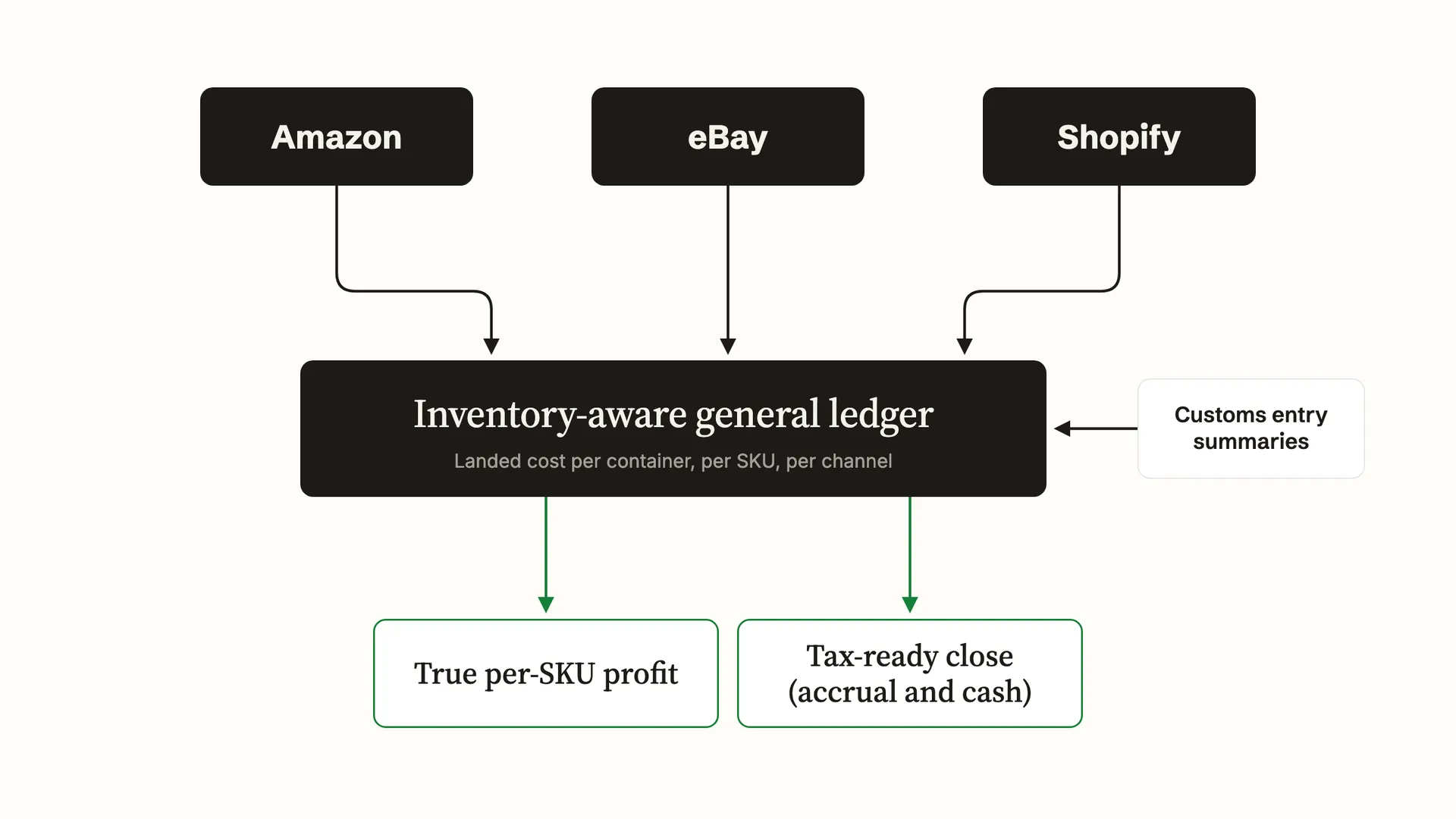
Splitting one shipment's freight and duty across several SKUs is covered in true landed cost and per-SKU profit for importing brands. This post stays with one SKU and follows the cash.
September to February: selling across three channels
On September 1 the hoodies go live on Shopify. The same day the 3PL ships 300 to boutiques on a wholesale order and sends 600 to Amazon's warehouses; the $660 for that transfer is billed with September's invoice. The Amazon units are checked in and selling from September 21.
Each channel turns a hoodie into cash on its own terms. Prices exclude sales tax, which passes through and is not revenue; on Amazon, Amazon collects and remits it as the marketplace facilitator. The cash figures below count only money that moves. A returned hoodie that goes back on the shelf is stock, not cash: it brings money in only when it sells again, at its own later date.
- Shopify, $68 a hoodie. Payment processing costs about $2.30. About 15% of orders come back for a $68 refund, which is $10.20 per hoodie sold. With $16 of ad spend for each hoodie sold, Shopify leaves $39.50 of cash per hoodie: $68 less $2.30, $10.20 and $16. Payouts land within days, so the example counts them, and the refunds, in the month of the sale. The 3PL charges $9.50 to pick, pack and post each order, billed the following month.
- Amazon, $68 a hoodie. A referral fee of 17% ($11.56), a fulfillment fee of $6.50 and $0.44 of other fees leave $49.50 per order. About 15% of units come back. Each return costs the $68 refund, less the part of the referral fee Amazon gives back, plus its returns processing fee on apparel. The example uses $58 a return, or $8.70 per hoodie sold, an illustrative round number to replace with the net cost of a return on your own settlement report. The payout is $40.80 a hoodie, and ads cost another $8. Amazon settles roughly every two weeks and can hold funds until after delivery, so the example pays each month's Amazon sales in the following month.
- Wholesale, $34 a hoodie. The 300-unit order invoices $10,200 on net 30, due October 1. The boutiques pay on October 8, a week late, which is normal enough to plan for. The 3PL charges $150 to pick and pack the order.
In the example, nine in ten returned hoodies go back into stock at their landed cost; the expected loss on the rest is booked with each sale as part of the returns estimate.
Storage at the 3PL, an illustrative figure, falls from $240 to $80 a month as stock sells.
Sales pace: Shopify sells 500 hoodies in September, 450 in October, 400 in November and December, and 350 in January. Amazon sells 50 in the last ten days of September, then 130, 140, 140 and 140. The example leaves out the holiday spike.
When the run pays back: cash from net receipts and payout dates
This is the whole run as the bank sees it. Each month's line nets the receipts and payments of that month; the right-hand column is the run's cumulative cash. Shopify figures are after Shopify's own ad spend; Amazon ads are shown on their own.
| Date | What happens | Cash in or out | Running cash for the run |
|---|---|---|---|
| Jun 1 | 30% deposit to the factory | −$12,600 | −$12,600 |
| Jul 27 | 70% balance before shipping | −$29,400 | −$42,000 |
| Aug 18 | Duty, customs fees and broker | −$11,578 | −$53,578 |
| Aug 20 | Ocean freight and delivery to the 3PL | −$4,800 | −$58,378 (lowest point) |
| September | Shopify 500 × $39.50 = $19,750; Amazon ads 50 × $8 = −$400 | +$19,350 | −$39,028 |
| October | Shopify 450 × $39.50 = $17,775; September Amazon payouts 50 × $40.80 = $2,040; wholesale paid $10,200; Amazon ads 130 × $8 = −$1,040; September 3PL bill −$6,250 | +$22,725 | −$16,303 |
| November | Shopify 400 × $39.50 = $15,800; October Amazon payouts 130 × $40.80 = $5,304; Amazon ads 140 × $8 = −$1,120; October 3PL bill −$4,475 | +$15,509 | −$794 |
| December | Shopify 400 × $39.50 = $15,800; November Amazon payouts 140 × $40.80 = $5,712; Amazon ads −$1,120; November 3PL bill −$3,960 | +$16,432 | +$15,638 |
| January | Shopify 350 × $39.50 = $13,825; December Amazon payouts $5,712; Amazon ads −$1,120; December 3PL bill −$3,920 | +$14,497 | +$30,135 |
| February | January Amazon payouts $5,712; January 3PL bill −$3,405 | +$2,307 | +$32,442 |
The September 3PL bill of $6,250 is the month's 500 Shopify orders at $9.50 ($4,750), storage ($240), the wholesale pick and pack ($150), receiving ($450) and the Amazon prep and shipping ($660). Each later bill is that month's Shopify orders at $9.50 plus storage.
The run ends November $794 short and is back above zero during December, about six months after the deposit left. A monthly table cannot give the exact day. With so little left to recover, small changes move the month: a few days of holiday sales, or the October 3PL bill paid in December instead of November, would bring payback into November, and a slower Amazon settlement would move the day later in December, but not out of it. At the end of November more than 1,000 hoodies, about a third of the run, are still unsold.
By the end of February the run is about $32,400 ahead in cash, before overheads. About 365 restocked returns, roughly $7,200 of stock at cost, are still on the shelf. They are worth that in the profit view today and bring cash only if they sell, after this table ends.
Profitable in September, short of cash until December
Read the September row against the P&L. That month the company ships 550 hoodies to consumers and 300 to boutiques: about $42,000 of revenue after the expected refunds. Cost of goods sold is $19.61 a unit ($20.71 on Amazon) for the hoodies customers keep plus the expected loss on returns that cannot be resold, about $15,300. The P&L shows a gross profit of about $26,700 before fees and ads.
The profit view and the cash view treat a return differently. On the P&L, a restocked hoodie's cost goes back into inventory. In the bank, the refund has gone out and nothing has come in yet.
The bank shows the run $39,028 in the hole at the end of September. Both are right. The P&L matches each hoodie's cost to the month it sells; the bank recorded the whole run's cost in June, July and August. Across the whole business, the same idea is measured as the cash conversion cycle: days of inventory, plus days to collect, minus days to pay suppliers.
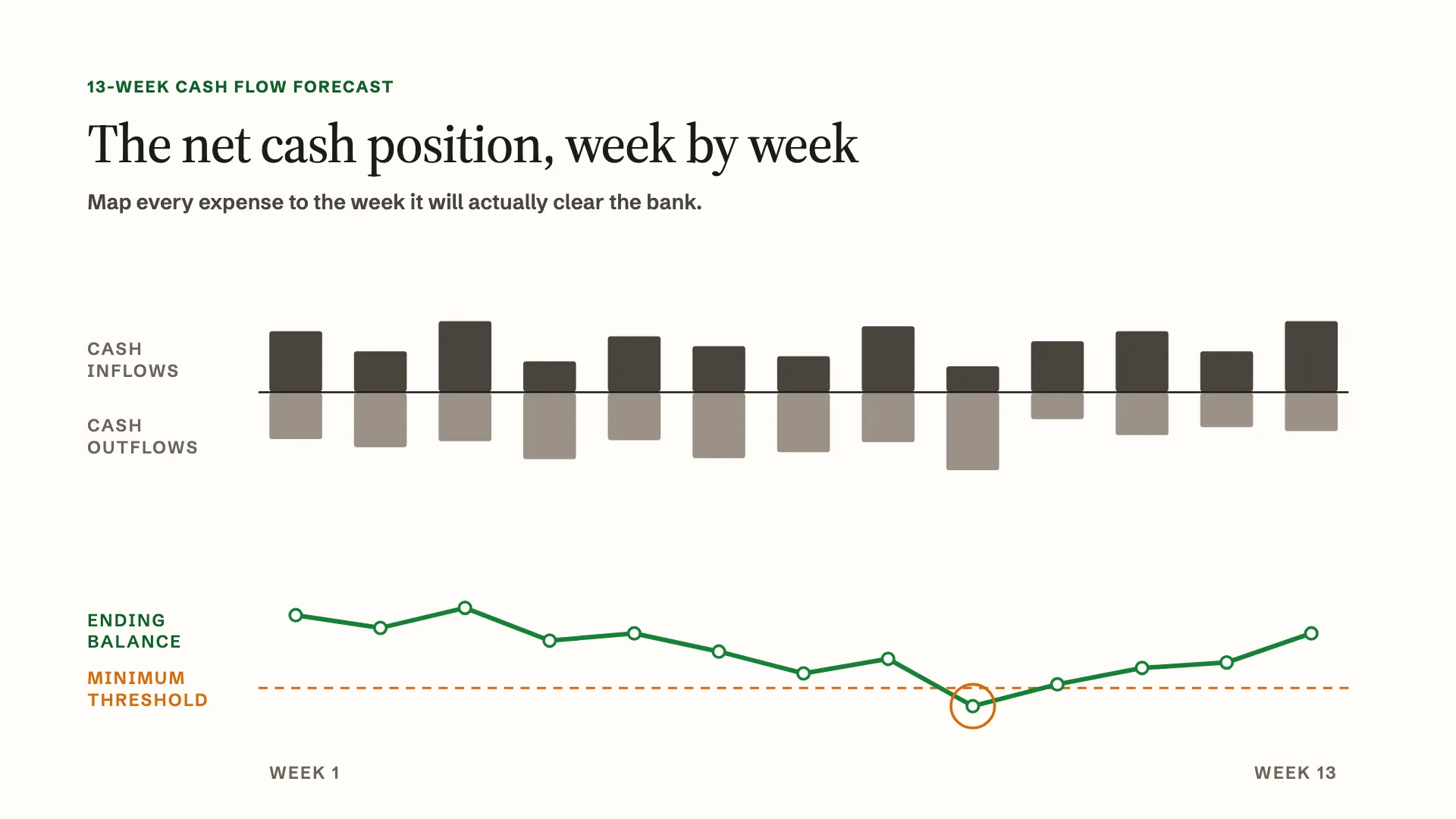
If the spring order goes out in October, its deposit leaves while this run is still underwater, at −$16,303 by the end of October. A 13-week cash flow forecast puts both runs on one page.
The same run on net 60 terms
Now change one term. The factory agrees to take the balance 60 days after shipment instead of before it, so the $29,400 is due on September 28 rather than July 27.
| Balance before shipping | Balance on net 60 | |
|---|---|---|
| Lowest point of the running cash line | −$58,378 on August 20 | about −$45,300 on October 1 |
| Payback | During December | During December |
| Cash ahead at the end of February | +$32,442 | +$32,442 |
The net 60 low assumes September's receipts arrive evenly through the month and the September 3PL bill is paid on October 1. On the morning of September 28, before that day's receipts, the line is −$28,978 after freight on August 20, plus about $17,400 of September's net receipts, less the $29,400 balance: about −$41,000. Two days of receipts later, the $6,250 3PL bill takes it to about −$45,300 on October 1, the net 60 low. The payback month does not move, because the balance is still paid before the line crosses zero. What moves is the depth of the hole: about $13,100 shallower, money that can go toward the next run's deposit or the ads that sell this one.
What are those 60 days worth? Borrowing $29,400 for 60 days on a credit line at an illustrative 12% a year costs about $580 in interest. If the factory does not raise its price in exchange, the terms save that interest and spare the company the credit line. Factories tend to offer them only after a year or more of clean, steady runs, and a factory may simply refuse; some sourcing agents offer terms at a markup, which is worth pricing against the $580. Longer payment terms show up as higher days payable outstanding, which shortens the cash cycle without changing a dollar of profit.
Sidebar: buying the fabric yourself
Some apparel brands buy the fabric themselves and pay the factory only to cut, make and trim (CMT).
In this example, the fleece for 3,000 hoodies costs $13,500 and has to be paid about four weeks before the factory order, around May 4. The factory price falls to $8.75 a hoodie, $26,250 for the run. Together that is $39,750, before freight to the factory and the extra fabric the cutter needs for waste, against the $42,000 full-package price: at most $2,250 saved, about 75 cents a hoodie.
Three things come with the saving. The first cash leaves a month earlier. Duty falls only with the total value, because the supplied fabric plus its freight to the factory is added to the customs value. And the company now owns the fabric: it is raw-materials inventory held at the factory, and any shortfall is the company's problem while any leftover is the company's to use on a later run, or to write down if it will not be used. Brands that make the move usually do it for control, not price: the same fabric on every reorder, and one fabric minimum spread across several styles.
What the balance sheet and P&L show at each step
| Step | Cash | What the accounts show |
|---|---|---|
| Deposit paid | −$12,600 | Prepaid asset (advance to the supplier); no expense |
| Goods loaded, title passes | $0 | Inventory in transit of $42,000; deposit and balance move into inventory |
| Freight, duty, fees, receiving | −$16,378 in August; the $450 receiving fee is paid with the September 3PL bill in October | Added to inventory: $58,828 in total, $19.61 a hoodie |
| 600 hoodies sent to Amazon | −$660, on the September 3PL bill paid in October | Added to those units: $20.71 each |
| Hoodie sold | Arrives with the payout | Revenue, net of expected refunds; the unit's landed cost moves from inventory to cost of goods sold; the cost of units expected back and resellable is held as a returns asset, not cost of goods sold |
| Wholesale order shipped | $0 until October 8 | Revenue and a $10,200 receivable |
| Amazon funds not yet paid out | $0 until the settlement | Money owed to the company by Amazon, not a cost |
| Storage, fulfillment, fees, ads | As billed | Expenses of the month they occur |
| Returned hoodie restocked | Refund out; no cash back until it sells again | Unit moves from the returns asset back into inventory at its landed cost |
| Returned hoodie damaged | Refund out | The expected loss is booked with the sale as part of the returns estimate; a damaged return is written off against it |
Some importers show fulfillment inside cost of goods sold and some below it. Either works if it is applied the same way every month. What does not work is booking the factory deposit as an expense in June, which makes June look like a loss and every selling month look better than it was.
So the run that looked profitable in September paid for itself in December, and in this example net 60 terms would have made the hole about $13,100 shallower without the payback moving at all.
FAQ
How long is an importing brand's cash cycle?
For one production run, the cash cycle runs from the factory deposit to the point where payouts and wholesale payments have paid the run back. In this illustrative example that takes about six months, from June 1 to December, while the P&L shows a profit from September. Across the whole business it is measured as the cash conversion cycle: days of inventory, plus days to collect, minus days to pay suppliers.
Is a factory deposit an expense?
No. A deposit paid before the importer owns the goods is a prepaid asset, an advance to the supplier. FOB terms set when risk passes, on board at the origin port; the purchase contract sets when title passes, and most importers book inventory then. At that point the deposit and balance become inventory, and the cost reaches the P&L only as each unit sells.
Is US duty charged on the freight cost?
Usually not. US duty is charged on the customs value, which is normally the price paid to the factory; international freight and insurance are generally excluded. The merchandise processing fee and harbor maintenance fee are charged on the same value. Fabric you supply to the factory, plus its freight there, is added to that value, so confirm the basis with your customs broker.