


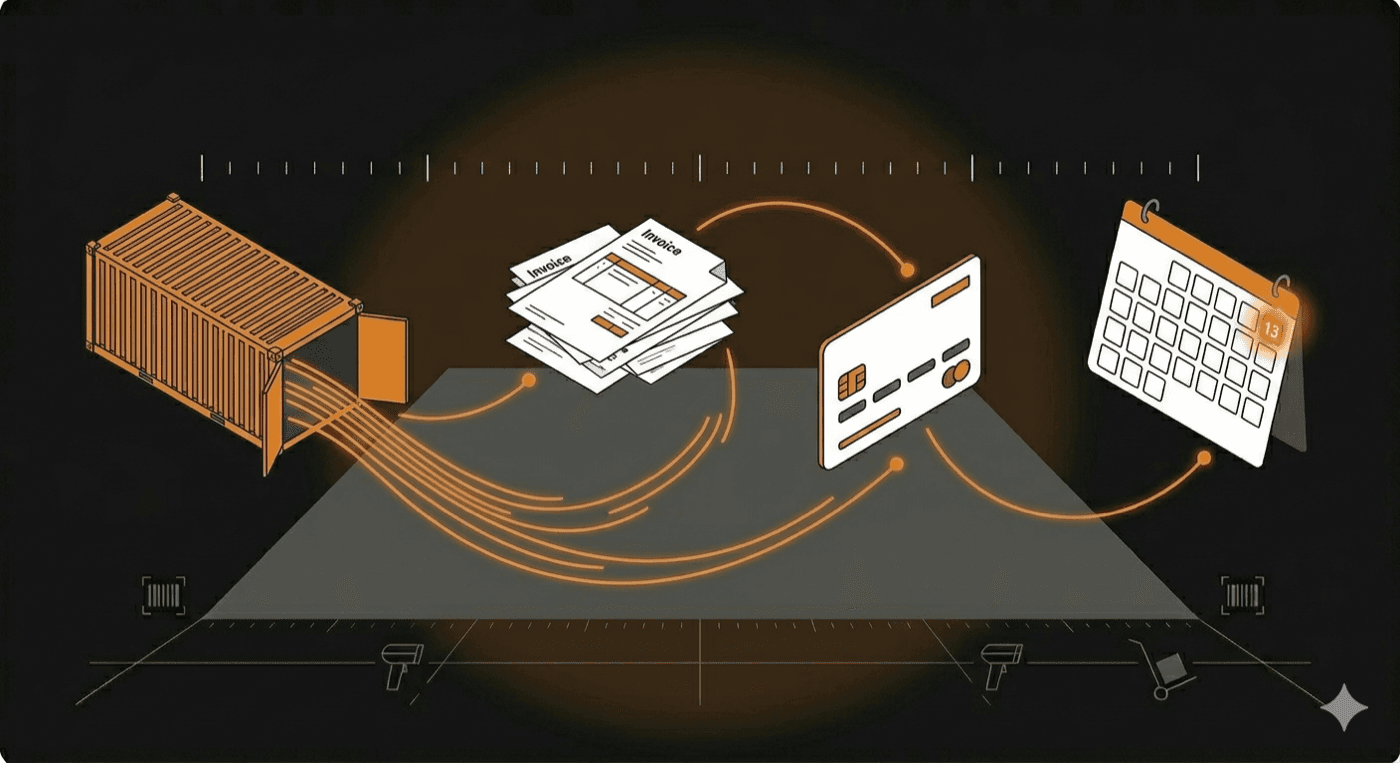
An ecommerce business can show a healthy profit on its income statement and still run out of cash. Inventory deposits land weeks before revenue hits the bank account. Supplier payments, shipping costs, and ad spend all pull cash out on different schedules than the sales they support. For founders managing these moving pieces in spreadsheets or, worse, by gut feel, a single delayed shipment or surprise tariff can turn a profitable quarter into a scramble for bridge financing.
The 13-week cash flow forecast exists to solve this exact problem. It maps every dollar in and every dollar out across the next quarter, week by week, so founders can spot shortfalls before they become emergencies. While most guides to the 13-week model focus on corporate restructuring or PE-backed turnarounds, ecommerce businesses need this tool just as much. The difference is what goes into the model.
What Is a 13-Week Cash Flow Forecast?
A 13-week cash flow forecast is a rolling, week-by-week projection of all cash inflows and outflows over the next 13 weeks (roughly one quarter). Unlike a monthly P&L or annual budget, it focuses on when cash actually moves, not when revenue is recognized.
The model typically starts with a beginning cash balance, adds expected inflows (customer payments, refunds received, loan proceeds), subtracts expected outflows (inventory purchases, payroll, ad spend, rent, software), and produces an ending cash balance for each week. That ending balance carries forward as the next week's starting point.
For ecommerce founders, the 13-week window hits a practical sweet spot. It is long enough to capture a full inventory cycle (from purchase order to sale to payout), but short enough that the inputs remain grounded in real data rather than speculative projections.
Why Monthly Forecasts Fall Short for Ecommerce
Monthly financial statements show what happened over 30 days. They smooth over the peaks and valleys that define ecommerce cash flow. A monthly view might show $80,000 in revenue and $60,000 in expenses, suggesting a comfortable $20,000 surplus. But that surplus hides the fact that $35,000 in inventory payments hit in the first week while most of the revenue does not settle until weeks two through four.
Ecommerce cash flow is lumpy by nature. Here are the forces that create those lumps:
- Marketplace payout delays. Amazon now uses a delivery-date-based reserve system: funds from each sale become available seven days after the buyer receives the package (the "DD + 7" policy). That means a product sold on January 1 and delivered on January 6 becomes available on January 13 at the earliest. Available is not the same as paid: the cash itself lands on the account's next scheduled disbursement, typically every two weeks unless the seller triggers an earlier payout. New sellers or accounts flagged for higher risk may face even longer reserve periods. Shopify payouts can take two to five business days. These lags mean revenue recognized today is cash received weeks later, depending on the channel, shipping speed, and disbursement schedule.
- Inventory prepayment cycles. Most suppliers require deposits 30 to 60 days before goods ship. For founders ordering from overseas manufacturers, the timeline stretches to 90 days or more.
- Seasonal demand spikes. Q4 often requires inventory purchases in August and September, months before the holiday revenue arrives.
- Ad spend front-loading. Paid advertising costs hit immediately, while the revenue those ads generate trickles in over days or weeks depending on conversion lag and fulfillment timelines.
- Return and refund timing. A 15% return rate does not spread evenly across the month. Post-holiday returns can cluster into a two-week window that drains cash right when founders expect to see holiday profits.
A weekly view exposes these mismatches. A monthly view buries them.
The Ecommerce 13-Week Cash Flow Model: What to Include
A generic 13-week model groups line items into operating receipts and operating disbursements. Ecommerce founders need a more specific structure that reflects how their cash actually moves.
Cash Inflows
Start with the sources of cash that hit the bank account each week:
- Marketplace payouts. Break these out by channel (Amazon, Shopify, Walmart, direct site). Each channel has its own payout schedule and fee structure. Amazon's delivery-date reserve policy means each transaction becomes available on its own timeline based on when the package is delivered, but the cash still pays out on the account's settlement cycle. Model availability per shipment, then model the cash receipt on the settlement dates when funds actually disburse to the bank.
- Direct payment processor settlements. Stripe, PayPal, or other processor deposits. Note that processor holds on new accounts can delay settlements.
- Wholesale or B2B receivables. If the business sells to retailers, these often operate on net-30 or net-60 terms, creating a different accounts receivable pattern than DTC sales.
- Refund credits and reimbursements. Amazon reimbursements for lost or damaged inventory, insurance claims, or supplier credits.
- Loan or financing proceeds. Revenue-based financing draws, lines of credit, or investor capital.
Cash Outflows
Map every recurring and known one-time expense to the week it will actually clear the bank:
- Inventory purchases and deposits. The largest and most variable outflow for most ecommerce businesses. Break into deposit payments, balance-due payments, and reorder cycles.
- Freight and shipping. Inbound freight from suppliers, outbound shipping costs, and any 3PL storage fees.
- Advertising and marketing. Weekly ad spend across Meta, Google, TikTok, and other channels. Most ad platforms charge daily or when a spending threshold is hit.
- Payroll and contractors. Fixed schedule, but knowing which week payroll lands is critical when cash is tight.
- Software and subscriptions. Monthly charges for Shopify, inventory management, email marketing, and other tools.
- Fulfillment costs. Packaging, labels, FBA fees, pick-and-pack charges. Note that COGS itself is an accrual figure, not a cash line; the cash version already lives in the inventory purchases bullet above.
- Rent, insurance, and overhead. Fixed monthly costs mapped to their actual payment week.
- Loan repayments. Revenue-based financing daily debits, term loan payments, or credit card minimums.
- Tax payments. Estimated quarterly taxes, sales tax remittances, and VAT payments.
The Net Cash Position
For each week, subtract total outflows from total inflows and add the result to the prior week's ending balance. This running total is the core output of the model. Any week where the ending balance drops below a minimum threshold (typically two to four weeks of operating expenses) is a red flag that requires action.
How to Build the Forecast: A Step-by-Step Approach
Building a 13-week cash flow forecast does not require a finance degree, but it does require discipline and accurate data. Here is a practical approach for ecommerce founders.
Step 1: Establish the Starting Cash Balance
Pull the actual cash balance from all bank accounts as of the forecast start date. Include checking, savings, and any operating reserves. Do not include inventory value, receivables, or credit availability. This number must reflect cash in hand, nothing else.
Step 2: Map Known Inflows
Start with what is most predictable and work toward what is less certain:
- Confirmed orders and pending payouts. Orders already placed and awaiting fulfillment or payout. These are near-certain inflows.
- Historical revenue patterns. Use the last four to eight weeks of daily sales data to project forward. Apply any known adjustments (upcoming promotions, seasonal trends, inventory constraints).
- Scheduled receivables. Wholesale invoices with known due dates, Amazon reimbursement claims in progress, or expected insurance payouts.
- Financing proceeds. Only include confirmed draws or funded rounds. Do not forecast hoped-for capital.
Step 3: Map Known Outflows
Pull upcoming payment obligations from accounts payable, payroll schedules, and subscription billing records:
- Purchase orders in progress. Deposits due, balance payments on goods in transit, and reorder POs already committed.
- Fixed recurring costs. Payroll, rent, insurance, and software subscriptions mapped to their specific payment weeks.
- Variable costs. Ad spend projected from current daily budgets, fulfillment costs estimated from projected order volume.
- One-time expenses. Equipment purchases, trade show costs, legal fees, or tax payments with known dates.
Step 4: Stress-Test with Scenarios
The first pass produces a baseline forecast. The real value comes from running scenarios that test what happens when assumptions change:
- Revenue dip scenario. What if sales drop 20% for three weeks due to a competitor launch, ad account issue, or algorithm change? How many weeks until cash runs out?
- Inventory delay scenario. What if a supplier shipment is delayed by two weeks? How does the revenue gap from stockouts compound with the delayed cost relief?
- Accelerated growth scenario. What if a product goes viral and order volume doubles? Can the business fund the inventory and fulfillment costs required to capture that demand?
Each scenario should produce its own 13-week projection, giving founders a range of outcomes rather than a single-point estimate. For a dashboard that tracks the financial KPIs feeding into these scenarios, see our guide to ecommerce KPIs and the financial dashboard you actually need.
Step 5: Update Weekly
A 13-week forecast is not a set-it-and-forget-it document. Each week, drop the completed week, add a new week at the end, and update all assumptions with actual data. Compare the previous week's forecast against actual results and adjust future weeks accordingly.
This rolling update process is where most founders struggle. The initial build takes a few hours, but the weekly maintenance is what turns a forecast into a decision-making tool. Without it, the forecast decays into an outdated spreadsheet within two to three weeks.
Common Mistakes Ecommerce Founders Make
Forecasting Revenue Instead of Cash Receipts
The most frequent error is projecting sales rather than cash. A $50,000 sales week does not mean $50,000 in cash. After marketplace fees (typically 15% to 30%), delivery-date reserves, and returns, the actual cash received might be $32,000. On Amazon, that cash does not become available until seven days after each individual order is delivered, and it only reaches the bank on the following disbursement date, so a week of sales can trickle in over several weeks depending on shipping speeds and the payout cycle. Always model the net cash that hits the bank and the week it actually arrives, not the gross sales figure.
Ignoring the Cash Conversion Cycle
Ecommerce businesses that manufacture or source products overseas often have cash conversion cycles of 90 to 120 days. That means cash spent on inventory today will not return as revenue for three to four months. A 13-week forecast that does not account for this cycle will underestimate cash needs during growth periods, exactly when the business is most vulnerable.
Treating Ad Spend as Fixed
Advertising budgets are often the most flexible outflow in the model. During a cash crunch, reducing ad spend is one of the fastest ways to preserve cash, but founders often model it as a fixed monthly cost. Build ad spend into the forecast as a variable that can scale up or down based on the cash position, not a static line item.
Skipping the Sensitivity Analysis
A single-scenario forecast creates false confidence. If the model shows positive cash for all 13 weeks, founders tend to stop thinking about cash. But a single assumption change (a supplier raising prices by 10%, a marketplace suspending payouts for review, a tariff increase) can flip the picture. Running two to three scenarios takes an extra 30 minutes and can prevent costly surprises.
When the Forecast Becomes a Growth Tool
Most founders first build a 13-week forecast because they feel the pressure of tight cash. But the model's greatest value is not defensive. It is strategic.
A rolling 13-week forecast helps founders answer growth questions with precision:
- "Can I afford to place a larger inventory order to hit a volume discount?" The forecast shows whether the cash outlay in weeks one and two is covered by the revenue generated in weeks six through ten.
- "When should I start pre-ordering for the holiday season?" Map the cash required for holiday inventory against projected summer revenue to find the right timing.
- "Should I invest in a new sales channel?" Model the upfront costs (channel fees, advertising, inventory allocation) against the expected revenue timeline for that channel.
- "Do I need to raise capital, or can I self-fund this growth?" A well-built forecast often reveals that a working capital line of credit or revenue-based financing solves the cash gap without giving up equity.
The forecast turns gut-feel decisions into data-backed choices. Instead of wondering whether the business can afford a move, founders can see exactly which weeks will be tight and plan accordingly.
From Spreadsheets to Real-Time Forecasting
Building a 13-week forecast in a spreadsheet works, but it has limits. Manual data entry introduces errors. Updating the model each week takes time that founders do not have. And spreadsheets cannot pull live data from marketplace accounts, payment processors, or ad platforms.
Getting the most from a 13-week forecast also requires clean books. For a practical guide to keeping ecommerce financials current, see ecommerce bookkeeping: the complete guide for online sellers. And for sellers who want to understand which SKUs justify restocking, product profitability analysis breaks down true margin per product after all cost layers.
This is where financial operating systems like Futureproof change the equation. By connecting directly to the business's bank accounts and financial data, Futureproof can generate and maintain a cash flow forecast that updates with real transactions, not manual inputs. Instead of spending hours each week rebuilding the model, founders can review their cash position in minutes and focus on the decisions that matter.
For ecommerce founders who have been managing cash by instinct or monthly bank balance checks, a 13-week forecast is the single most valuable financial tool to build next. It will not eliminate uncertainty, but it will show exactly where the risks are and how much time is available to respond.
Start your 14-day trial and see your ecommerce cash flow in real time.