

Ecommerce bookkeeping is the practice of recording and organizing every financial event an online business generates, including sales, platform fees, fulfillment costs, refunds, and inventory purchases, across every channel it sells on. Done well, it produces a current and accurate picture of profit and cash rather than a revenue number alone.
Most ecommerce operators and sellers know their revenue number. Fewer know their actual profit. And almost none can tell you, on any given Tuesday, exactly where their cash went last week.
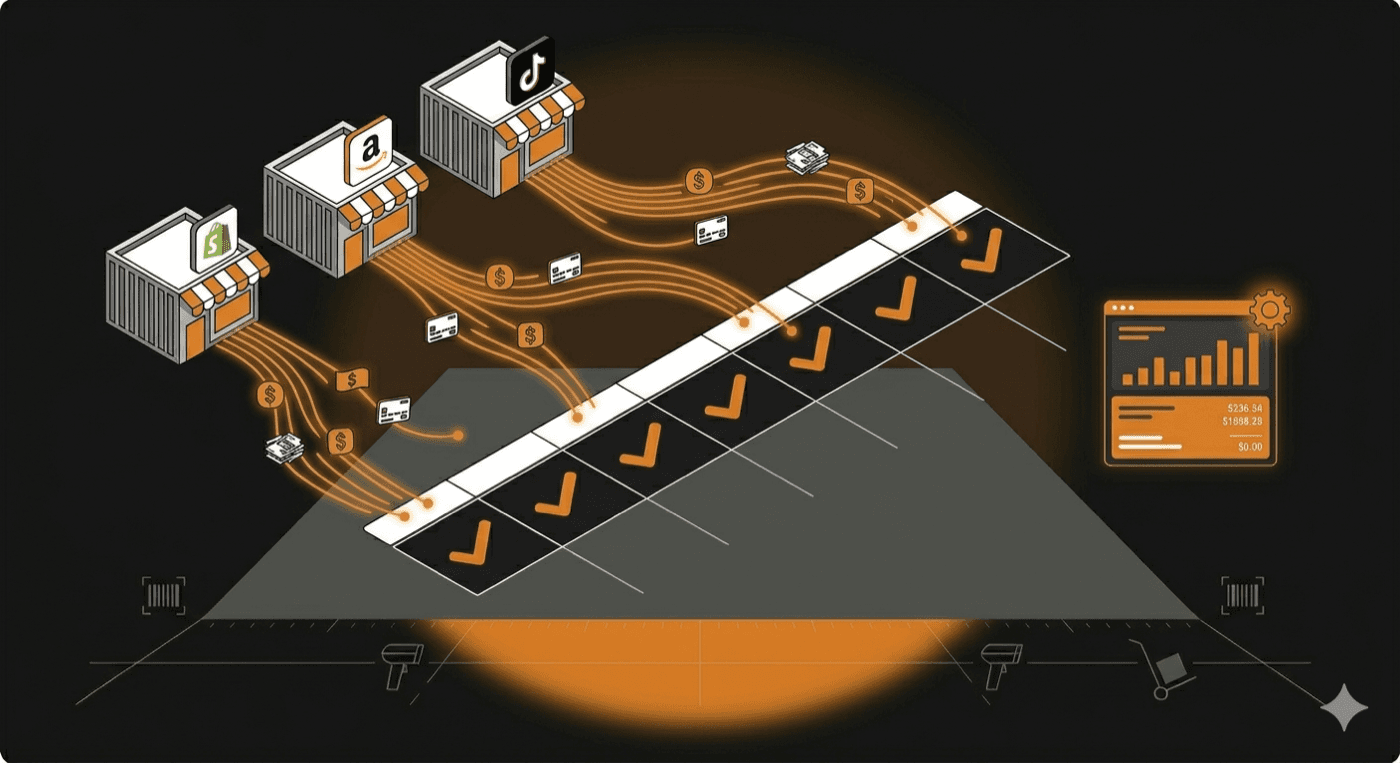
That gap between revenue confidence and financial clarity is where ecommerce bookkeeping lives. It is the system that turns raw transaction data from Shopify, Amazon, TikTok Shop, and payment processors into organized records. When bookkeeping works well, founders make better purchasing decisions, file taxes without panic, and spot margin problems before they become cash crises. When it falls behind, every financial decision becomes a guess.
This guide covers how ecommerce bookkeeping differs from standard small business accounting, the specific challenges that trip up online operators and sellers, and a practical framework for keeping books current without hiring a finance team. It is part of our complete guide to ecommerce accounting.
What Makes Ecommerce Bookkeeping Different
Traditional bookkeeping follows a predictable pattern: invoices go out, payments come in, expenses get recorded. Ecommerce adds layers of complexity that most accounting systems were not designed to handle.
A single Amazon order can generate five or six distinct financial events: the customer payment, the platform fee, the FBA fulfillment charge, the referral fee, the shipping cost, and (eventually) a possible return or chargeback. Multiply that across hundreds of daily orders on two or three channels, and the transaction volume alone can overwhelm a manual process.
Three characteristics make ecommerce bookkeeping distinct from traditional retail or service-based accounting:
- Multi-channel sales data. Revenue arrives from different platforms with different fee structures, payout schedules, and reporting formats. Shopify settles in two days. Amazon holds funds for two weeks. TikTok Shop pays out on its own schedule with its own commission structure. Each channel calculates fees differently, and our ecommerce fee calculators show what each one takes per order.
- Inventory as a financial asset. For product-based businesses, inventory turnover directly affects both the balance sheet and cash flow. Unsold inventory ties up capital. Damaged inventory creates write-offs. Tracking COGS accurately requires knowing the landed cost of every SKU.
- High return and refund rates. Online return rates average roughly 15% to 20%, with apparel running 25% or higher, compared to 8% to 10% for brick-and-mortar retail. Each return reverses part of the original transaction and may involve restocking fees, return shipping costs, or inventory that cannot be resold.
Newer channels add their own wrinkles. TikTok Shop, for example, bundles commissions, shipping subsidies, and promotional deductions into a single settlement. A viral product video can generate hundreds of orders in a day, each with a different effective commission rate depending on which promotion was active. Operators and sellers who go from 10 orders a day to 500 overnight rarely have bookkeeping systems that can absorb that spike. For more on how sudden sales surges create financial chaos, see our post on why a viral TikTok Shop moment is a cash flow event.
These factors mean ecommerce operators and sellers deal with three to five times more financial transactions per dollar of revenue than a typical service business. Without a system designed for that volume, books fall behind fast.
Why Ecommerce Books Fall Behind (and What It Costs)
The most common complaint from ecommerce founders is not that bookkeeping is hard. It is that bookkeeping is always behind. Monthly reconciliation becomes quarterly catch-up, which becomes a frantic scramble at tax time.
This happens because of a structural mismatch. Ecommerce generates transaction data continuously, but most operators and sellers still approach bookkeeping as a periodic task. They download a CSV from Shopify at month-end, sort through Amazon settlement reports and TikTok Shop transaction summaries, and try to match everything to bank deposits. By the time the picture comes together, the data is already weeks old.
The cost of falling behind goes beyond filing stress. Late books create three specific problems:
Invisible margin erosion. Platform fees, shipping surcharges, and advertising costs can shift week to week. An operator or seller running 25% gross margins in January might be running 18% by March without realizing it, because ad costs crept up while the books sat untouched. By the time the quarterly P&L reveals the problem, thousands of dollars have already leaked.
Cash flow surprises. Ecommerce cash flow is notoriously lumpy. Inventory purchases happen in large batches weeks before the resulting revenue arrives. Without current books, operators and sellers cannot see the timing gap between cash going out and cash coming back in. This is the scenario that leads to "profitable on paper, broke in reality," a pattern covered in detail in our post on cash flow vs. profitability.
Tax exposure. Sales tax obligations multiply with every new state or jurisdiction where an operator or seller has nexus. The burden falls hardest on direct channels: Amazon, eBay, and TikTok Shop act as marketplace facilitators and collect and remit sales tax on the orders they process, but a standalone Shopify store gets no such coverage, so those sales carry the full nexus tracking and remittance responsibility. Falling behind on bookkeeping makes it easy to miss nexus thresholds, underreport liabilities, or fail to remit on time. The penalties are real: most states charge 5% to 25% of the unpaid balance, plus interest.
The Ecommerce Chart of Accounts
A chart of accounts is the backbone of any bookkeeping system. It defines the categories where every transaction gets recorded. For ecommerce, the standard chart of accounts needs modification to capture the financial flows unique to online selling.
Here is a simplified structure that works for most ecommerce businesses doing $50K to $5M in annual revenue:
Revenue Accounts
- Product Sales (by channel). Separate accounts for Shopify, Amazon, TikTok Shop, wholesale, and any other channel. This makes it possible to measure profitability by channel without running custom reports.
- Shipping Revenue. If charging customers for shipping, track it separately from product revenue. It affects margin calculations.
- Returns and Refunds. A contra-revenue account that offsets gross sales. Tracking net revenue requires knowing how much comes back.
Cost of Goods Sold
- Product Cost (Landed). The purchase price of goods plus freight, duties, and customs fees. Landed cost is the only honest way to calculate product margins.
Fulfillment and Selling Fees
- Platform Fees. Amazon referral fees, Shopify transaction fees, payment processing charges. These are direct costs of making a sale, but they are selling expenses, not product costs, so they belong in their own tier below COGS, matching the format in our ecommerce P&L template.
- Fulfillment Costs. FBA fees, third-party logistics charges, pick-and-pack costs. Whether an operator or seller fulfills in-house or uses a service, these costs belong in this tier, not in COGS.
- Shipping Costs (Outbound). The actual cost of getting product to the customer.
Operating Expenses
- Advertising and Marketing. Ad spend by platform (Google, Meta, Amazon PPC, TikTok Ads), influencer costs, and promotional expenses.
- Software and Tools. Inventory management, listing tools, analytics platforms, accounting software.
- Warehouse and Storage. Rent, utilities, and supplies for in-house fulfillment. FBA storage fees for Amazon sellers.
- Returns Processing. The cost of handling returns, including return shipping labels, restocking labor, and inventory losses.
This structure gives operators and sellers visibility into their true cost per order, channel-level profitability, and the real margin on each product category. For a step-by-step method to use this data for SKU-level decisions, see our guide to product profitability analysis.
Accrual vs. Cash Basis: Which Method Fits
The choice between accrual accounting and cash basis accounting matters more for ecommerce than for most other business types, because the timing gaps between ordering inventory, receiving it, selling it, and getting paid are so large.
Cash basis records revenue when money arrives in the bank and expenses when money leaves. It is simpler and works fine for very small operators and sellers. But it creates distortions: a $30,000 inventory purchase in October will make that month look terrible, while November (when sales from that inventory land) looks artificially profitable.
Accrual basis records revenue when earned and expenses when incurred, regardless of when cash moves. This matches costs to the revenue they generate, producing a more accurate picture of profitability over time. For our breakdown of how this choice plays out across business models, see accrual vs. cash basis for SaaS and ecommerce.
For most ecommerce operators and sellers doing over $100K in annual revenue, accrual basis is the better choice. It aligns inventory costs with the sales they support, prevents month-to-month volatility from distorting margins, and prepares the business for growth (investors and lenders expect accrual-basis financials).
The practical challenge is that accrual accounting requires more discipline. Revenue needs to be recognized at the point of sale, not when the payout settles. COGS needs to be matched to units sold, not recorded when inventory is purchased. This is where most manual bookkeeping processes break down, and where automation becomes worth the investment.
The Daily Close: A Better Model for Ecommerce
The traditional model of monthly bookkeeping was designed for businesses with predictable, low-volume transactions. Ecommerce does not fit that model.
A daily close process means transactions are categorized, matched, and reconciled every day (or close to it). This does not mean a founder needs to spend an hour each morning in a spreadsheet. It means the systems and automation are in place to keep books current without manual effort piling up.
The benefits of closing books daily instead of monthly:
- Margin visibility in real time. When a supplier raises prices or a platform increases fees, the impact shows up within days, not after the quarter closes.
- Faster decision-making. Operators and sellers can adjust ad spend, reorder quantities, and pricing based on actual profitability data, not last month's numbers.
- Simpler reconciliation. Matching 30 transactions is manageable. Matching 3,000 at month-end is a project.
- Reduced error rates. Discrepancies between platform payouts and bank deposits are easier to catch and resolve when they are only a day old.
The daily close works best when transaction data flows automatically from sales channels and bank accounts into the bookkeeping system. Manual data entry at scale is not a bookkeeping strategy; it is a bottleneck.
Common Ecommerce Bookkeeping Mistakes
Even operators and sellers who take bookkeeping seriously make errors that compound over time. These are the five most frequent problems that show up when ecommerce books are finally reviewed by an accountant or tax professional.
Mixing personal and business expenses. This is the most basic error and the most damaging. Commingled accounts make it impossible to calculate real business profitability and create audit risk. Every ecommerce business needs a dedicated business bank account and credit card from day one.
Ignoring sales tax obligations. Economic nexus rules have expanded rapidly. An operator or seller shipping into 20 states may have sales tax obligations in 10 or more of them. Failing to track, collect, and remit sales tax creates a growing liability that does not go away.
Recording gross revenue instead of net. Amazon and TikTok Shop both deposit net of fees into seller accounts. Some operators and sellers record the deposit amount as revenue, losing visibility into the fees being charged. Always record gross revenue and fees separately. The difference matters for margin analysis and tax reporting.
Not tracking inventory accurately. When inventory records do not match physical counts, COGS calculations become unreliable. This affects reported profit, tax liability, and purchasing decisions. Regular inventory counts (monthly at minimum) should reconcile with the bookkeeping system.
Treating marketplace payouts as revenue. An Amazon or TikTok Shop payout is not revenue. It is a net settlement that includes revenue minus fees, refunds, promotional deductions, and other adjustments. Each component needs to be broken out and recorded in the correct account.
How to Choose an Ecommerce Bookkeeping Solution
The right bookkeeping approach depends on transaction volume, channel complexity, and how the founder wants to spend their time. There are three tiers to consider.
Spreadsheets and Manual Tracking
Works for operators and sellers under $50K in annual revenue with a single sales channel. The cost is low but the time investment grows linearly with transaction volume. Once an operator or seller processes more than 100 orders per month, manual tracking becomes the bottleneck that keeps books behind.
Traditional Accounting Software (Plus the Middleware Tax)
Tools like QuickBooks and Xero can handle ecommerce bookkeeping, but not out of the box. Neither platform knows how to parse an Amazon settlement report or break a TikTok Shop payout into gross revenue, commissions, and shipping deductions. To bridge that gap, most operators and sellers add a middleware connector like A2X, ConnectBooks, or Blue Onion. These tools pull transaction data from each sales channel, break it into the correct accounting entries, and push summarized journals into QuickBooks or Xero.
The middleware solves the data translation problem, but it adds cost, complexity, and another point of failure. A2X runs roughly $30 to $100 per month per channel (pricing changes, so check current plans). ConnectBooks starts around $49 per month. Blue Onion charges based on order volume. An operator or seller on Shopify and Amazon with a QuickBooks subscription, a middleware connector for each channel, and a bookkeeper to review everything can easily spend $700 to $2,500 per month before the books are even closed. And the books still close monthly, not daily, because the middleware syncs on a schedule and someone still needs to review the output.
For a fuller breakdown of how these stacks get assembled and what each layer costs, see our guide to ecommerce accounting software.
The middleware layer also creates dependency risk. When a platform changes its payout format (Amazon does this regularly), the connector needs to update its mapping. If it lags behind, transactions import incorrectly or fail to import at all, and the operator or seller may not notice until reconciliation reveals a gap weeks later.
AI-Powered Bookkeeping
The alternative to the QuickBooks-plus-middleware stack is a platform built for ecommerce from the start. AI-based bookkeeping tools categorize transactions automatically, match payouts to orders, and flag discrepancies without manual intervention. There is no middleware layer to configure, no journal mapping to maintain, and no scheduled sync to wait on. The best ones learn from corrections, handle multi-channel complexity natively, and close books daily rather than monthly.
This is the approach Futureproof runs for ecommerce operators and sellers. Transactions from connected sales channels and bank accounts are categorized in real time using AI, so founders get a current P&L and cash position without waiting for month-end reconciliation. The full AI finance team is $1,000 per month flat, replacing the $700-to-$2,500 monthly stack of accounting software, middleware connectors, bookkeeper review, and separate analytics tools that most operators and sellers cobble together. If you are weighing the options in this category side by side, see Futureproof vs. Finaloop and Futureproof vs. Sellerboard.
Building a Bookkeeping Routine That Scales
Regardless of the tools chosen, every ecommerce operator and seller needs a rhythm for financial review. Here is a practical cadence that keeps books clean without consuming the founder's week.
Daily (automated). Transactions flow from sales channels and banks into the bookkeeping system. AI or rules-based categorization handles 80% to 95% of entries without manual input.
Weekly (15 minutes). Review uncategorized transactions, check that platform payouts match expected amounts, and flag any unusual expenses. This is also a good time to glance at the gross margin trend to catch any shifts early.
Monthly (1 hour). Reconcile all bank and credit card accounts. Review the P&L by channel. Confirm inventory records match COGS entries. Check sales tax collection against obligations.
Quarterly (2 hours). Run a full margin analysis by product category and channel. Review year-to-date performance against budget. Prepare for estimated tax payments. Assess whether the current bookkeeping approach still fits the business's growth rate.
This rhythm keeps books closed, not just open. The difference between an operator or seller who reviews finances weekly and one who catches up quarterly is not knowledge. It is timing. The weekly reviewer spots a margin problem in February and adjusts. The quarterly reviewer discovers the same problem in April and absorbs the loss.
Moving from Bookkeeping to Financial Clarity
Accurate bookkeeping is the foundation, but it is not the finish line. The real value comes when clean financial data feeds into decisions about inventory purchasing, advertising budgets, pricing changes, and growth planning.
Ecommerce operators and sellers who keep current books can answer questions that their competitors cannot: Which products earn the highest margin after all fees? Which channel is most profitable per order? How much cash is needed to fund the next inventory cycle? What is the breakeven point for a new product launch?
These are not accounting questions. They are business questions that require accounting data. And the answers are only useful when the data is current.
For a deeper look at the metrics your bookkeeping should feed, see our guide to ecommerce KPIs and the financial dashboard you actually need.
FAQ
What is ecommerce bookkeeping?
Ecommerce bookkeeping is the practice of recording and organizing every financial event an online business generates, including sales, platform fees, fulfillment costs, refunds, and inventory purchases, across every channel it sells on. It differs from standard small business bookkeeping because a single order can produce five or six separate financial events that arrive on different platform schedules.
How much does ecommerce bookkeeping cost?
It depends on how the work is assembled. A typical stack of accounting software, a middleware connector per sales channel, and a bookkeeper to review the output runs roughly $700 to $2,500 per month, with connectors alone in the $30 to $100 per channel range. Spreadsheets cost nothing but consume founder hours that grow with order volume. Futureproof is $1,000 per month flat for the full AI finance team, including a monthly review call with a human financial specialist.
Should ecommerce businesses use cash or accrual accounting?
Accrual, for most operators and sellers above roughly $100K in annual revenue. Accrual matches inventory costs to the sales they support, which keeps a large purchase in one month from making that month look unprofitable and the next look inflated. Very small sellers on a single channel can start on cash basis and switch later.
How often should ecommerce books be closed?
Daily, or as close to daily as the systems allow. Ecommerce generates transactions continuously, so a monthly close means fee changes, margin erosion, and payout discrepancies sit undetected for weeks. Reconciling 30 transactions a day is routine work; reconciling 3,000 at month end is a project.
For operators and sellers ready to move beyond catch-up bookkeeping and into real-time financial visibility, start your 14-day trial or book a demo and close books daily, not monthly, so the numbers are ready when the decisions need to be made.