


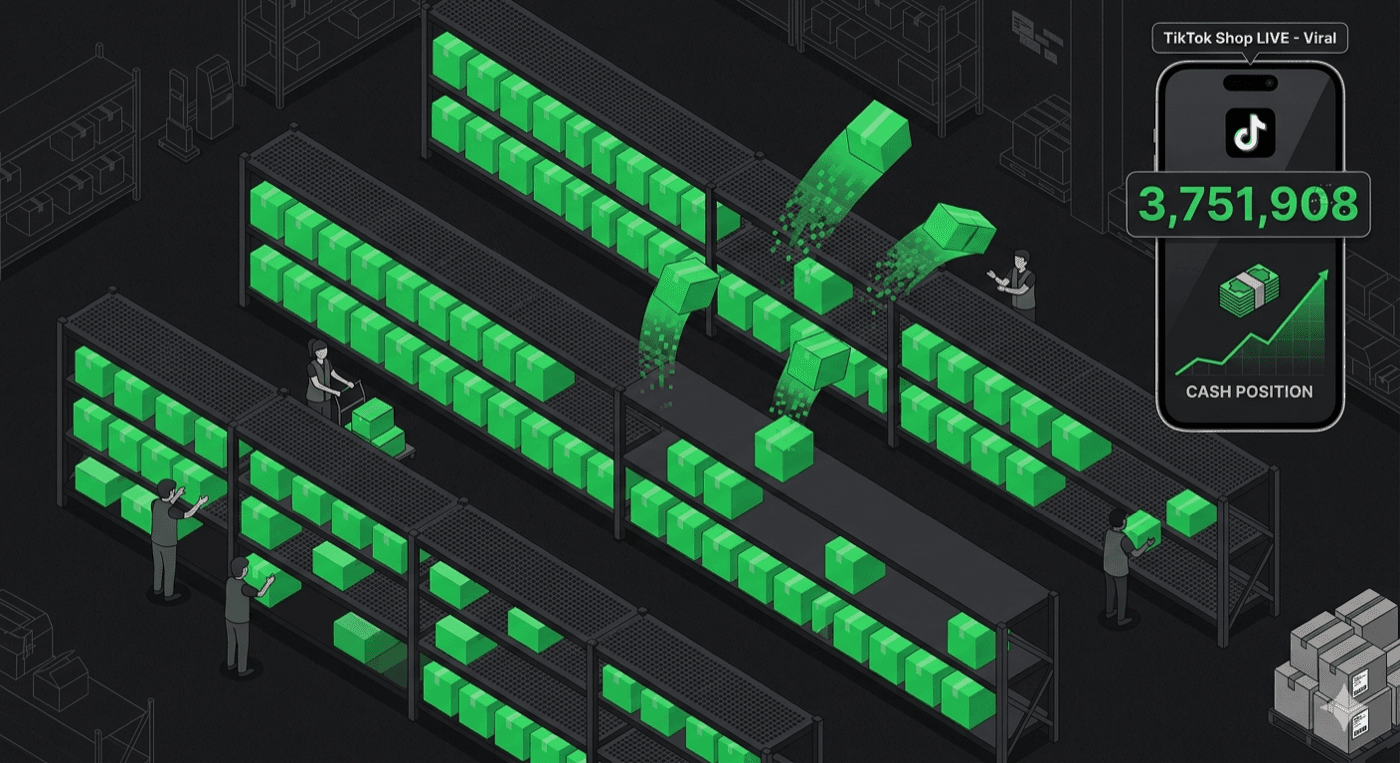
An operator posts a video on a Tuesday afternoon. Nothing special about the setup. Good lighting, a clean demo, a hook that lands. By Wednesday morning the video has 400,000 views and orders are coming in at 15x normal velocity. The product page is converting at rates the operator has never seen.
By Thursday, inventory is gone. Sold out. The video is still circulating. The algorithm is still pushing it. Orders are still coming in, but there's nothing to ship. The operator scrambles to place an emergency reorder with their supplier. The supplier needs three weeks and 50% upfront.
The operator doesn't have the cash.
Not because the business isn't working. The revenue from the spike hasn't settled yet. TikTok payouts take days to process. The money is earned but not available. The reorder needs to happen now. The cash to fund it arrives later.
The moment passes. The ranking drops. The algorithm moves on to the next product. It never gives this one another look.
That operator didn't lose because the product was bad. They lost because they weren't financially ready for their own success.
The Math Most Operators Skip
Most TikTok Shop operators track views, conversion rates, and daily revenue. Very few map the cash flow sequence of what happens when a product takes off. Here's what that sequence looks like with real numbers.
Normal velocity: 20 units per day at a $35 average order value. That's $700 per day in revenue.
Viral spike: 10x for five days. 200 units per day. $7,000 per day. $35,000 across the spike.
Starting inventory: 300 units. At spike velocity, that stock is gone in a day and a half.
Reorder needed: 1,000 units to ride the extended tail of the video's reach and the follow-on traffic it generates.
Reorder cost at $12 COGS: $12,000 total. Most suppliers want at least 50% upfront on a rush order: $6,000 due today, the remaining $6,000 due at shipment.
TikTok payout timeline: 7 to 15 days after sale settlement. That first wave of spike revenue won't hit your bank account for at least a week, possibly two.
The gap: You need $6,000 today and the other $6,000 within three weeks, when the goods ship. Your spike revenue starts arriving in one to two weeks. The deposit deadline and the cash arrival don't line up.
That gap is the cash flow event. The revenue looks great on a dashboard. But the cash position tells a different story. You're profitable on paper and broke in practice, at the exact moment when speed matters most.
Most operators feel this gap but have never put numbers to it. They experience it as stress, as a scramble, as a near-miss. Mapping it out in advance turns a panic moment into a planning exercise.
And the example above is generous. It assumes a single SKU, a single supplier, and a clean reorder process. Operators running multiple trending products or sourcing from overseas factories with longer lead times face wider gaps and higher capital requirements. The more products you have in rotation, the more exposed you are to a spike on any one of them catching you underfunded.
Why Safety Stock Math Is Different on TikTok
On Amazon or Shopify, demand is relatively predictable. You can model reorder points from historical velocity with reasonable accuracy. If you're selling 20 units a day and your supplier lead time is 21 days, your lead-time demand is roughly 420 units. That's the base of your reorder point; safety stock is the extra layer you add on top of it. Standard days inventory outstanding calculations work because the inputs stay stable week to week.
TikTok breaks that model.
Demand on TikTok is algorithmically driven and non-linear. A product can go from 20 units a day to 200 overnight with no warning. There's no seasonality curve to model. No gradual ramp. The algorithm either picks you up or it doesn't, and when it does, the demand spike is sudden and steep.
Standard safety stock formulas are built on average daily sales and standard deviation. They assume demand follows a somewhat predictable distribution. On TikTok, the distribution has a fat tail that those formulas don't account for. You're not planning for a 20% increase in orders. You're planning for a 500% or 1,000% increase that lasts three to seven days.
The input that matters isn't your baseline velocity. It's your expected spike multiplier. Look at your category. Look at your past video performance. If your best-performing video drove a 5x increase, plan for 8x to 10x on your next breakout. If you've never had a spike, look at comparable operators in your category and use their spikes as a proxy.
Then calculate your working capital needs against that multiplier, not against your average daily sales. The EOQ formula gets you to the right reorder quantity for steady-state operations. But it won't save you when the algorithm decides your product is the one everyone needs to see this week.
There's another wrinkle that makes TikTok different from catalog-based platforms. On Amazon, a stockout hurts your ranking but the demand doesn't vanish. Customers search for the product again tomorrow. On TikTok, the demand is driven by a specific video at a specific moment. When you stock out, the video keeps getting views, but customers see "out of stock" and scroll past. The algorithm reads that as declining engagement. By the time you're back in stock, the video's momentum is gone. There is no second chance at the same spike. The cost of a stockout on TikTok isn't lost sales for a few days. It's a permanently missed demand window.
The Working Capital Question Nobody Asks Before They Go Viral
Every TikTok operator asks the same question: what do I need to do to go viral?
Better hooks. Better lighting. Trending sounds. Post at the right time. All of it matters. None of it matters if you can't fulfill the orders when the answer is yes.
The right question is: what do I need to have ready for when I do?
Three things determine whether a viral moment becomes a business-changing event or a missed opportunity.
Cash reserves or credit access. How much capital can you deploy within 48 hours of a spike? If your entire working capital position is tied up in existing inventory and you have no credit line, a spike actually puts you in a worse position than steady-state selling. You sell through your stock, can't reorder fast enough, and lose the organic momentum the algorithm was building for you.
Supplier relationship and lead time. Do you have a supplier who can turn around an emergency PO in under two weeks? Have you had that conversation with them before you need it? Operators who negotiate rush-order terms in advance (even at a slightly higher per-unit cost) are buying optionality. That conversation costs nothing when demand is normal and is worth thousands when demand spikes. Some operators maintain relationships with two suppliers: a primary for standard orders and a secondary (often domestic) who can ship faster at higher cost. That secondary supplier isn't a backup. It's a spike response plan.
Payout gap awareness. Do you know your cash conversion cycle on TikTok Shop? From the moment a sale is made to the moment cash hits your bank account, how many days elapse? Factor in TikTok's settlement schedule, your payment processor, and your bank's clearing time. That number is the minimum bridge period you need to fund from existing reserves or credit.
These aren't exciting questions. They don't make good content for a TikTok video about growing your brand. But they're the questions that separate operators who scale from operators who had one good week and then went back to baseline.
Most operators treat these as problems to solve after a spike happens. The operators who build real margin treat them as infrastructure they put in place while things are calm. A credit line is easier to secure when your financials look stable. A supplier conversation is easier to have when you're not placing an emergency order. Everything about cash flow preparation works better when you're not in the middle of a crisis.
One Thing to Do Before Your Next Video Goes Live
Not after. Before.
Calculate your spike threshold. The formula is simple.
Spike threshold (in days) = Current inventory / Expected spike daily velocity
If you're carrying 300 units and your expected spike velocity is 200 units per day, your spike threshold is 1.5 days. That means a viral moment burns through your entire stock in 36 hours.
If that number is less than seven, you're exposed.
Seven days is the minimum buffer. It gives you enough time to identify the spike (day one), confirm it's sustained and not a one-day blip (day two), place an emergency reorder with your supplier (day three), and have that supplier begin production or pull from their own stock before your inventory hits zero.
Less than seven days and you're hoping the spike doesn't last. That's not a plan. That's a bet.
Here's what adjusting for it looks like in practice. If your spike threshold is 1.5 days and you want it to be seven, you need to carry enough inventory to cover 1,400 units at spike velocity (200 units times 7 days). At $12 COGS, that's $16,800 in inventory. That might feel like a lot of capital to tie up. But compare it to the alternative: a viral moment that drives $35,000 or more in potential revenue, and you capture only about $10,500 of it in gross sales, your 300 units at $35, because you stocked out on day two. Less still once fees come out.
The math isn't complicated. The discipline to run it before you need it is the hard part.
Going Viral Is a Cash Management Problem
There's no dramatic reframe needed here. The pattern is straightforward.
A viral spike depletes inventory. Replenishing inventory requires cash. The cash from the spike hasn't settled yet. The operators who capture the full value of that moment are the ones who had the inventory depth and the financial position to bridge the gap.
The operators who build real businesses on TikTok Shop aren't the ones with the best products or the most views. They're the ones who had the inventory and the cash ready when the algorithm gave them their shot. Everyone else watches the moment pass and wonders what went wrong.
Run the spike threshold calculation. Know your cash conversion cycle. Have the supplier conversation. Do it this week, while demand is normal and the math is calm. The worst time to think about cash flow is when the orders are already flooding in.
Futureproof tracks your inventory value and cash position in real time across TikTok Shop and your other channels. When a spike hits, you'll know exactly how many days of stock you have and what a reorder costs against your current cash balance. Start your 14-day trial.