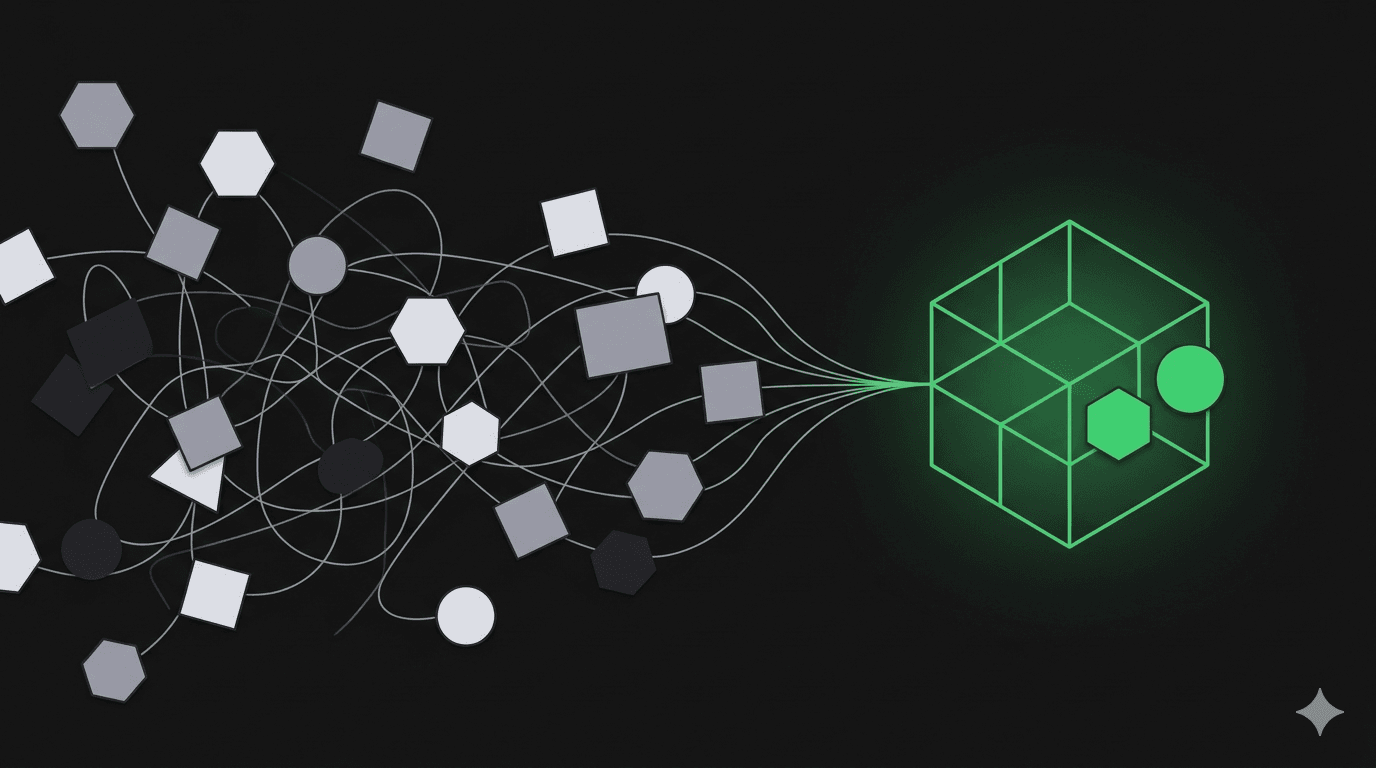



It is 11pm the night before the board meeting. Three browser tabs are open: QuickBooks, the forecasting spreadsheet, and Carta. The MRR number on the dashboard does not match the revenue line in the model. The model does not match the slide deck a co-founder updated last Tuesday. Somewhere, a SAFE that closed two weeks ago is missing from the cap table. The board update is due in nine hours.
This is not a finance problem. It is an integration problem. And the integration layer is the founder.
Software was supposed to handle this. Bookkeeping platforms record transactions. Forecasting tools project the future. Cap table services track ownership. Each one does its job. The trouble is that none of them talk to each other, which means someone has to move numbers between them, reconcile when they disagree, and make sure the version in the board deck matches the version in the bank. At early-stage startups, that someone is almost always the founder.
The fix is not more tools. It is a stack that does not require a human in the middle.
What "Human API" Means in a Finance Context
In software architecture, an API is the connector between two systems. It moves data, translates formats, and handles the cases where one system expects something the other does not provide. Engineering teams build APIs because manual data movement at any scale is too slow and too error-prone to be reliable.
Founders without a finance team end up doing this work by hand. The bank feed says one thing. The forecast says another. The cap table is two rounds out of date. The board deck pulls from a fourth source that someone updated last Tuesday. Every system needs to be kept current, and every divergence has to be resolved. That is API work. The difference is that the human version runs on weekends, breaks under cognitive load, and produces stale outputs by the time it finishes.
The label is not metaphorical hyperbole. It describes a specific operational pattern that pre-seed through Series A founders fall into by default. Recognizing the pattern is the first step to dismantling it.
There is a deeper layer worth naming. Software replaced the artifacts of finance, not the roles. Spreadsheets replaced the paper ledger. QuickBooks replaced the bookkeeper's filing cabinet. Carta replaced the cap table spreadsheet. None of these tools replaced the person operating them. The bookkeeper, the AR clerk, the FP&A analyst, the controller, the IR lead. Those roles still exist, and at early-stage startups, the founder is performing all of them at once.
The Three Failure Modes
Acting as the integration layer creates three categories of damage. Each looks small in isolation. Stacked together, they consume a workday a week and degrade the quality of every financial decision the company makes.
The Data Entry Tax
Categorizing transactions in QuickBooks. Logging a new SAFE on the cap table after a round. Updating headcount in the model when a hire signs. Reconciling Stripe payouts against the bank statement. Copying actuals from the P&L into the forecasting spreadsheet so the model reflects last month.
None of these tasks produce new information. They move information that already exists from one place to another. A pre-seed founder might spend four hours a week on this. By seed, with more transactions and a more complex cap table, the number is closer to six or eight. By Series A, founders who have not consolidated are spending the equivalent of a part-time finance role on data movement that should be automatic.
The cost is not the time alone. It is what the founder is not doing during those hours. Every hour spent re-entering invoice data is an hour not spent on customer development, product roadmap, or the next raise.
Reconciliation Drift
Three numbers exist for the same metric, and none of them agree. The bookkeeper closed last month and reported burn of $187K. The forecasting model, pulling from a slightly older export, shows $194K. The number in the founder's head, from a quick look at the bank account, is closer to $210K because two large vendor invoices hit after the close.
This is reconciliation drift. Each system is internally consistent. None of them are consistent with the others. The drift is small enough to ignore for a week, then a month, then a quarter, until a board meeting forces a hard reconciliation and the founder discovers that decisions over the prior 60 days were made on numbers that were already wrong when they were quoted.
The compounding effect is what causes real damage. Investors notice when the runway figure in the board deck does not match the figure in the data room. The CFO at a future Series A lead notices when the financial model and the historical P&L tell different stories about the same period. By the time someone catches the divergence, the trust cost is paid.
Decision Lag
The data exists. It just is not connected. A late vendor invoice arrives in the inbox on Monday. It should immediately update the burn calculation, the cash runway projection, and the next forecast revision. Instead it sits in the inbox until Friday, when the founder catches up on bookkeeping. The forecast does not refresh until the following Monday's planning session, which means the company spent a full week making hiring and spending decisions on numbers that were already a week behind reality.
Decision lag is the most expensive of the three failure modes because the cost is invisible. There is no line item for "decisions made on stale data." The damage shows up later as the hire that should not have been made, the contract that should have been pushed, or the runway that turned out to be six weeks shorter than the founder believed when they signed the lease.
The Real Cost: Time, Accuracy, and Trust
The data entry tax has a measurable cost. Six hours a week of founder time, multiplied by 52 weeks, is more than a month of founder capacity per year spent on tasks that any modern system should handle automatically. At a pre-seed valuation, that month is worth more than a small finance hire would cost.
The accuracy cost is harder to quantify but easier to feel. Founders who run the integration layer themselves develop a quiet uncertainty about their own numbers. The forecast might be right. It probably is. But the last time someone reconciled it against actuals was three weeks ago, and a few things have changed since then. That uncertainty leaks into every decision that depends on the number.
The fundraising cost is the one founders feel most acutely when it lands. Investors read across documents. They notice when the burn rate cited in the deck does not match the burn rate implied by the model. They notice when the headcount in the cap table does not match the headcount in the operating plan. They are not trying to catch the founder. They are doing diligence. Every divergence they find raises a question, and every question slows the round.
A founder who can pull a clean number on demand, from a single source, signals operational maturity. A founder who has to caveat every figure because the underlying systems disagree signals the opposite, regardless of how strong the underlying business is.
A Connected Stack Is Not Enough. Hand the Role Off.
The intuitive next move is to consolidate. Replace five disconnected tools with one connected platform. The reconciliation work goes away. The numbers stay in sync. The board deck pulls from the same source as the investor update.
This helps. It does not solve the problem.
A connected stack still needs an operator. Someone has to categorize the unusual transaction. Someone has to chase the late invoice. Someone has to update the forecast when a hire is signed. Someone has to draft the monthly investor letter. Better tools shorten the list of tasks. They do not eliminate the role.
The real shift is from "I do the work" to "an agent does the work, and shows me what changed." That is what Futureproof was built around. The platform is staffed by six AI agents, each owning a specific finance role end-to-end. The founder reviews and approves. The work itself happens in the background.
- Vic runs bookkeeping. Daily reconciliation, transaction categorization, and month-end close. The books are accurate every day, not three weeks after the period ends.
- Remi runs accounts receivable. Invoices go out on time, dunning sequences run automatically, and Remi learns when each customer actually pays so reminders land at the right moment.
- Theo runs accounts payable. Vendor bills get captured, coded, and scheduled against runway, not against whoever asks loudest.
- Margo runs FP&A. Forecasts, runway projections, and scenario modeling on demand. Ask what hiring two AEs in May does to the next eighteen months and get an answer in seconds.
- Hugo runs metrics. MRR, ARR, NRR, CAC, LTV, payback for SaaS. CAC by channel, ROAS, AOV, and cohort LTV for ecommerce. Channel-level attribution that flags when the cost of acquisition shifts before the founder notices on the bank statement.
- Nia runs investor relations. The cap table stays clean through SAFE conversions and option grants. The data room stays current. Monthly investor updates and board deck drafts arrive ready for the founder's sign-off.
The integration problem dissolves at this layer. The work is not moving between tools because the agents own the work end-to-end. The founder is not the API. The agents are the team.
Which Role to Stop Playing First, by Stage
The damage pattern is the same at every stage. The role that costs the founder the most to keep performing is not.
Pre-Seed
At pre-seed, transaction volume is low and complexity is manageable, but the founder has the least margin for non-product work. The role bleeding the most hours is the bookkeeper. Every hour spent categorizing transactions is an hour not spent on the first ten customers.
Hand off bookkeeping first. Vic categorizes every bank and card transaction as it lands, reconciles Stripe payouts to the general ledger, and closes the books on a daily cadence rather than a monthly scramble. Founders who hand this role off recover four to six hours a week immediately and avoid building the manual habit that gets harder to break later.
Seed
By seed, the cap table is more complex (multiple SAFEs, early option grants), the forecast carries weight on hiring decisions, and the first real board meetings are happening. Two roles dominate at this stage: the FP&A analyst and the IR drafter.
Hand off FP&A. Margo turns scenario questions into answers without a Friday night spent in a spreadsheet. As fundraising approaches, hand off IR drafting. Nia keeps the cap table clean through SAFE conversions, prepares the data room, and turns the monthly update into a draft the founder edits rather than a document the founder builds from scratch. The board reporting workflow is the stress test. If preparing a board update takes more than a few hours, the founder is still performing the role.
Series A
At Series A, the company has real volume and the founder is no longer the only person looking at the numbers. Hires, vendor contracts, and customer commitments are happening fast enough that week-old data is not good enough. The roles that have to come off the founder's plate at this stage are the ones with the highest transaction volume: AR, AP, and metrics.
Remi runs receivables. Invoices go out, dunning runs, and the AR aging stays current without a weekly chase. Theo runs payables. Bills get scheduled against runway with early-pay discounts captured automatically. Hugo watches the numbers. When CAC moves on a paid channel, the alert lands before the next board meeting, not after. A founder who has handed off these three roles is in position to make a controller or VP Finance hire whose job is to manage the agents and the strategic work, not to inherit two years of accumulated reconciliation debt.
The Operating Question
The test for whether the finance function is working is not whether the tools are connected. It is whether the work is being done by someone (or something) other than the founder. When a SAFE closes, who updates the cap table and the runway? When a vendor invoice arrives, who reflects it in next week's cash flow view? When CAC moves on Meta, who flags it before the board meeting?
If the answer to any of these is "the founder, eventually, when there is time," the founder is still the API. Connected tools shorten the API. They do not remove it. Removing it requires handing the role off.
Futureproof replaces the first six finance hires with six AI agents at $1,000 a month flat. A finance team built from full-time hires costs $30,000 to $80,000 a year per role and takes weeks to recruit. Vic, Remi, Theo, Margo, Hugo, and Nia start tomorrow, work weekends without complaint, and surface what changed since the last time the founder looked. The numbers stay current because the agents are doing the work, not because someone is reconciling at midnight. That is the difference between running the software and being run by it.