


Run the textbook formula on a $6 million home goods brand and its cash is out for 98 days. The company is an example, with its numbers laid out below so each step can be checked. Add the factory deposits it pays before production and look at each channel separately, and this post's own adjustment for deposits gives 108 days overall and 140 days on wholesale, with about $920,000 tied up under these assumptions. The second set of numbers is the one to bring to a lender.
The cash conversion cycle is the number of days between paying for inventory and collecting the cash from selling it: days inventory outstanding plus days sales outstanding minus days payable outstanding. For a brand that pays suppliers ahead and sells through channels that pay on different timetables, the formula needs two adjustments, and the adjusted figure, stated in dollars, is what sizes a financing request.
The cash conversion cycle formula
CCC = DIO + DSO − DPO
- Days inventory outstanding (DIO): average inventory ÷ cost of goods sold × 365.
- Days sales outstanding (DSO): average receivables ÷ net sales × 365.
- Days payable outstanding (DPO): average payables ÷ cost of goods sold × 365.
Inventory and collections add days because cash is out of the business; payables subtract days because an unpaid supplier is funding part of the stock. The cash conversion cycle is the speed side of working capital, which the working capital blueprint covers as a balance.
Use average balances from the twelve month-ends, not the year's opening and closing figures. For a company with a fourth-quarter peak, both of those dates fall in the quiet season. In the example below, opening and closing inventory of $520,000 and $510,000 average $515,000 and a DIO of 70 days, while the twelve month-end balances average $740,000 and a DIO of 100. The two-point method would hide a month of the cycle.
A worked example: the standard formula
The example company, which is illustrative and not a benchmark, has $6.0 million in annual net sales and $2.7 million in cost of goods sold, a 55 percent gross margin. Half of sales come from its Shopify store, 35 percent from Amazon and 15 percent from wholesale accounts on net 30. It imports finished goods from one factory.
- Daily cost of goods sold: $2,700,000 ÷ 365 = $7,397.
- Daily net sales: $6,000,000 ÷ 365 = $16,438.
Days inventory outstanding
Month-end inventory, valued at landed cost, averages $740,000.
DIO = $740,000 ÷ $7,397 = 100 days.
Days sales outstanding
Consumers pay at checkout, but the money does not reach the bank at checkout. Shopify pays out a few days later, Amazon pays out on a settlement cycle, and wholesale buyers pay on terms. Each balance is a receivable until the cash arrives.
| Channel | Share of sales | Days from sale to bank (example) | Average balance owed |
|---|---|---|---|
| Shopify | 50% | 3 | $24,700 |
| Amazon | 35% | 14 | $80,500 |
| Wholesale (net 30, paid in about 45) | 15% | 45 | $111,000 |
| Total | 100% | $216,200 |
DSO = $216,200 ÷ $16,438 = 13 days.
Days payable outstanding
The company owes its 3PL and its packaging supplier on 30-day terms, and has earned 30 days from its forwarder; many forwarders want payment before they release the container. Those bills average $110,000 outstanding.
DPO = $110,000 ÷ $7,397 = 15 days.
CCC = 100 + 13 − 15 = 98 days.
What supplier deposits add to the cycle
The standard formula leaves out money paid to a supplier before the goods exist. This company pays a 30 percent deposit when it places an order and the 70 percent balance when the goods are loaded. It buys about $2.0 million a year from the factory, and production takes about 45 days.
Average deposits outstanding = $600,000 × 45 ÷ 365 = $74,000.
Days prepaid = $74,000 ÷ $7,397 = 10 days.
Adjusted cycle (this post's adjustment for deposits, not the standard metric) = 98 + 10 = 108 days.
Deposits sit on the balance sheet as a prepaid asset, outside inventory and outside payables, which is why the textbook formula misses them. There is a second gap if the books record stock only when it lands rather than once the company owns it in transit: the balance paid at loading, about $1.4 million a year paid roughly 30 days before arrival, adds about $115,000 and another 16 days under these assumptions. The factory deposit to payout walkthrough follows the same cash through one production run.
In dollars, the cycle ties up:
$740,000 inventory + $216,200 owed by channels and buyers + $74,000 in deposits − $110,000 owed to suppliers = $920,200.
If sales grow 30 percent and the adjusted cycle stays at 108 days, that gap grows roughly in line, to about $1.2 million. The extra $276,000 or so has to come from profit, a lender or a shorter cycle, which is how a company runs short of cash in a record year.
How channel mix changes the cycle
The blended DSO of 13 days hides where the days come from. Weighted by share of sales, Shopify contributes 1.5 days, Amazon 4.9 and wholesale 6.75: wholesale is 15 percent of sales and more than half of DSO. Running this post's deposit-adjusted formula by channel, with inventory, deposit and payables days held constant:
| Channel | DIO | Days prepaid | DSO | DPO | Adjusted cycle |
|---|---|---|---|---|---|
| Shopify (DTC) | 100 | 10 | 3 | 15 | 98 days |
| Amazon | 100 | 10 | 14 | 15 | 109 days |
| Wholesale | 100 | 10 | 45 | 15 | 140 days |
On Shopify, the store chooses part of its own DSO: Shopify Payments offers a daily, weekly or monthly payout schedule.
On Amazon, the cash from each sale is held until after the customer has received the order, and fees, refunds and advertising charges come out of the balance before it is paid out. Amazon can also hold part of the balance as a reserve, and that reserve can jump without warning, so forecast as if it might and count cash from the date it reaches the bank.
On wholesale, net 30 rarely means 30 days. Buyers in this example pay in about 45, and a buyer that takes deductions lengthens the cycle further, because the disputed amount arrives later or not at all.
The channel view changes growth decisions. A $500,000 wholesale order at an illustrative 35 percent wholesale margin, below the blended 55 percent because wholesale sells at a lower price, carries about $325,000 of cost. At an adjusted 140 days rather than 98, that cost is out six weeks longer than the same sales on Shopify, and the deductions come off the payment when it finally arrives. The order can be worth taking and still need financing.
Can a cash conversion cycle be negative?
Yes, when customers pay before suppliers do. A company that holds 30 days of stock, receives its Shopify payout in 2 days and pays its supplier on net 60 runs 30 + 2 − 60 = −28 days. Preorders and prepaid subscriptions can do the same for a run or a season, but that cash is settled by shipping the goods, or refunded if orders cancel, so treat it as committed to the cost of filling those orders rather than spare.
How to shorten the cash conversion cycle
At this company, one day of inventory or payables is worth about $7,400, and one day of wholesale collections about $2,500.
Supplier payment terms
Supplier terms are usually the largest lever for an importer. If the factory takes the 70 percent balance 30 days after the goods arrive rather than at loading, with a 30-day crossing, the company pays that balance 60 days later. On $1.4 million a year of balance payments, that holds about $230,000 more cash on average ($1,400,000 × 60 ÷ 365) and adds about 31 days to DPO, taking the adjusted cycle from 108 days to about 77. Cutting the deposit from 30 to 20 percent frees about $25,000 more.
Factories rarely give this on the first order, and the factory in this example may refuse it outright. Expect to earn it and to see it in the price. A couple of points on the unit cost for 60 more days can still be cheaper than any loan available at this size, so compare it as a rate. The guide on how to negotiate with suppliers covers what a factory looks at first.
Wholesale collections
Invoice on the day the order ships, follow up on the day an invoice goes past due, and ask for a deposit on large opening orders. Taking wholesale collections from 45 days to 35 frees about $24,700 and cuts blended DSO by 1.5 days. Early payment discounts work but cost more than they look: 2 percent for paying in 10 days instead of 30 is about 37 percent a year (2 ÷ 98 × 365 ÷ 20).
Payout timing
On Shopify, a daily payout schedule removes days that a weekly one adds. On Amazon, a seller can request a transfer of the available balance rather than wait for the next settlement, though cash Amazon is still holding stays held.
Slow stock
Stock that has not sold in six months is the easiest part of DIO to release, through a discount channel, a bundle or a liquidator, at a loss that is usually smaller than another year of carrying it. The guides to dead stock and inventory carrying cost cover both sides; how much stock to hold is an operations question for the ecommerce inventory management guide.
Together, better supplier terms and faster wholesale collections take this company's adjusted cycle from 108 days to about 76 and free roughly $255,000 at the same sales, if the factory agrees.
Why the adjusted cycle belongs in a financing conversation
A lender wants to know how long its money is out before it comes back, and how much the business needs to grow. The adjusted cycle answers the first, and in dollars it answers the second.
It also sets the shape of the financing. Money borrowed for inventory should be repaid from the sales of that inventory. A production loan due in 60 days against an adjusted 108-day cycle has to be repaid before the stock has paid it back, usually by borrowing again; a facility at least as long as the cycle, or one that advances against inventory and receivables as they turn, fits the cash better. Be careful with advances repaid as a share of daily sales: when stock runs short, the share keeps coming out of every sale while you wait for the next container, exactly when you need the cash. The guides to ecommerce financing options and inventory and PO financing match each funding type to its job.
Bring three things:
- The cycle by month for the last twelve months, adjusted for deposits.
- The cycle by channel, so the lender can see why growth in wholesale needs more cash than growth on Shopify.
- The dollar gap at today's sales and at next year's plan, which sizes the facility.
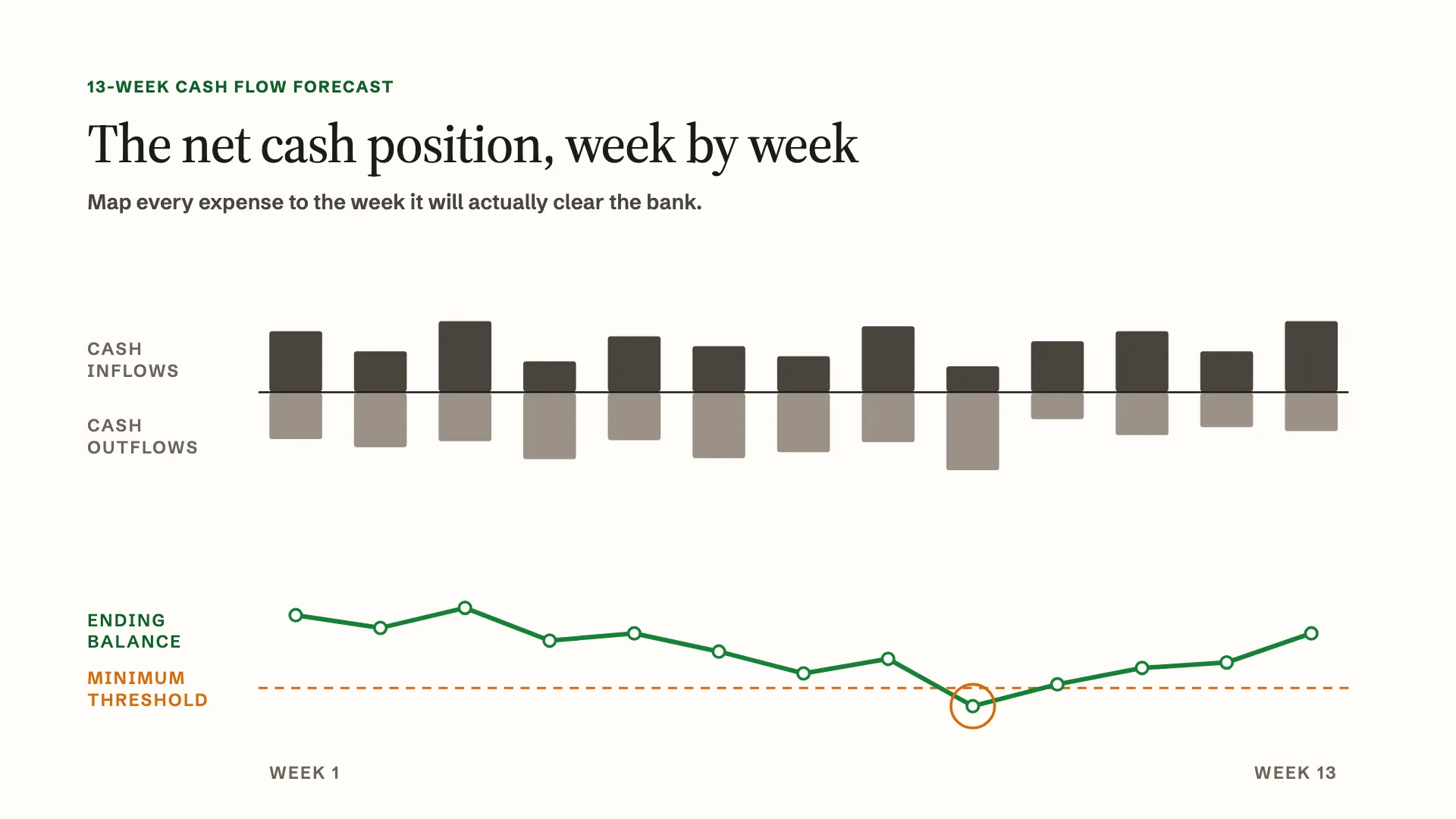
A 13-week cash flow forecast turns the same timing into weekly balances for the next quarter.
FAQ
What is a good cash conversion cycle for an ecommerce brand?
A good cash conversion cycle is shorter than last year's at the same time of year, and short enough that growth does not outrun available cash. The figure varies widely with sourcing, channel mix and terms, so a brand importing finished goods and selling wholesale runs a much longer cycle than a fast-turning store. Compare against your own history, month by month and channel by channel.