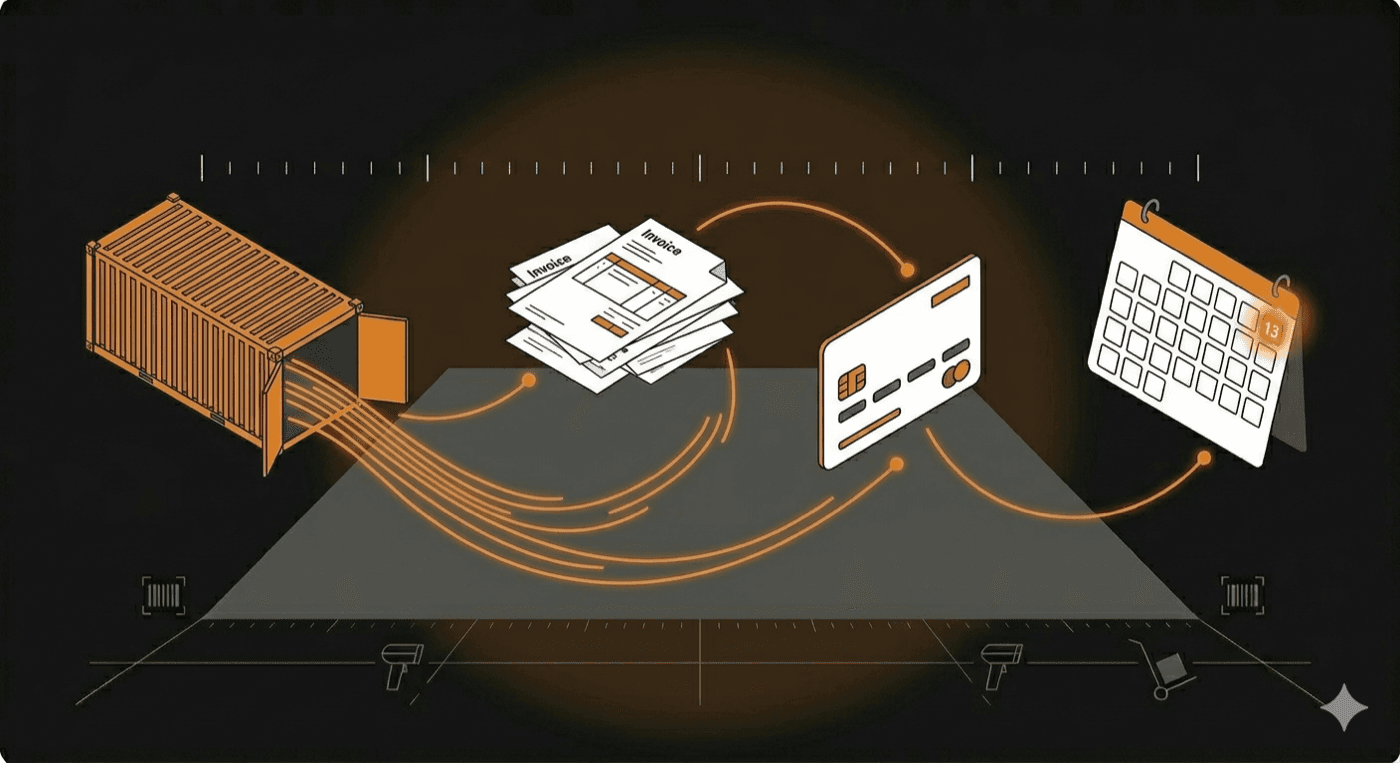



Ecommerce financing options fall into twelve types: asset-based lending, lines of credit, term loans, SBA loans, merchant cash advances, revenue-based financing, inventory financing, PO financing, receivables factoring, platform capital, equity, and charge cards that pay cash back on ad spend. The rule for choosing among them is short: match the repayment shape to the way the funded money comes back to you.
It is part of our complete guide to ecommerce accounting.
The short answer: match the money to the job it does
Most lists of ecommerce funding are written by a lender selling one of the twelve, and they rank options by speed or approval odds. The better question is how the dollars you spend will return to the business, and when.
A container of stock returns cash over the months it takes to sell through. A wholesale order returns cash on the retailer's payment terms. Ad spend returns cash within weeks if the campaign works, and a new hire returns it slowly, sometimes over years.
Each funding type has its own repayment shape: a fixed monthly payment, a share of daily sales, a lump sum when an invoice is paid, or no repayment at all in exchange for ownership. When the two shapes match, the financing pays for itself out of the thing it funded. When they do not, you repay one purchase out of the cash meant for the next, which is how a profitable brand runs short of working capital.
Twelve funding types compared
Cost basis below describes how each price is quoted, which is rarely how it compares. Converting every quote to one annual figure is a separate step, covered in our guide to cost of capital for ecommerce.
| Instrument | What it funds best | How it is repaid | Typical cost basis | Speed | What it needs from your books | Collateral or guarantee |
|---|---|---|---|---|---|---|
| Asset-based lending | Ongoing working capital for larger operators | Revolving; interest on the drawn balance | Interest rate plus monitoring and field-exam fees | Weeks to months | Monthly borrowing-base reports, inventory and receivables detail | Inventory and receivables |
| Bank or fintech line of credit | Short gaps between paying out and getting paid | Revolving; interest on the drawn balance | Interest rate, sometimes a draw or annual fee | Days (fintech) to weeks (bank) | Bank statements, P&L, balance sheet, tax returns | Often a lien on business assets; banks usually ask for a personal guarantee |
| Term loan | One-time projects with a long payback | Fixed installments over a set term | Interest rate plus origination fee | Days to weeks | Two or more years of statements and tax returns | Business assets; often a personal guarantee |
| SBA loan | Larger, longer-lived needs at bank-style pricing | Fixed installments over a long term | Interest rate tied to a benchmark, plus fees | Weeks to months | Full financial package, projections, tax returns | Business assets and owner guarantees |
| Merchant cash advance | Urgent needs when other credit is closed | Fixed share of daily card or channel sales | Factor rate (a flat multiple of the advance) | Days | Recent sales and bank statements | Claim on future sales; guarantee terms vary |
| Revenue-based financing | Ad spend and fast-turning stock | Percentage of revenue until a fixed total is repaid | Flat fee as a percentage of the advance | Days | Channel and bank data, margin, sales history | Usually a lien on business assets |
| Inventory financing | Stock already bought or in a warehouse | Fixed installments or on sale of the stock | Interest or a flat fee per period | Weeks | SKU counts, unit costs, turnover, aging | The inventory itself |
| PO financing | A confirmed order you cannot fund on your own | Paid off when the customer pays | Fee per 30 days the money is out | One to two weeks | The purchase order, supplier quote, customer credit | The order and its receivable |
| Invoice or receivables factoring | Cash locked in wholesale receivables | The factor collects from your customer | A percentage of invoice face value | Days | Receivables aging, customer list, invoices | The receivables |
| Platform capital (Shopify Capital, Amazon Lending) | Inventory and growth on the platform you sell through | Share of platform sales or fixed deductions | Fixed fee or interest, set by the offer | Days, by invitation | Your sales history on that platform | Platform sales; terms vary by offer |
| Equity | Long-payback bets: new categories, teams, acquisitions | No repayment; investors own part of the company | A share of all future value | Months | Full financials, forecast, diligence data room | None; you give up ownership |
| Charge cards with cash back on ad spend | Monthly ad and software spend | Paid in full each statement cycle | No interest if paid in full; cash back offsets spend | Days | Bank balances and revenue | Usually a cash-balance requirement; some ask for a guarantee |
Two rows deserve a note. Platform capital is a category, not a product: as of October 2026, Shopify Capital in the United States is repaid from a percentage of daily sales with either a fixed fee or a monthly fee, and Amazon Lending offers term loans and merchant cash advances from third-party providers to eligible US sellers through invitations in Seller Central. Charge cards fund only the gap between purchase and statement date.
Three of the twelve are often confused with one another, so each gets a closer look below.
Asset-based lending
Mechanics. An asset-based lender sets a borrowing base: an advance rate against eligible receivables plus a lower advance rate against eligible inventory. You draw up to that base as it moves with your stock and receivables, report the assets monthly, and host periodic field exams.
Cost basis. Interest on the drawn balance, plus fees for the facility, the field exams, and unused capacity. Hard collateral keeps the rate below unsecured options; the fees and reporting load are what make it expensive for a small operator.
Who it suits. Established brands carrying meaningful inventory and wholesale receivables, with a finance function able to produce an accurate borrowing-base report every month. It rarely suits a young brand selling only through marketplaces, whose receivables are payouts due within days.
Line of credit
Mechanics. A bank or fintech approves a limit. You draw what you need, pay interest only on what is drawn, and repay to reopen the line for the next draw. Banks review the line each year; many fintech lines set a repayment term for each draw.
Cost basis. An interest rate on the drawn balance, sometimes with an annual or per-draw fee. The quoted rate is close to the true cost, which makes it the easiest of the twelve to compare.
Who it suits. Operators with steady revenue history who need to cover predictable timing gaps: paying a supplier deposit before payouts land, or carrying a seasonal build for six weeks. A line that never comes down to zero during the year is funding something permanent, and is the wrong instrument for it.
Merchant cash advance
Mechanics. The provider buys a portion of your future sales for a lump sum today. It collects a fixed share of daily card or channel receipts until it has received the agreed total. In a strong week you repay faster; in a slow week you repay less.
Cost basis. A factor rate, a multiple of the advance such as 1.2, which means you repay $1.20 for every $1.00 received. The fee does not change with time, so the faster you repay, the higher the annualized cost. An illustrative case: a $50,000 advance at a 1.2 factor rate, repaid in four months, costs $10,000. That is about 60 percent annualized on the full advance and roughly double that on the balance you held on average, because the balance shrinks every day.
Who it suits. Operators who need cash within days and cannot get a line of credit, for a purchase with a short, clear payback. Taking a second advance before the first is repaid, called stacking, compounds the daily deductions.
Funding by purpose: what to use for each job
Inventory buys. Stock you will sell over three to six months suits inventory financing, a line of credit, or platform capital if you sell mainly through one platform. Our comparison of inventory financing vs PO financing works the fee math on both. Match the term to your inventory turnover: a loan that must be repaid before the stock sells through puts the payments on next month's revenue.
A confirmed wholesale order. PO financing pays the supplier, and factoring turns the resulting invoice into cash before the retailer pays. Both price by the period the money is out, so the retailer's payment habits matter as much as the fee.
Ad spend. Ad spend returns cash fastest of any category when it works, which suits revenue-based financing, a charge card paid in full, or a short draw on a line of credit. Before funding it, confirm the campaign's return on ad spend covers the product's margin as well as the financing fee.
Seasonal gaps. A pre-season build that sells through by year end suits a line of credit or a seasonal inventory facility, drawn in late summer and repaid by January. A 13-week cash flow forecast shows how deep the gap goes and in which week the balance turns.
Hires and launches. A new category, a key hire, or a move into wholesale pays back over a year or more. Sales-linked financing is a poor match because repayments start long before the return; a term loan, an SBA loan, or equity fits the timeline.
For the cash levers that come before any borrowing (supplier terms, payout timing, slow stock), see our working capital blueprint for ecommerce.
When is equity the right answer?
Equity is the right answer when the return is large, uncertain, and slow: a new category that needs a year of losses, or a team built ahead of revenue. Debt requires repayment whether the bet works or not. Equity investors share the downside, which is the point of paying for it.
It is also the most expensive money most brands will ever take. A lender's fee ends when the balance is repaid; an investor's share is permanent, and if the company later sells for many times today's value, that share dwarfs any interest bill. Dilution is a cost that never appears on the profit and loss statement.
The working rule: when a purchase pays back inside a year, borrowing almost always costs less than selling ownership. Equity belongs to the bets debt cannot carry.
What every lender reads first
Underwriters in every category start from the same four facts.
Revenue history. How much, how steady, and how long. Lenders look for months of consistent deposits and give little weight to a single spike from a viral moment.
Channel tenure. How long you have sold on each channel, and how concentrated revenue is. Heavy reliance on one marketplace carries account-suspension risk, and lenders price it.
Margin. Gross margin after channel fees, returns, and landed cost tells a lender whether there is room in each sale to service debt. Margin taken from a dashboard estimate rather than reconciled books is easy for an underwriter to set aside.
Existing debt. Every advance, loan, and line already in place, and the daily or monthly payments they take. Lenders check this against your cash flow, often with a ratio such as debt service coverage. An undisclosed merchant cash advance found in the bank statements ends most applications.
Price the option, then check the return
Two calculations come before any signature.
First, price the option. A factor rate, a flat fee, and a 30-day fee are three different ways of quoting a price, and none of them is an annual rate. Convert each to the same annualized basis, on the balance you hold on average, and the lowest-looking quote often turns out to be the most expensive. Our guide to cost of capital for ecommerce shows the conversion for each type.
Second, check the return. A purchase is worth financing when the profit it earns per dollar tied up, per year, is higher than the annual cost of the money. A fast-turning SKU with a modest margin can clear a costly advance; a slow-turning SKU with a strong margin may not clear a low-cost loan. Our guide to return on capital for ecommerce works through that test on a single purchase order.
If the cost is higher than the return, the right amount to borrow is zero.
How to read your own books before you apply
- Revenue history. Pull twelve to twenty-four months of revenue by channel, net of refunds, and check that each month ties to your bank deposits. Gaps are the first question a lender asks.
- Margin. Confirm that landed cost, channel fees, and returns are recorded against the sales they belong to, on an accrual basis. Cash-basis books make the month the supplier went unpaid look like the best month.
- Turns. Calculate how many times inventory sold through in the last year, by SKU where you can. Slow turns mean longer-outstanding financing.
- Existing debt. List every balance, its payment, and its end date, and add the payments to your cash forecast.
- The next purchase. Put the purchase you want to fund into your cash forecast and look at the balance in each week until it sells through. If the balance stays above your floor without financing, you may not need it.
This is the work Futureproof does every day. Vic posts every order, fee, and refund from Amazon and eBay (and Shopify, in beta) and matches each payout to the orders behind it, Theo produces the landed cost per unit that margin is built on, Hugo ranks channels by what they keep after fees and returns, and Margo rebuilds the thirteen-week cash plan nightly and shows whether the balance covers the next container on the date the deposit clears. The result is the set of books lenders ask for, current and on an accrual basis, and a clear answer to what you can afford next. Futureproof never lends and never moves money.
Plans start from $1,000/month for all six agents. Start a 14-day trial or book a demo.
FAQ
What is the best way to fund inventory for an ecommerce brand?
The best way is the one whose repayment matches how fast the stock sells. For stock that sells through in three to six months, inventory financing, a line of credit, or platform capital on your main channel usually fits. For a confirmed wholesale order, PO financing pays the supplier directly. Some buys need no financing at all, so check the cash forecast first.
Is revenue-based financing better than a bank loan for an online store?
It is faster and needs less paperwork, but it usually costs more once the fee is annualized, and the cost rises when sales are strong because you repay sooner. A bank loan suits a long, predictable payback; revenue-based financing suits short, fast-returning spend such as ads or quick-turning stock. Our guide to revenue-based financing for ecommerce covers the math.
Can I get ecommerce funding without a personal guarantee?
Sometimes. Platform capital, some revenue-based financing, factoring, and asset-based lending lean on sales data or collateral rather than the owner, though many agreements still include a guarantee or a business-asset lien. Bank and SBA loans usually ask for one.
How much revenue do I need before a lender will fund my store?
There is no single threshold; each lender sets its own minimums for revenue and months in business. Every lender checks consistency: steady deposits over several months, margin after channel fees, and existing debt. Clean, reconciled books shorten the process more than any revenue figure.