


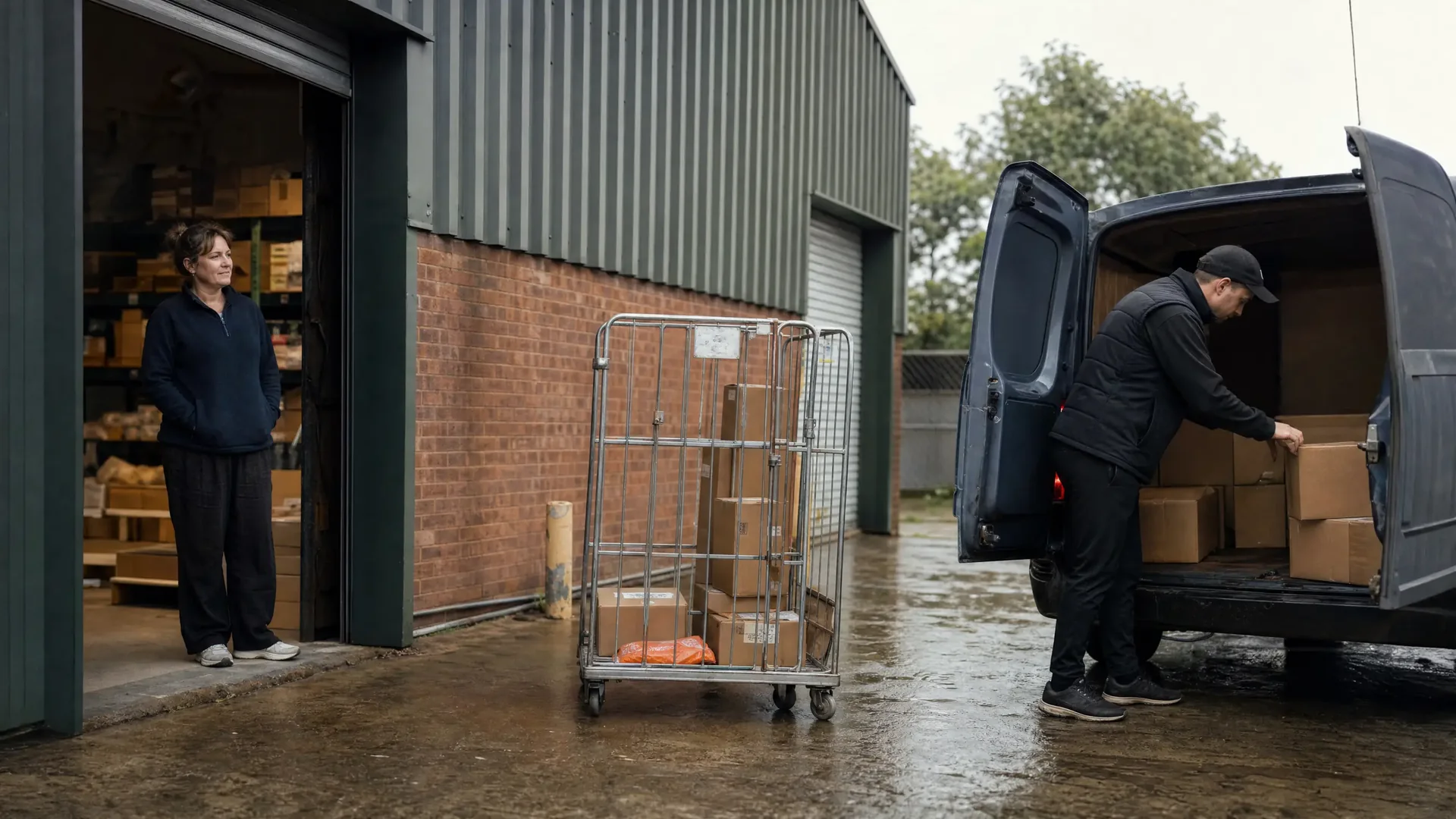
At the example prices worked through below, a teak shower stool that a furniture workshop ships for you earns about $60 a sale. The same stool bought by the case and shipped from your own stock earns about $79, after you have paid about $16,000 up front for 240 of them.
Drop shipping means selling a product you never hold: the customer orders and pays you, and a supplier ships it from the supplier's own stock. The alternative, often searched as fulfillment, is holding the stock yourself, in your own warehouse or at a third-party logistics provider (3PL), and shipping each order from it. Drop shipping is the cheap way to find out whether a product sells. Holding stock is the cheaper way to sell it once you know, so judge the two on the profit each earns against the cash it ties up.
Drop shipping vs fulfillment: the two sides a brand meets
An established brand meets drop shipping from two directions.
Buying. A supplier offers to ship its product to your customers one order at a time. You list it on your store or a marketplace, take the payment, and pay the supplier a per-unit price that is usually higher than its bulk price. The question is whether to list the product that way or buy a case and hold it.
Selling. A large store or marketplace asks your company to join its drop ship program. The store lists your products on its website, takes its customer's order and payment, and sends you the order. You ship one unit from your own stock to the store's customer and invoice the store at your wholesale price. The question is whether that beats a bulk wholesale order, or selling the same unit yourself.
The two sides look alike from the warehouse floor and work very differently in the accounts, so each gets its own section below. Both are compared with holding and shipping stock yourself on the same four things.
| Drop shipping (someone else's stock ships) | Holding stock (your warehouse or a 3PL) | |
|---|---|---|
| Margin per unit | Lower when you buy: the drop ship price sits above the bulk price. Lower when you sell into a program: you pay the parcel at a wholesale price | Higher per unit, less storage, pick and pack, and parcel shipping |
| Control | The party holding the stock sets the ship date, the box and the packing slip; you see its stock only through its feed | You set all of it and count your own stock |
| Cash | Buying: the customer pays before you pay the supplier. Selling: your stock waits on your shelf, then you wait for the store to pay | You pay for stock weeks or months before it sells |
| What goes into the accounts | Buying: no inventory; the full sale or only your margin, depending on who controls the goods. Selling: your inventory until it ships, then a wholesale sale | Inventory at landed cost; cost of goods as each unit sells |
A worked example: one product, both ways
Here is one product costed both ways; the company and its numbers are an example. It is a home goods company selling about $12 million a year of its own wool throws, linen bedding and bath towels. A furniture workshop it already knows makes a teak shower stool that would sit well beside the towels, and offers it two ways: drop shipped at $96 a stool plus $15 to ship to the customer, or $62 a stool on a minimum order of 200. The company would sell it at $180 on its Shopify store with shipping included, and expects to sell about 40 a month.
| Assumption | Drop shipped | Held at the 3PL |
|---|---|---|
| Selling price, shipping included | $180 | $180 |
| Price paid to the workshop, per stool | $96 | $62 (order of 240) |
| Freight from the workshop to the 3PL, per stool | None | $6 ($1,440 for 240) |
| Landed cost per stool (the factory price plus freight and duty) | Not held | $68 |
| Shipping to the customer | $15, billed by the workshop | $15, the 3PL's parcel rate |
| Pick, pack and packaging | In the workshop's price | $6 |
| Storage over six months | None | $540 |
| Payment processing | 3% | 3% |
| Returns and damage, per stool sold | $4 | $4 |
The workshop's prices and the 3PL's rates are example prices, not market quotes; processing, returns, storage and the 40 a month are judgments to replace with your own. Ad spend is left out because it is the same either way. In the accounts, expected refunds come off sales when the sale is booked; returns are one cost line here only to keep the comparison simple.
If the stool sells as planned
| Six months, 240 stools sold | Drop shipped | Held |
|---|---|---|
| Sales | $43,200 | $43,200 |
| Payment processing | ($1,296) | ($1,296) |
| Cost of goods | ($23,040) | ($16,320) |
| Shipping to customers | ($3,600) | ($3,600) |
| Pick, pack and packaging | None | ($1,440) |
| Storage | None | ($540) |
| Returns and damage | ($960) | ($960) |
| Profit before ads and overhead | $14,304 | $19,044 |
| Per stool | $59.60 | $79.35 |
| Cash paid before the first sale | $0 | $16,320 |
Holding earns $4,740 more over six months for $16,320 paid up front, money that comes back only as each sale's receipts, less fees and refunds, reach the bank (from factory deposit to payout works that timing). Even at 9% a year on a credit line, carrying that cash for six months costs well under $1,000. If 40 a month is right, holding wins by a wide margin.
If it sells at less than half the plan
| Six months, 100 stools sold | Drop shipped | Held |
|---|---|---|
| Sales | $18,000 | $18,000 |
| Payment processing | ($540) | ($540) |
| Cost of goods | ($9,600) | ($6,800) |
| Shipping to customers | ($1,500) | ($1,500) |
| Pick, pack and packaging | None | ($600) |
| Storage | None | ($720) |
| Returns and damage | ($400) | ($400) |
| Profit before ads and overhead | $5,960 | $7,440 |
| Stools left, at cost | None | $9,520 (140 at $68) |
| Cash after six months | $5,960 | ($2,080) |
On the income statement the held stool still earns more, about $1,500 more. In the bank it is about $8,000 behind, because 140 stools are sitting at the 3PL with $9,520 of the company's cash in them. They stay at cost while they can still sell above it after selling costs; if they can only be cleared below that, the write-down belongs in that month.
That is the case for drop shipping a new product first. The company gives up about $20 a stool for a few months and learns the real monthly rate before it commits $16,000. If the test shows 40 a month, it orders the case. The test has one cost the tables leave out: the workshop's stock feed updates once a day and its owner would not put a ship-by time in writing, so some orders will sell after the workshop has run out and have to be cancelled, and the customer sees that cancellation as the company's. Count those each month as part of what the test costs.
Whose sale is it? Full revenue or only the margin
When you drop ship, does the income statement show the $180 sale with the workshop's $111 as cost, or only the $69 you keep? If you set the price, take the order, and are responsible to the customer for delivering the stool as promised and for replacing or refunding it when it is wrong, you usually record the full $180 sale, even though you never held the stool. If you only send customers to the supplier's checkout for a cut, you record the cut. Plenty of agreements sit in between, so have your CPA read yours once.
The sale lands in the month the customer takes control of the stool, usually when it ships or arrives under your terms. Payment for a stool the workshop has not yet shipped is owed to the customer, not revenue. The dates that decide which month a sale lands in are in the workshop's tracking file, so ask for it every month. The workshop's charge for the stool is cost of goods; its $15 shipping charge is a cost of the month, like your own parcels.
When a store asks you to drop ship: the drop ship vendor program
Now the other side. A national home goods chain asks the company to put its wool throw into the chain's drop ship program. The chain lists the throw on its website at $160, the company's own store price, sends each order through a supplier portal, and pays the company's $80 wholesale price for every throw shipped. The company picks, packs and ships each one to the chain's customer, with the chain's packing slip, from its own stock.
Programs differ on who pays the parcel, what fees apply per order, how late shipments and missing tracking are charged back, and how returns are handled. The figures below are assumptions for this example; read the program's own vendor terms for yours.
| Per throw | Bulk wholesale order | Drop ship program | Own Shopify store, shipped by the 3PL |
|---|---|---|---|
| Price | $80.00 | $80.00 | $160.00 |
| Expected deductions, returns and payment processing | ($3.20), 4% | ($4.00), 5% | ($10.80): 3% processing, $6 returns |
| Left after deductions, returns and processing | $76.80 | $76.00 | $149.20 |
| Landed cost | ($30.00) | ($30.00) | ($30.00) |
| Pick, pack and packaging | ($0.50), by the pallet | ($5.50) | ($5.50) |
| Shipping | ($1.00), freight to the chain's warehouse | ($9.00), parcel | ($9.00), parcel |
| Ad cost per order (assumed) | None | None | ($35.00) |
| Left after these costs, per throw | $45.30 | $31.50 | $69.70 |
In the accounts, processing fees are a selling expense; they share this row only to keep the comparison short.
The drop ship throw earns about $14 less than the same throw in a bulk order, because the company pays for a parcel and a pick on every unit at a wholesale price. The contribution margin on the company's own store is higher still, if the $35 ad cost per order holds, and that figure moves more than any other in the table.
Cash moves the other way from the buying side. In a bulk order the chain buys 600 throws at once, they leave the warehouse together, and the chain pays on its terms. In the drop ship program every throw stays on the company's shelf, funded by the company, until a customer orders it, and the invoice for that one throw then waits on the same terms. The company carries the stock for longer and is paid later, which stretches its cash conversion cycle for every unit sold this way.
The accounts are plain once the chain is treated as the customer. The throw stays in inventory, at landed cost, until it ships. When it ships, the company records a sale to the chain at $80 and $30 of cost of goods, and the chain owes it the money as an account receivable. Per-order fees, chargebacks and expected returns usually come off the sale as an estimate when it is booked, unless a fee buys a separate service from the chain. Pick, pack and the parcel are monthly costs, not part of what the stock cost (3PL costs).
Some large stores run a marketplace instead of a drop ship program: you set the price, sell to the store's customer and pay the store a commission. That is usually a sale to the store's customer at the full price, with the commission as a selling cost, because the store is selling on your behalf; the agreement decides, so have your CPA read it.
Why join a program that earns less per unit than a bulk order? The chain lists the full catalog online without buying any of it. No purchase order means no unsold stock to take back and no markdown money to fund at season end, and the throws stay the company's own to sell elsewhere if the chain's site does not move them. The trade-off: the chain keeps the customer. You ship the box, but the email address, the reorder and the review are the chain's.
Three things to raise before signing. Ask whether the program pays a drop ship unit price above bulk wholesale or a shipping allowance; some buyers will discuss it and others will not move. Ask what it takes to connect: many programs run orders through a portal or EDI network the buyer chooses, set a ship-by window of a day or two, and fine late tracking, so price the setup and the staff time before the first order. And ask how deductions are reported. A remittance that takes a lump sum off for late tracking uploads without naming the orders is a number nobody can trace. How to match payments to invoices and chase deductions is covered in the wholesale section of order to cash.
When each model fits, and the mixed model many brands settle on
Drop ship a supplier's product when you are testing demand, when the product is bulky or slow enough that holding it deep would tie up cash for months, or when it is an add-on to your core range that a customer would expect to find with it. It fits best when the supplier will commit to ship times and stock updates you can live with.
Hold the stock for the products that make up most of your sales, the ones where delivery time, packaging and the first impression carry your name, and the ones whose demand you can forecast. The margin per unit is higher, and once demand is known the cash comes back fast enough to pay for itself. What it costs to keep that stock on hand, month by month, is in inventory carrying cost.
Join a store's drop ship program when it adds reach you would not otherwise get, when you already hold the stock, and when the per-unit figure after the parcel and the deductions still clears your bar. It suits slower products in the catalog better than best sellers you could sell in bulk.
Take the bulk wholesale order when the buyer will commit to volume at a price that leaves room for its deductions.
Many brands of this size end up with a mix. They hold the core range at their own warehouse or a 3PL, drop ship a handful of tests and add-ons, and accept drop ship programs for the long tail of the catalog. Each month they move a tested product into held stock once its sales have settled and the extra profit from holding clearly beats what the cash would cost elsewhere. For the stool, that is the month the test shows 40 a month and the company orders 240.
Drop shipping buys the answer to whether a product sells. Holding stock is how you make money on the answer.
FAQ
Is dropshipping worth it for an established brand?
For testing new products and adding complementary ones, often yes, because the company learns real demand without paying for stock first. For the core range it usually is not, because the drop ship price sits above the bulk price and the supplier controls ship times and packaging. Compare the profit each way against the cash holding would tie up, and move a product into held stock once its demand is known.
What is the difference between drop shipping and using a 3PL?
A 3PL stores and ships stock you own, so you pay for the inventory up front and pay the 3PL for storage, pick and pack, and shipping; the inventory sits on your balance sheet at cost. A drop ship supplier ships its own stock, so you hold no inventory and pay a higher per-unit price only when an order comes in.
Who handles returns when a product is drop shipped?
Whoever the agreement names. Some suppliers take returns back to their own warehouse and credit you the product cost; others refuse returns and leave you to refund the customer and keep or scrap the item. Settle it in writing before listing, because the customer will hold your company responsible either way, and estimate expected returns as a reduction of each month's sales.