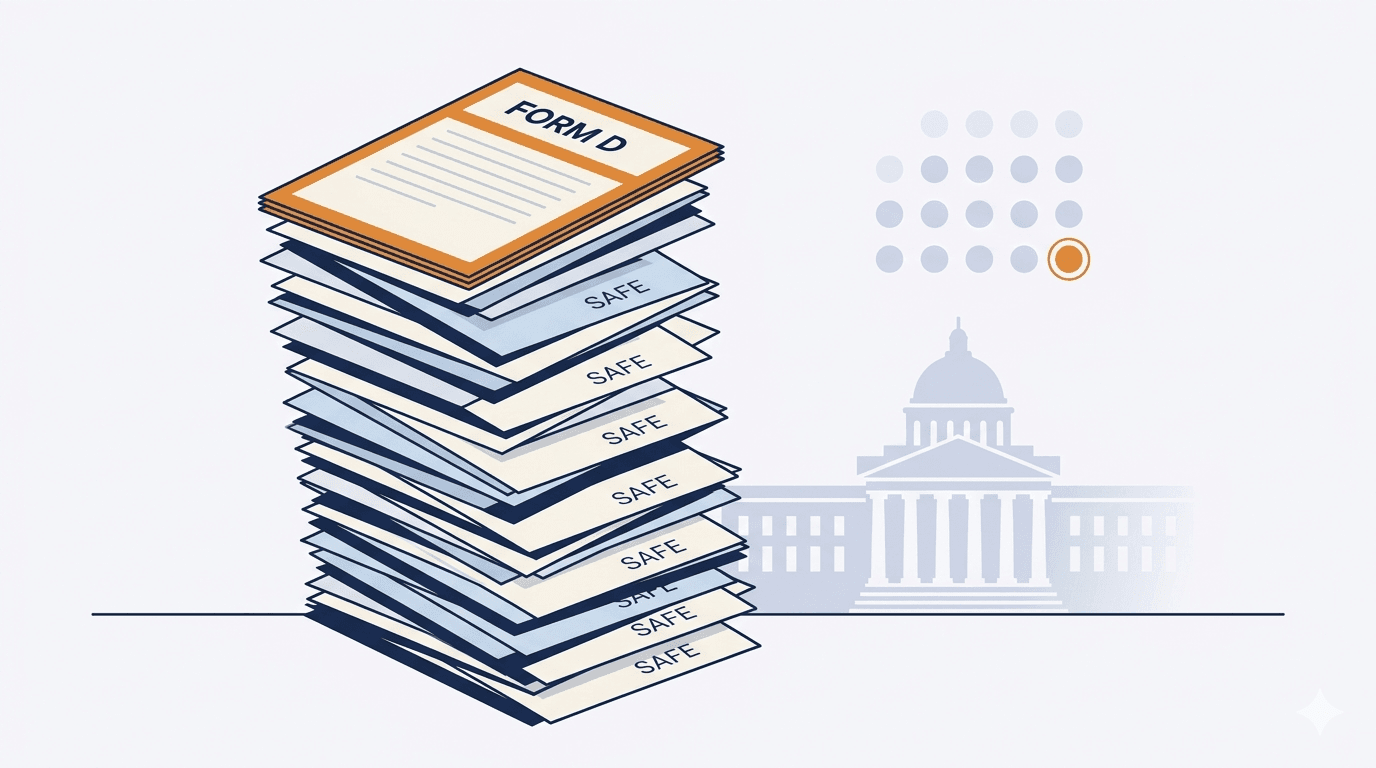
Most founders treat their first SAFE round like a handshake. The investor sends a wire, you both sign a four-page Y Combinator template, and the money hits the account. Done.
Then six months later, a securities lawyer asks if you filed a Form D, what exemption you used, and whether you generally solicited. You stare at them, because you assumed "SAFE" was a legal product, not a financing event that triggers actual SEC obligations.
It does. Every SAFE round in the U.S. is a securities offering. Every securities offering needs an exemption from registration. And the exemption you use determines, among other things, whether you can tweet about your raise.
This guide covers the parts of SAFE fundraising that don't appear in the YC template: when to raise on a SAFE, what Form D actually is, and the 506(b) vs 506(c) decision that quietly shapes who you can talk to about your round.
When a SAFE Is the Right Instrument
A SAFE is a contract that converts to equity at a future priced round. No interest. No maturity date. No board seat. The investor gives you money now in exchange for shares later, at terms anchored to a valuation cap and/or a discount.
That simplicity is the point. SAFEs were built so founders and angels could close a check in a week instead of a quarter. They work best when:
You're raising under ~$3M from sophisticated investors who don't need a board seat. Above that, leads tend to want a priced round so they can negotiate governance and protective provisions.
You expect a priced round within 18-24 months. SAFEs sit on your cap table as a promise. The longer they sit, the more uncertainty stacks up. Multiple SAFEs at different caps compound dilution in ways most founders don't model until it's too late (we wrote a full breakdown of SAFE stacking math here).
Your investors are accredited. SAFEs aren't legally restricted to accredited investors, but the exemptions you'll rely on almost always are. More on that below.
You're not raising in a state with weird local rules. California, New York, and a few others have specific notice requirements that layer on top of federal rules.
If you're raising a larger round, taking on a lead investor who wants governance, or expecting a long gap before your next financing, a priced seed or convertible note may serve you better. But for the typical pre-seed or seed angel round, the SAFE is the right default.
Form D: The 15-Day Clock Most Founders Miss
Here's the thing nobody tells first-time founders: when an investor wires money for a SAFE, you've sold a security. That sale needs to be registered with the SEC, or it needs to qualify for an exemption. Almost every SAFE round relies on an exemption under Regulation D, and Regulation D requires you to file a Form D within 15 calendar days of your first sale.
The first sale is when the first investor wires the money or countersigns the SAFE, whichever comes first. Not when the round "closes." Not when you finish negotiating with the next investor. The clock starts on dollar one.
A few things to understand about Form D:
It is not a disclosure document. You're not handing the SEC your pitch deck, your financials, or your investor list. Form D tells the SEC that an offering is happening, who's running it, what exemption you're using, and roughly how much you're raising. It's a notice, not a prospectus.
It is public. Anyone with an internet connection can pull your Form D from EDGAR. That's why competitors, journalists, and recruiters sometimes know about your raise before you announce it. If stealth matters, plan accordingly.
It can be filed late, but late filings carry risk. Technically, under Rule 507, an issuer that fails to file Form D could lose the ability to use Regulation D in the future. In practice, the SEC rarely brings enforcement actions for missed deadlines, but state regulators sometimes do, and your next round's lead investor will absolutely ask about it during due diligence.
It only covers federal compliance. Most states require their own "blue sky" notice filing within 15 days of the first sale to a resident of that state. California's Section 25102(f) filing is the one that bites founders most often. Your lawyer should handle this, but it's worth asking explicitly: "Are we filing Form D, and which state filings are you also handling?"
The Form D itself takes a lawyer about 30 minutes to prepare. The cost is trivial compared to the cleanup work if you skip it.
Regulation D, Rule 506(b) vs 506(c): The Decision That Shapes Your Outreach
Inside Regulation D, almost every SAFE round uses one of two exemptions: Rule 506(b) or Rule 506(c). They look similar on paper. In practice, the choice between them changes how you're allowed to fundraise.
Rule 506(b): The Quiet Default
506(b) is what most founders use without realizing it. The rules:
- No general solicitation. You cannot publicly advertise the offering. No tweets that say "we're raising," no LinkedIn posts pitching the round, no demo day announcements that include investment terms, no website page describing the deal.
- Pre-existing substantive relationships. Each investor needs to be someone you (or your placement agent) already had a relationship with before pitching them on this specific round.
- Up to 35 non-accredited investors allowed, though in practice almost every SAFE round restricts to accredited only because it simplifies disclosure obligations.
- Reasonable belief standard for accreditation. You can rely on the investor's own representation that they're accredited. A signed subscription agreement with an accreditation checkbox is usually enough.
The trade-off: you cannot market the round. If you post on X that you're raising a seed, you've likely just blown your 506(b) exemption. (Cue your lawyer's heavy sigh.)
Rule 506(c): The Public Round
506(c) was added in 2013 under the JOBS Act specifically to let issuers publicly advertise. The rules:
- General solicitation is allowed. Tweet about the round. Post a deck. Put a "we're raising" banner on your homepage. Pitch from a conference stage.
- All investors must be accredited. No exceptions. No 35-investor carveout for non-accrediteds.
- Reasonable steps to verify accreditation. This is the catch. You can't just take the investor's word for it. You (or a verifier) must review tax returns, bank statements, broker statements, or get a signed letter from their CPA, attorney, registered broker-dealer, or registered investment adviser confirming their status.
The verification piece is what trips people up. The mechanics aren't that hard. There are services (VerifyInvestor, Parallel Markets, others) that handle it for $30-100 per investor. But it adds friction. Sophisticated angels sometimes resist handing over tax returns to a startup they barely know.
There's also a quieter cost: signaling. A 2024 NYU/SEC working paper on venture funds found that managers and their lawyers broadly view 506(c) as sending a "negative signal," a tell that you couldn't raise through your existing network. That research focused on VC funds raising from LPs, but the same dynamic shows up in startup rounds. Investors notice when a deck is on the open internet versus when it arrived through a warm intro.
How to Choose
Default to 506(b) if your round is happening primarily through warm intros and you don't plan to publicly market it. This is the right call for the vast majority of pre-seed and seed SAFE rounds.
Default to 506(c) if you genuinely need to reach investors outside your network and you're willing to accept the verification friction. This makes sense for some specialized cases: deep tech founders with no fintech network, second-time founders running a public "we're back" announcement, or rounds where the public visibility is itself a marketing event.
The single most expensive mistake: starting on 506(b), then casually tweeting about the raise mid-process. The SEC takes the view that once you've generally solicited, you've generally solicited. There's a six-month "integration" window where past 506(b) activity can be folded into a single offering, and crossing that line can invalidate the exemption for the entire round. Your lawyer will need to weigh whether you can convert to 506(c) and verify all prior investors retroactively, which is uncomfortable for everyone.
The Practical Playbook
Here's the operating procedure most well-run SAFE rounds follow:
Before you take a single check. Decide which exemption you're using. Get your subscription documents (SAFE + investor questionnaire + accredited investor representation) ready. Pick a lawyer who has done at least 50 of these. Most startup firms have a fixed-fee package in the $1,500-3,500 range for a first-round Form D and standard subscription docs.
When the first wire hits. Note the date. The 15-day Form D clock starts now, not on the round close date.
Within 15 days. File Form D with the SEC. Trigger the state blue sky filings for every state where you've taken money (your lawyer should maintain a checklist).
During the round. Keep a clean investor log: name, entity, accreditation method, date of first contact (for 506(b) substantive relationship documentation), date of investment, amount. Your future Series A lead's lawyer will thank you.
If you amend the offering. Increase the round size, change the terms materially, or extend it beyond a year, you may need to file a Form D amendment. Same 15-day clock concept applies in some cases.
For state filings. California, New York, Massachusetts, and Florida are the four where founders get burned most often. If you've taken money from a resident of any of those states, ask your lawyer explicitly whether the state notice is filed.
Stacking SAFEs: Each One Is Its Own Securities Sale
Most founders don't raise a single SAFE. They raise three, or five, or twelve. Angels trickle in, one at a time, over a six-month stretch. Each new SAFE feels like an extension of the same round, but to the SEC, each one is a separate sale of a security. That has two consequences: a compliance one and a dilution one.
Each SAFE Triggers Form D Mechanics
When you sign your first SAFE, you've started an offering. The 15-day Form D clock runs from that first sale. Every subsequent SAFE in the same round is either part of that ongoing offering, or it's a new offering, and the difference matters.
If it's the same offering (the standard "rolling close" pattern): you don't file a new Form D for every check. The original Form D covers the whole round. But you do owe two kinds of amendments:
- Material change amendments. If something material changes (the offering size goes up by more than 10%, the type of security shifts, the named officers change), you file an amendment within a reasonable time after the change. Increasing your target raise from $1M to $2M is a material change. Adding a new SAFE at terms substantially different from the prior ones can also qualify.
- Annual amendments. If your offering is still ongoing one year from the original filing date, you file an annual amendment. SAFE rounds that drag on for 18 months often miss this and only discover it during Series A diligence.
If it's a new offering (a distinct round, separated in time, with different terms or a different purpose): you file a brand-new Form D, with a fresh 15-day clock. The SEC's integration framework, updated in 2021, gives you a safe harbor: offerings separated by 30 or more days are presumed to be distinct, with some carve-outs. If your "second SAFE round" closes more than 30 days after the first one wrapped, you're generally in new-offering territory and owe a new filing.
The practical implication: keep a clean log of every SAFE: date signed, amount, terms, which Form D it's covered under. Your lawyer should maintain this, but you should be able to pull it in five minutes. If you can't, your records aren't where they need to be.
Each SAFE Compounds Your Cap Table Math
The Form D obligation is the cheap part. The expensive part is what stacked SAFEs do to your cap table.
Each SAFE converts independently at its own valuation cap when your priced round triggers. SAFE 1 at a $5M cap, SAFE 2 at a $6M cap, and SAFE 3 at a $4M cap don't blend into an average. They each convert on their own terms, and the lowest-cap SAFE gets the most shares per dollar. Founders who track their dilution as "I raised $850K, that's roughly 10% gone" routinely discover at Series A that the real number is closer to 17%.
We wrote the full math of this, including the difference between pre-money and post-money SAFEs, the option pool shuffle, and the four mistakes that maximize dilution, in our breakdown of SAFE stacking. The short version:
- Each new SAFE is incremental dilution that doesn't get smaller because you raised at a higher cap later. Post-money SAFE dilution is locked in the moment you sign.
- Caps that felt fine in isolation become a problem in aggregate. A single $3M cap SAFE is annoying. Five SAFEs at five different caps from $3M to $8M is a Series A negotiation nightmare.
- Sophisticated investors model your full SAFE stack before writing a Series A check. If they see 30% pre-money locked up in SAFE conversions plus a 15% option pool refresh, the deal math may not work for them. Some lead investors will pass on companies with messy SAFE stacks. Others will demand a recap.
The Form D and the cap table problem are the same problem viewed from two angles. Each new SAFE adds a row to the cap table, a line to the compliance log, and a paragraph to your Series A diligence memo. The discipline that prevents one prevents the others.
Mistakes That Compound
A few patterns that look small at the time and turn into real problems later:
Tweeting "raising our seed" before you've decided on 506(b) vs (c). This is the single most common founder mistake. A public statement about an active offering, even a vague one, can blow a 506(b) exemption.
Taking money from investors you met at a conference last week. If there's no pre-existing substantive relationship, the SEC may view that as general solicitation. The "substantive relationship" standard isn't a single coffee meeting; it's enough interaction that you can reasonably assess the investor's financial situation and sophistication.
Skipping the Form D entirely because "it's a small SAFE round." Dollar amount is irrelevant. A $25K SAFE from one angel triggers the same filing requirements as a $2M SAFE round. The exemption isn't a function of size.
Letting the lawyer "handle it" without confirming what got filed. Ask for the SEC accession number for your Form D. Ask for confirmation receipts from each state filing. These are 30-second emails that prevent month-long diligence rabbit holes during your Series A.
Mixing SAFE rounds and equity rounds without integration analysis. If you close a SAFE round, then start a priced round 90 days later, the SEC may view them as a single integrated offering. The rules for integration changed in 2021 and are now more founder-friendly, but they're not nonexistent. Your lawyer should run the analysis.
Why This Matters for the Long Game
Series A investors care about two things during diligence on prior rounds: did you actually own what you sold (cap table integrity), and were the sales legally compliant (securities exemptions properly documented).
Sloppy SAFE rounds with missing Form Ds, undocumented accreditation, and general solicitation that wasn't supposed to happen are the diligence questions that turn a two-week close into a six-week close. Worst case, they force you to do a rescission offer to past investors, which is the legal equivalent of asking your earliest believers if they'd like their money back. Nobody wants to make that call.
The good news: this is one of the cheapest categories of compliance work in your company. A lawyer fee of a few thousand dollars and an hour of your time per closing covers it. The cost of skipping it shows up later, at exactly the moment you can least afford the distraction.
Get the paperwork right at the start. Future you will be doing the diligence.
For a complete view of the finance and compliance systems you should have in place before (or right after) your first raise, see our guide to the seed-stage finance stack. And if you want to model how your existing or planned SAFEs will convert in your next priced round, use our cap table dilution calculator.