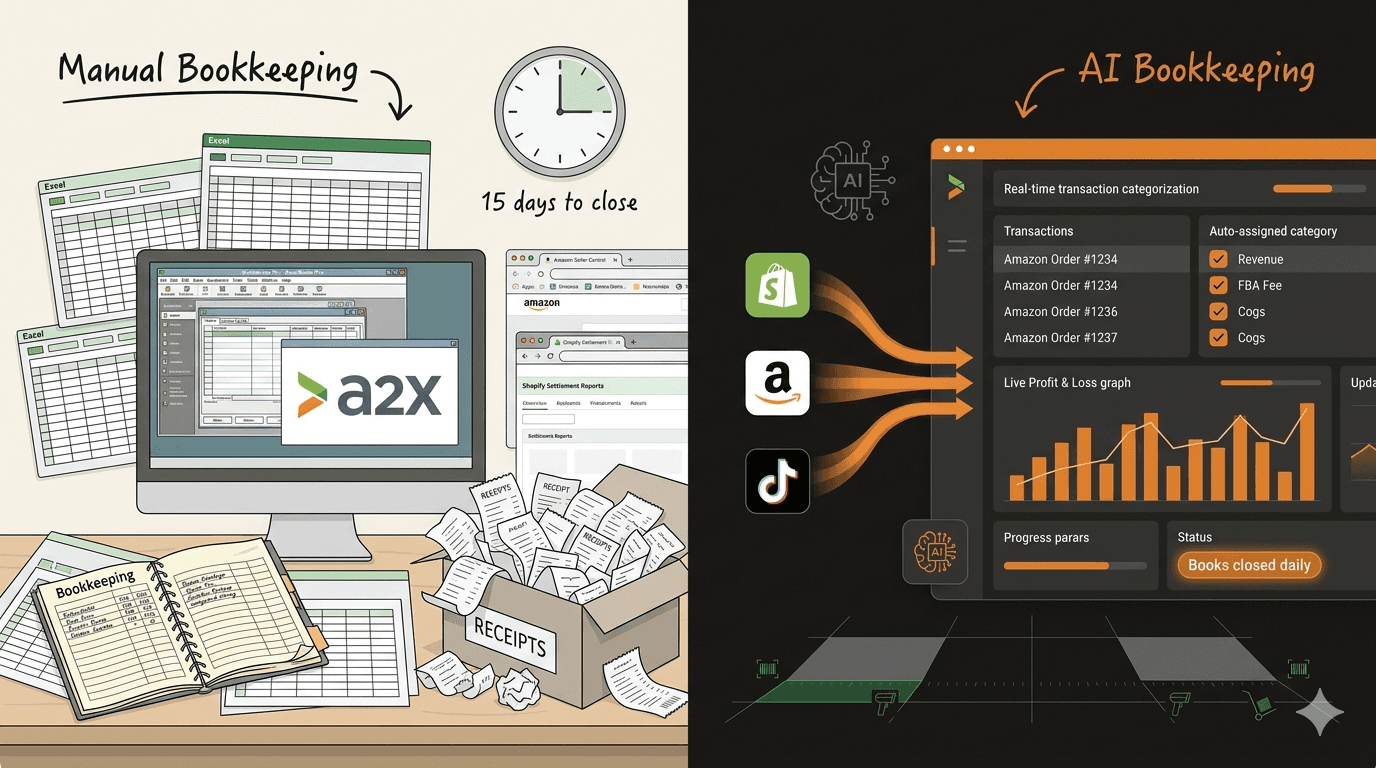



Outsourced bookkeeping services like Pilot and Zeni assign human bookkeepers, assisted by software, to close your books in a monthly batch, typically for $500 to $2,500 per month. AI bookkeeping does the categorization and reconciliation continuously on your live ledger, with humans reviewing instead of doing. The real differences between the two models are latency, scope, and cost.
Search results treat these as two separate shopping lists, one for "best bookkeeping services" and one for "best AI bookkeeping tools," which leaves founders assembling the comparison themselves. This is that comparison, including the honest cases where each model wins and the third option that collapses the dichotomy.
How does each model actually work?
The service model
You hand off your books. A bookkeeper, somewhere between dedicated and pooled depending on your tier, works through the month's transactions after the month ends, asks you questions about the ambiguous ones, and delivers statements. The service model's pitch is zero involvement, and the mechanics are batch processing: books are touched when the humans get to them. Pricing scales with your transaction volume and expense level; as of mid-2026, Pilot's Core plan, with a US-based bookkeeper, starts at $299 per month billed annually and rises with monthly expenses, with CFO-type services sold separately starting around $1,750 per month. Traditional firms and startup-focused services generally land in the $500 to $2,500 per month range for bookkeeping alone.
The AI model
Agents categorize transactions as they land in the general ledger, reconcile against bank feeds continuously, and flag what they are unsure about; you approve exceptions in minutes a week instead of handing off everything. The mechanics are covered in depth in our AI bookkeeping explainer; the operating difference is that the books are a live system rather than a monthly deliverable. Notably, the service firms themselves are validating this direction: Pilot now leads its own pricing page with a $99 AI-driven tier. The models are converging on AI doing the work; what differs is what sits around it.
What's the real cost difference?
Bookkeeping-only comparisons understate the gap because the service quote usually covers just the books. Forecasting, metrics, and investor reporting are add-ons, often expensive ones.
| Outsourced service | Futureproof (AI finance team) | |
|---|---|---|
| Bookkeeping | $500–$2,500/mo | Included |
| Forecasting and budget vs actuals | Add-on or CFO tier ($1,750+/mo at Pilot) | Included (Margo) |
| AR and AP execution | Add-on or higher tier | Included (Remi, Theo) |
| Revenue metrics | Usually a separate tool | Included (Hugo) |
| Investor reporting | Usually manual | Included (Nia) |
| Price | Scales with volume | $1,000/mo flat |
The comparison shifts from "cheaper bookkeeping" to "more function per dollar." One flat fee covering six functions changes what the line item buys, which is the whole premise of an AI finance team. Contract terms belong in the comparison too: many services discount for annual commitments, so check whether you are agreeing to month-to-month or a year of lock-in before the price registers as final.
Why does latency matter more than founders expect?
A service closing your books mid-month means every decision until then runs on last month's numbers. That is survivable for a stable small business. It is expensive for a startup, where the questions are current by nature: can we afford this hire now, what is runway if the enterprise deal slips, what is real MRR for the investor call tomorrow. Batch bookkeeping answers all of these with "let me check after the close."
Continuous books invert that. Categorization happens daily, reconciliation runs against live feeds, and the runway number reflects this morning's balance. The founder scenario that sells it is mundane: a mid-month spend decision made against actual cash position instead of a stale export and a guess.
Where do human bookkeepers still win?
An honest comparison names the cases the other side takes. Messy historical cleanups, books that have drifted for a year, benefit from a human working through context AI lacks. Unusual one-off transactions, an acquisition payment, a legal settlement, deserve human eyes regardless of who does the routine work. And some owners genuinely want zero involvement, not minutes-a-week involvement; a full-service firm delivers that, at full-service prices.
Error accountability is the other honest point in the service model's favor. With a firm, a human is contractually responsible when something is booked wrong. With AI bookkeeping, ask the vendor directly: who reviews the work, who signs off, and what is the escalation path when something looks off? That question is exactly what Futureproof's built-in human review exists to answer.
Two things hold either way: a well-built AI flags what it is unsure about rather than guessing, and year-end still goes through a CPA. Neither model removes the accountant who signs things.
What's the third option: AI execution with human review?
The dichotomy is false. Futureproof pairs the AI agents doing the work with a human financial specialist who reviews it on a monthly call, included in the $1,000 per month flat price while covering all six functions rather than bookkeeping alone. Details are on the pricing page. For founders whose real hesitation is "I want a person accountable for checking this," that is the direct answer.
How does Futureproof compare with Pilot and Zeni specifically?
The structural difference is headcount versus agents. Service firms scale by assigning people, so price tracks your volume and scope tracks your tier. Zeni follows the same playbook as Pilot, AI-assisted software with a human finance team layered on top and tiered pricing that scales with your expense level. Futureproof scales by software, so the price is flat and the scope is the whole finance function. For line-by-line comparisons, see Futureproof vs Pilot and Futureproof vs Zeni.
FAQ
Is AI bookkeeping cheaper than outsourced bookkeeping? Generally yes. Services run $500 to $2,500 per month for books alone, while Futureproof's $1,000 per month flat covers bookkeeping plus AR, AP, forecasting, revenue metrics, and investor reporting.
Is AI bookkeeping accurate enough to trust? Every entry is grounded in the general ledger and traceable to a transaction, and the agents flag uncertain items for review instead of guessing. You approve exceptions rather than auditing everything.
Do I still need a CPA with AI bookkeeping? Yes, for taxes and filings. The output is a clean, CPA-ready year-end package, which typically makes that engagement cheaper, not unnecessary.
Can I get human review with AI bookkeeping? Yes, and it is included. Every Futureproof plan comes with a monthly review call with a human financial specialist who checks the agents' work, at no extra cost.
The bottom line
Outsourced bookkeeping buys you last month's books, accurately, from people. AI bookkeeping buys you this morning's books, continuously, from agents you approve. For startups making time-sensitive decisions on thin margins of error, latency is the deciding variable, and it is the one a batch service cannot fix at any tier.
Start a 14-day trial of Futureproof, no credit card required, and compare your current books to a live ledger directly.