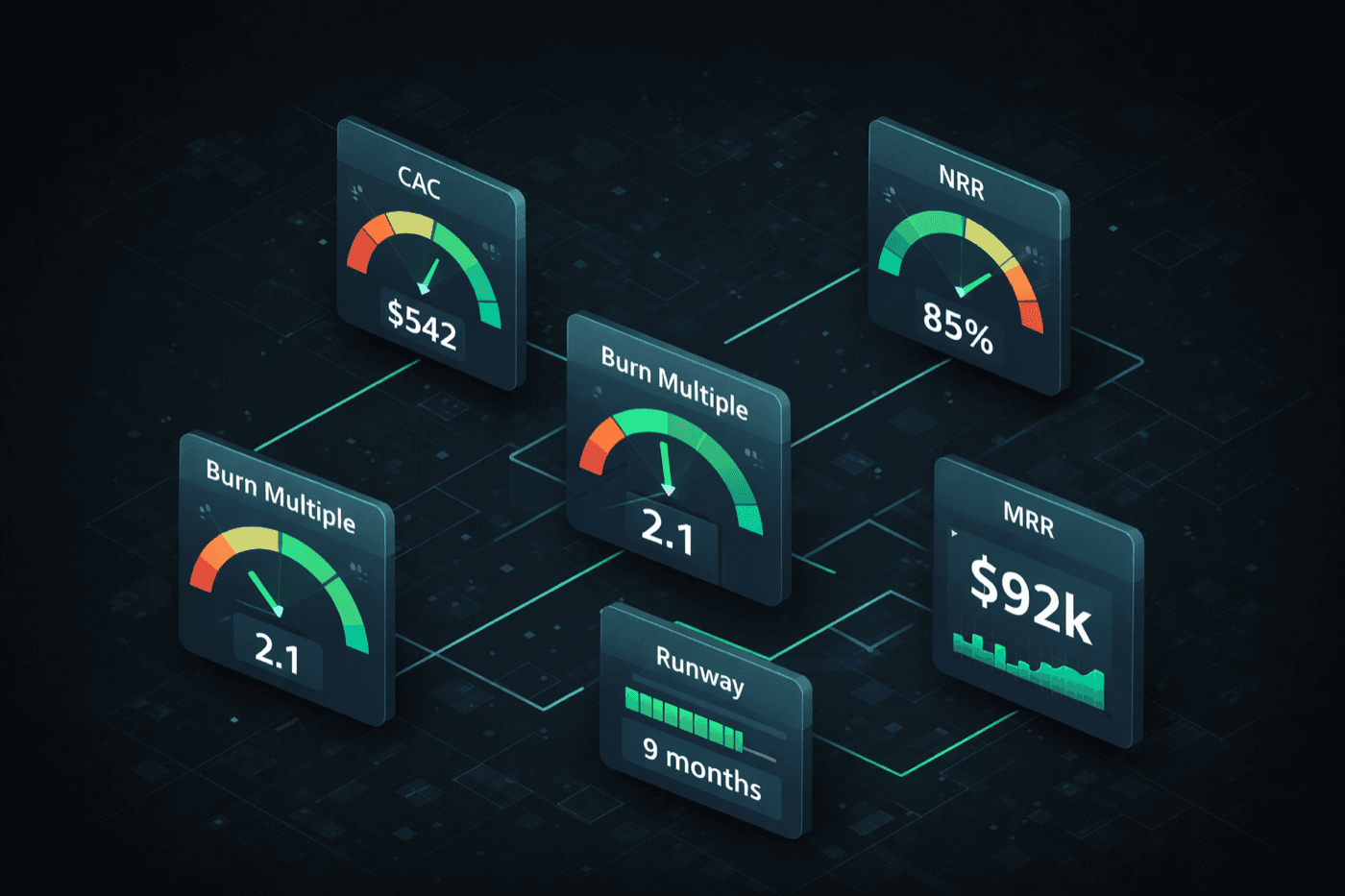



NRR and GRR measure the same thing with one difference. Gross revenue retention is the percentage of last year's recurring revenue you kept from those same customers, counting only losses, so it can never exceed 100%. Net revenue retention adds expansion back in, upsells, cross-sells, and price increases, so it can and should exceed 100%. GRR tells you whether the product holds; NRR tells you whether the business compounds.
Founders tend to meet these metrics for the first time in a diligence request, which is the wrong moment. This guide covers the formulas, what the survey data says "good" actually means at different contract sizes, why investors read retention before they read growth, and which lever fixes which number.
How do you calculate NRR and GRR?
Both follow a cohort of customers across a year. Using SaaS Capital's survey definition: take the customers you had in December of last year, and divide their MRR this December by their MRR last December. Include expansion from those customers and it is NRR; cap each customer at last year's level (counting only downgrades and churn) and it is GRR. New customers acquired during the year are excluded from both. Churn, in this framing, is just the mirror: 95% GRR equals 5% revenue churn.
A concrete cohort: $100K of MRR a year ago. Those customers churned $8K, downgraded $3K, and expanded $15K. GRR = (100 − 8 − 3) / 100 = 89%. NRR = (100 − 8 − 3 + 15) / 100 = 104%. Same year, two different stories: a modest leak, more than refilled by expansion.
What's a good NRR?
The most useful benchmarks group companies by contract size, because a $20-per-month product and a $200,000-per-year product retain differently by nature. In SaaS Capital's 2025 survey of private B2B SaaS companies, companies with ACVs between $25,000 and $50,000 showed a median NRR of 102%, with the top quartile at 111% and the bottom quartile at 97%, and median NRR rises with ACV across the range. GRR follows a related pattern: the highest-ACV companies show the strongest gross retention, which tracks intuition, since expensive products come with implementation depth and account management that make them sticky.
The rough reading grid for an early-stage SaaS company:
| Signal | What it says |
|---|---|
| NRR below 100% | The bucket leaks faster than customers expand; growth must be bought with new logos |
| NRR ~100–105% | Normal for smaller ACVs; retention is not the problem or the superpower |
| NRR 110%+ | Compounding; the installed base grows the company by itself |
| GRR in the high 90s | The product holds; losses are trickle, not leak |
| GRR below ~85% | A product or ICP problem that expansion revenue is papering over |
The growth connection is the reason to care: in the same survey, companies with NRR of at least 110% grew faster than the population median of 24%, while sub-100% NRR groups grew slower. Retention compounds, in both directions.
Why do investors check retention before growth?
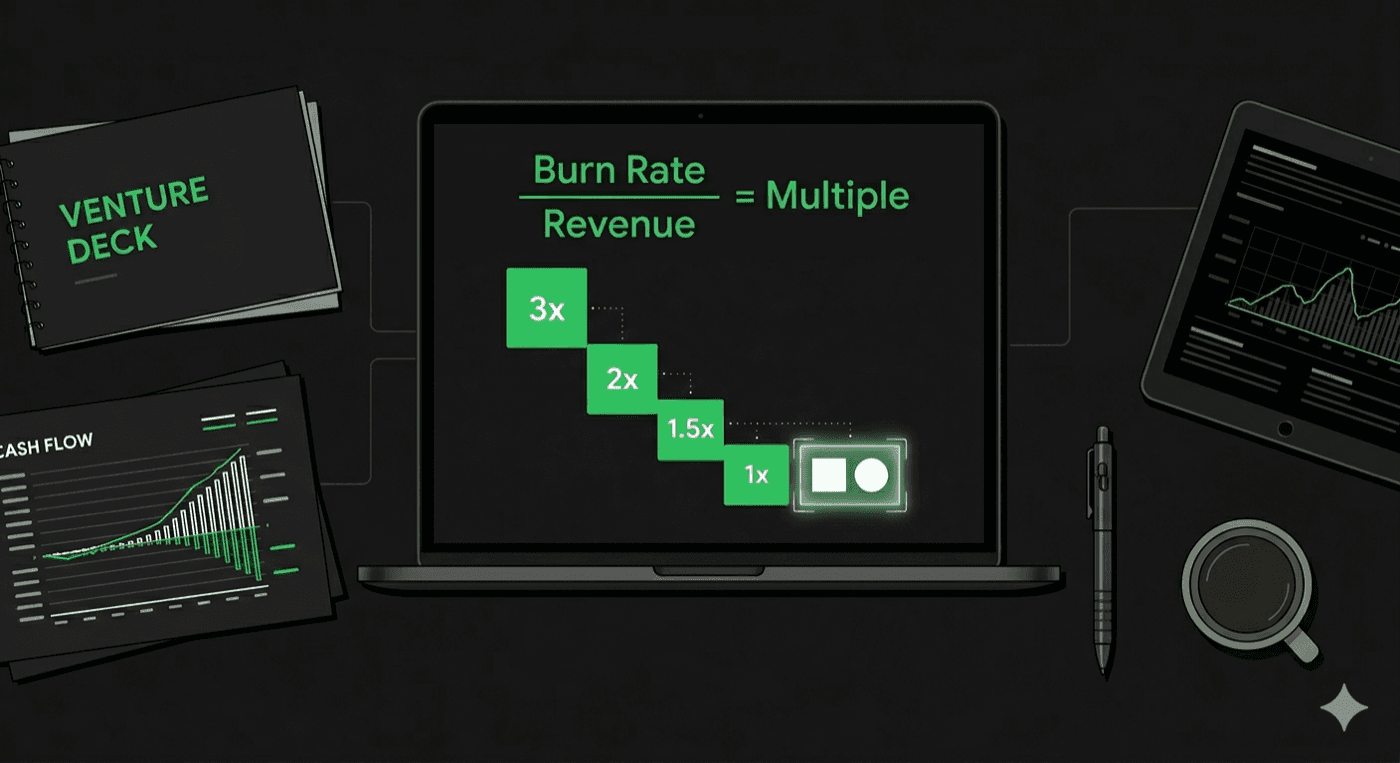
Because retention is the quality-of-revenue metric that growth numbers can hide. Two companies growing 60% look identical until you see that one has 115% NRR (the base compounds; new sales are pure addition) and the other has 85% GRR (new sales are mostly refilling a leaking bucket, at full acquisition cost). The second company's growth gets more expensive every quarter, which is why churn is so much costlier than it looks, and why retention sits alongside burn efficiency in the metrics investors examine before a Series A. By the time you are preparing for that raise, you want four to six quarters of cohort-based retention history ready, not reconstructed.
How do you fix retention?
Match the lever to the broken number.
If GRR is the problem, fix keeping. Churn and downgrades concentrate in the first months and in bad-fit customers. The levers: tighter ICP discipline in sales (bad-fit logos are churn with a delay), onboarding that reaches first value fast, annual contracts where they fit the motion, and watching leading indicators like usage decay instead of waiting for the cancellation. Pricing-plan surgery alone rarely does it; as we argued in killing the monthly plan won't fix churn, contract structure changes when churn happens more than whether.
If NRR is the ceiling, build expansion paths. A product with nothing more to buy caps NRR at GRR. The levers: pricing axes that scale with customer value (seats, usage, tiers), a second product or module, and price increases actually taken at renewal. Expansion is a product and packaging strategy, not an account-management afterthought.
Either way, measure by cohort from real data. Retention computed from a spreadsheet that disagrees with billing is diligence risk wearing a KPI costume. At Futureproof, Hugo computes NRR, GRR, and churn directly from billing data on the same reconciled foundation as the books, so the retention story you tell is the one your data room confirms. It is part of the standard $1,000 per month plan.
FAQ
What is the difference between NRR and GRR? GRR measures revenue kept from existing customers, counting only churn and downgrades, and cannot exceed 100%. NRR adds expansion from those same customers and can exceed 100%.
What is a good NRR for a SaaS startup? Depends on contract size. SaaS Capital's 2025 survey shows a median of 102% for companies with $25K–$50K ACVs, with the top quartile at 111%; medians rise with ACV. Above 110% is compounding territory at most sizes.
Can NRR be high while GRR is bad? Yes, and it is a warning sign: heavy expansion from surviving customers can mask a real churn problem. Investors read the pair together for exactly this reason.
Do NRR and GRR include new customers? No. Both follow only the existing cohort year over year. New-customer revenue shows up in growth metrics, not retention metrics.
The bottom line
GRR is the leak test, NRR is the compounding test, and neither can stand in for the other. Know both numbers by cohort, know which lever moves each, and get the history clean well before someone across a term-sheet table asks for it, because retention is the part of the story you cannot revise in the quarter you need it.
Start a 14-day trial of Futureproof, no credit card required, and get NRR and GRR computed from your real billing data.