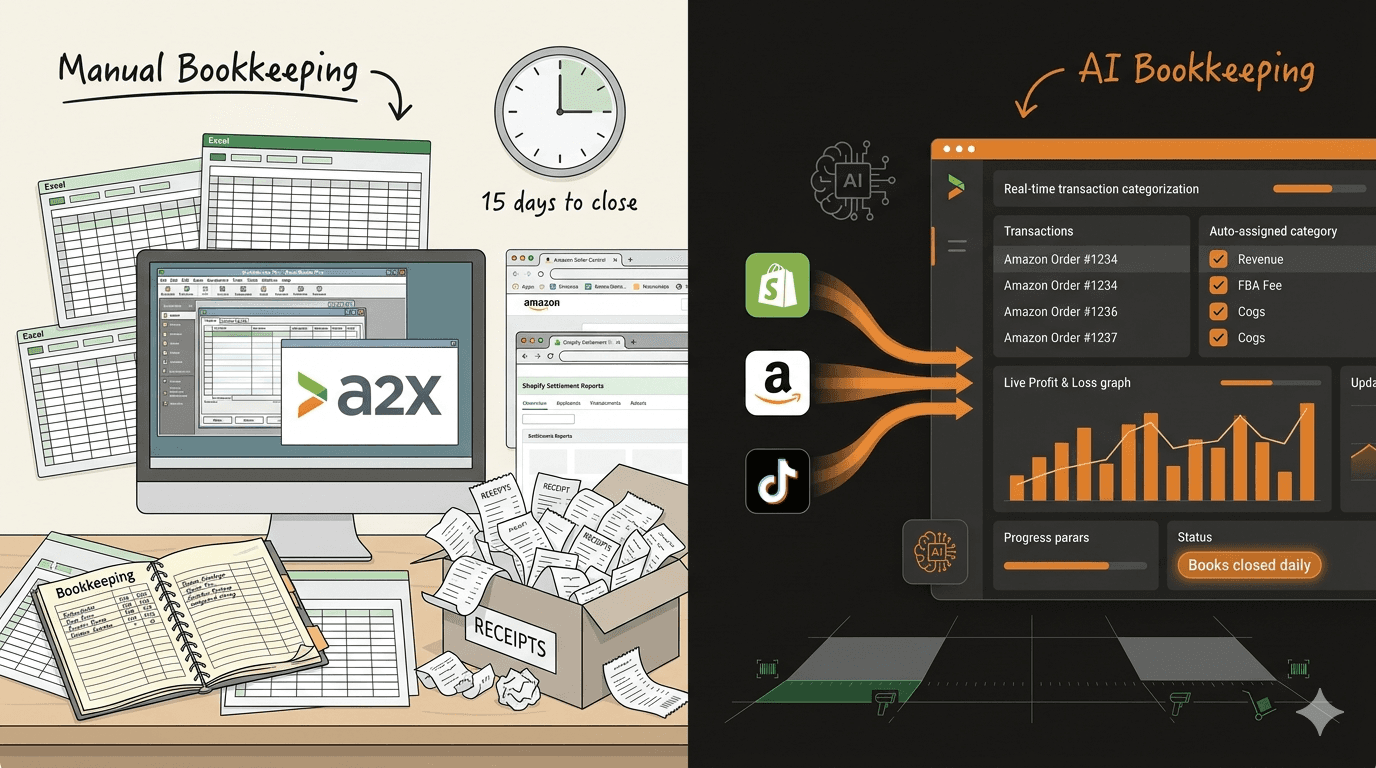

Most SaaS startups between pre-seed and Series A have a finance function that looks the same. One overworked bookkeeper. A Pilot or Bench subscription on top. A fractional CFO on retainer for monthly reviews. A spreadsheet that tries to track everything else.
Four of the six finance roles a SaaS startup actually needs at this stage get done badly, late, or not at all. The bookkeeper is buried in transactions and Stripe payouts. Accounts receivable runs on whoever notices the failed payment. Accounts payable runs on whoever is asking loudest. FP&A happens once before a board meeting. SaaS metrics live in a spreadsheet that lags reality by three weeks. Investor updates get written from scratch the night before.
Hiring out of the problem does not work at this stage. Six full-time finance hires, fully loaded with benefits and overhead, run $384,000 to $605,000 a year. That is more than most SaaS startups carry in their entire operating budget pre-Series A. So the function stays underbuilt, and the founder absorbs the cost in slower decisions, missed NRR signals, and runway surprises that show up at the worst possible moment.
An agentic finance team changes the math. Six AI agents, each owning one of the six roles end-to-end, available for $12,000 a year. The cost difference is the headline. The structural difference is what changes the business.
This brief lays out what an agentic finance team replaces, what it produces, and how to think about the value at the pre-seed through Series A stage.
The Four Questions That Decide Whether the Team Is Worth It
Most discussions of AI value get tangled in vocabulary. Tokens. Inference. Work units. Inference-to-work ratios. Those metrics matter for the engineers building the agents. They do not help a founder decide whether to hire an agentic finance team.
The four questions that matter are simpler.
What role is being replaced?
A SaaS startup at scale needs six finance functions. A bookkeeper. An accounts receivable clerk. An accounts payable clerk. An FP&A analyst. A revenue operations analyst. An investor relations coordinator. Each role has a defined scope, a defined output, and a defined consequence when it is missing.
Futureproof's six agents each replace one of those six roles. Not a feature. The role itself, with the scope of work that role would otherwise own.
- Vic runs bookkeeping. Daily reconciliation across Stripe, the bank, and corporate cards. Transaction categorization. Deferred revenue recognition on annual contracts. Month-end close as a check, not a project.
- Remi runs accounts receivable. Subscription invoices go out on time, dunning runs automatically on failed payments, and Remi learns when each customer actually pays so reminders land at the right moment.
- Theo runs accounts payable. Vendor bills get captured, coded, and scheduled against cash runway rather than against whoever asks loudest.
- Margo runs FP&A. Hiring plans, runway projections, and scenario modeling on demand. Ask what hiring two account executives in May does to the next eighteen months and get an answer in seconds.
- Hugo runs SaaS metrics. MRR, ARR, NRR, CAC, LTV, payback period, burn multiple, magic number. Cohort-level retention and channel-level CAC, current as of yesterday.
- Nia runs investor relations. The cap table stays clean through SAFE conversions and option grants. The data room stays current. Monthly investor updates and board decks arrive ready for the founder's sign-off.
The function fills out at a level most startups at this stage cannot reach by hiring.
What is the agent's standing capacity?
A human bookkeeper closes the books once a month, in business hours, after waiting for Stripe payouts to settle and bank statements to arrive. Vic closes the books daily, across Stripe, the bank, and cards, in roughly six minutes. The throughput difference is not 10 percent or 30 percent faster. It is a different operating model.
A human FP&A analyst rebuilds the forecast once a quarter and updates it under duress when the board asks. Margo updates the forecast every time a hire signs, a contract closes, or a vendor bill lands. The function is the same. The capacity is structurally higher.
This pattern repeats across all six roles. Receivables get worked daily, not weekly. Forecasts run on the actuals that landed yesterday, not the actuals that landed three weeks ago. Investor updates draft themselves continuously, not from a blank page on the 14th of the month.
What decisions become possible that were not before?
This is where the value separates from the cost. A founder with one overworked bookkeeper can know, eventually, what last month looked like. A founder with an agentic finance team can ask and answer questions about the present and the future in the time it takes to type them.
Examples of the questions an agentic finance team handles in seconds, not weeks:
- What is the burn multiple this quarter versus last, and what's driving the change?
- Can the company afford to hire two engineers next month without shortening runway past the next raise?
- Which acquisition channel has CAC payback under 12 months, and which is dragging the blended number?
- What is net revenue retention by cohort, and which segment is leaking?
- If a $1.5M raise on a $10M post happens in October, what does dilution look like across the existing SAFEs?
These are not questions a single bookkeeper can answer. They require books that are clean every day, subscription revenue recognized correctly, channel attribution maintained, and a forecast that updates as conditions change. They require six roles working together, not one role working overtime.
What is the cost-to-coverage ratio?
The Futureproof agentic team is priced at $1,000 per month, or $12,000 per year. Against full-time hires at $384,000 to $605,000, the ratio runs 32x to 50x. Against an outsourced firm like Pilot or Bench at $30,000 to $60,000 per year for bookkeeping alone, the ratio is roughly 3x to 5x, and the firm only covers one of the six roles.
The math is the headline. The structural advantages behind the math matter as much.
- Available 24 hours a day, seven days a week, with no business-hours constraint
- No PTO, no sick days, no holidays, no parental leave gaps
- No health insurance, no benefits administration, no payroll tax overhead
- No equity dilution, which compounds at 0.05 to 0.5 percent per finance hire
- No 18-week rehire cycle when a controller leaves
- No coordination cost between six humans with six operating styles
For a founder at pre-seed through Series A, the alternative is not "hire all six." The alternative is "do without four of them and overload one." That is the trap an agentic team is designed to break.
What Changes When a SaaS Founder Makes the Shift
A few things change in measurable ways.
Books close in minutes, not weeks. Stripe-to-bank reconciliation, deferred revenue recognition on annual deals, and corporate card categorization happen daily, with auto-match rates above 99 percent and exceptions flagged for review. The month-end close that used to take a week becomes a check rather than a project.
SaaS metrics become decision-grade, not slide-grade. MRR, ARR, NRR, CAC, LTV, and payback move with the underlying contracts and not with the spreadsheet refresh schedule. Logo churn shows up the day it happens. NRR by cohort gets surfaced before a board meeting raises the question.
Cash decisions become forward-looking, not reactive. Hiring, vendor commitments, and ad spend get modeled against runway before they happen, not reconciled after the fact. Founders stop finding out about runway shortfalls in arrears. The hiring plan for the next four quarters is a live model, not a quarterly exercise.
Investor updates become a review task, not a writing task. Monthly updates and board decks come pre-drafted with the metrics that matter to SaaS investors: ARR, growth, NRR, burn multiple, magic number, runway. The data room stays current as the cap table evolves. The founder reviews and approves. The agent handles assembly.
Six roles get covered for the price of less than one. Founders stop choosing which finance role to underinvest in. The function fills out at a cost that makes the choice obvious.
The Bottom Line
A finance function has been chronically underbuilt at the pre-seed through Series A stage because building it the old way costs more than most startups can carry. The founder ends up running on one bookkeeper and a spreadsheet, absorbing the cost of the other five roles in slower decisions, blurry metrics, and runway calls made on stale data.
An agentic finance team breaks the tradeoff. Six roles covered, end-to-end, for less than the cost of a junior controller. The books close every day. SaaS metrics are current. Runway is forecast forward. Cap table and data room stay clean through SAFE conversions and option grants. The founder reviews and approves.
The question is not whether agentic finance works. It is whether to build the function the old way and discover the cost too late, or build it the new way and use the cost difference as fuel for the next raise.
Review the six agents at Futureproof ready to run finance for a SaaS startup between pre-seed and Series A. Hire the team in the morning. Review their first reconciliation by lunch.