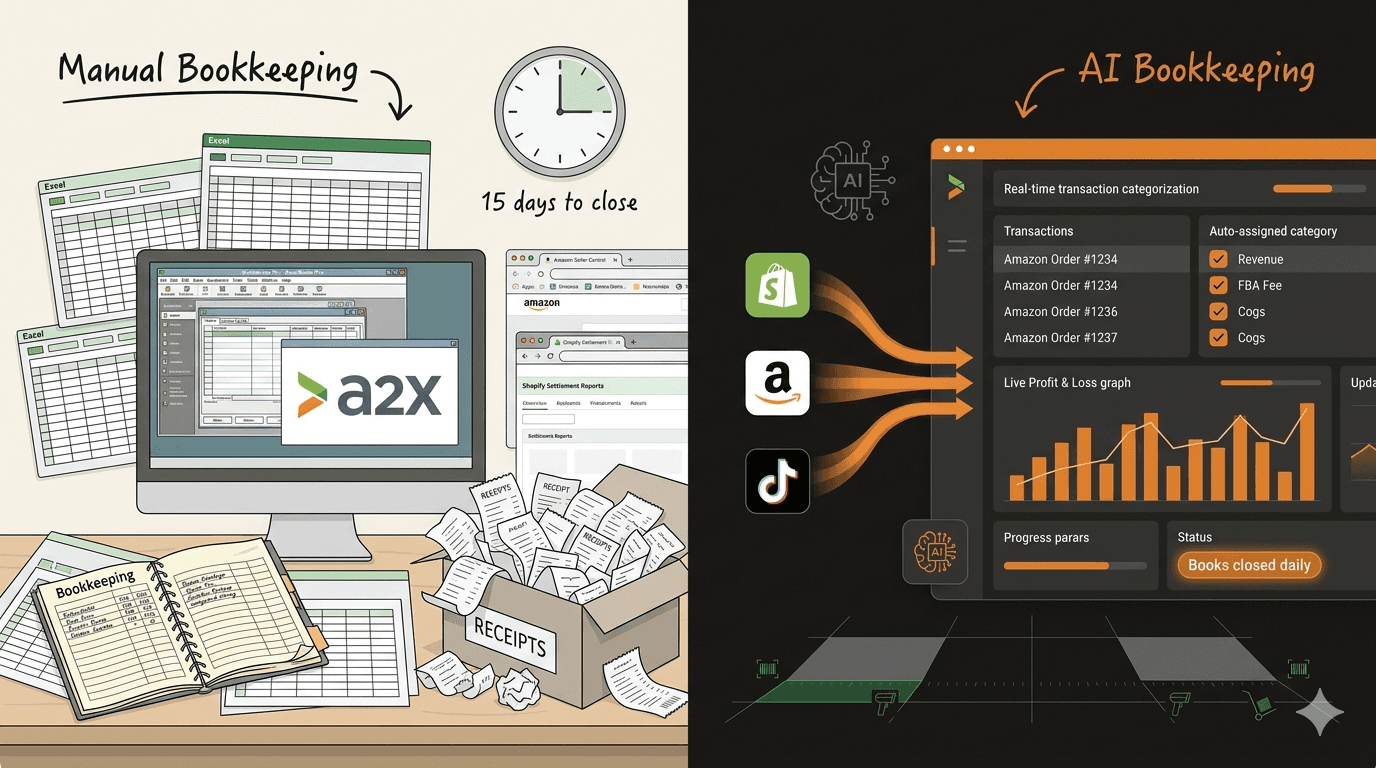



No. AI will not replace accountants, and the employment data says so directly: the Bureau of Labor Statistics projects accountant and auditor employment to grow 5 percent from 2024 to 2034, faster than the average occupation, with about 124,200 openings a year. What AI is replacing is a large share of what accounting work consists of: the execution layer of categorization, reconciliation, data entry, and report assembly.
Both halves of that answer matter. The people asking this question are usually asking one of three different things: accountants wondering about their careers, founders wondering whether they still need an accountant, and finance leaders wondering how to staff. The honest answer differs for each, so this post takes them in turn.
What does the data actually say?
Start with the numbers, because the doom headlines rarely include them. Alongside the 5 percent growth projection, the BLS makes a specific prediction about automation: routine tasks like data entry will be automated, and this "is not expected to reduce overall demand." Instead, it expects automation to make accountants' advisory and analytical duties more prominent. Median pay for accountants and auditors was $81,680 as of May 2024, against $49,210 for bookkeeping and accounting clerks, and that gap is the labor market pricing exactly this split: judgment earns more than execution, and execution is what automates.
None of this means nothing changes. It means the change has a shape, and the shape is task-level, not job-level. The projections themselves deserve some humility too: BLS forecasts have historically missed technology inflections, so treat them as a considered baseline rather than a guarantee.
What accounting work is AI actually taking over?
The execution layer automates first because it is high-volume and checkable against ground truth:
- Transaction categorization and coding
- Bank and card reconciliation
- Invoice generation, payment matching, and collections follow-up
- Bill capture, coding, and payment-run preparation
- Deferred revenue schedules and routine journal entries
- Close checklists and subledger tie-outs
- Metric computation and report assembly
Notice what the list has in common: every item is work that, at a startup, either consumes a founder's nights or gets bundled into an outsourced bookkeeping subscription. It is also the work where AI can be held accountable, because every action lands as a traceable entry on the general ledger. Our overview of AI in accounting covers the mechanics of each; the short version is that AI does the doing, and people approve.
What stays human?
Three categories, and they are stable:
Judgment. Accounting policy choices, revenue recognition interpretations, what a forecast assumption should be, whether the company can afford the third engineer. AI can maintain the model that informs these calls; it does not make them.
Accountability. Tax filings, audit signatures, anything a regulator or investor needs a licensed human to stand behind. CPAs are not a transitional arrangement. Year-end goes through one regardless of how automated the year was.
Relationships. Explaining the numbers to a board, negotiating with a vendor, walking a founder through a hard tradeoff. The BLS's "advisory duties become more prominent" prediction is precisely this: as execution automates, the human work concentrates where trust and context live.
For accountants, that reads as a career direction rather than a threat: the profession is shifting up the stack, away from the clerical work that the bookkeeper pay gap already undervalued, toward the advisory work that commands accountant-level pay.
The strongest counterargument to that sunny read deserves naming honestly. The junior roles AI absorbs first are the same roles that have traditionally trained future CPAs, and that collides with a CPA pipeline already short on entrants. If entry-level work automates faster than firms redesign how they develop people, the profession could face a mid-career gap the employment projections do not capture. That debate is live, and pretending it is settled would be selling past the evidence.
What does this mean for startups?
Here is the part the career-anxiety framing misses entirely: most startups asking "will AI replace accountants" do not have an accountant. Pre-seed through Series A, the "accounting department" is a founder with QuickBooks at midnight, maybe an outsourced bookkeeper working in monthly batches. There is nobody to replace.
For that company, AI is not a replacement question. It is a coverage question: work that was going undone, or done late, or done by the most expensive person in the company, can now be done continuously by an AI finance team. At Futureproof, that means six agents covering bookkeeping, receivables, payables, forecasting, revenue metrics, and investor reporting for $1,000 per month flat, replacing the team a startup would eventually hire underneath its finance leader, not the leader.
The division of labor lands like this:
| Work | Who does it now |
|---|---|
| Categorization, reconciliation, close prep | AI agents, continuously |
| AR follow-ups, bill capture, payment prep | AI agents, with human approval on payments |
| Metrics, forecasts, investor reporting | AI agents maintain; humans set assumptions |
| Accounting policy, strategy, board narrative | Founder or finance leader |
| Taxes, audits, filings | Your CPA |
And a person reviews the agents' work inside the product: every plan includes a monthly review call with a human financial specialist. When judgment work grows past that, the common sequence is to bring in a fractional CFO on top of already-clean books, which makes their hours dramatically more productive.
FAQ
Will AI replace accountants? No. The BLS projects 5 percent employment growth for accountants and auditors through 2034 and expects automation to shift the profession toward advisory work. AI replaces execution tasks, not the accountant.
Will AI replace bookkeepers? Bookkeeping is the most automatable layer, and AI now performs most of it: categorization, reconciliation, and close preparation, with human review. The durable human work sits in cleanups, complex cases, and review, where context matters more than throughput.
Do startups still need a CPA if they use AI accounting? Yes. AI produces clean, documented books and a year-end package; a CPA turns that into tax filings and stands behind them. The two are complements.
Should a startup hire an accountant or use AI? Before Series A, most startups need execution coverage rather than a full-time hire: current books, paid bills, collected invoices, and credible numbers. An AI finance team covers that for $1,000 per month; the first finance hire then inherits clean books instead of a cleanup project.
The bottom line
AI is replacing accounting work, not accountants, and the distinction is not spin. It is visible in the labor data, in the pay gap between execution and judgment, and in what actually automates well. Accountants move up the stack. Startups get coverage they never had. And the finance leader's job, at every company size, remains the one thing no model does: deciding what the numbers should mean.
Start a 14-day trial of Futureproof, no credit card required, and see what the execution layer looks like when it runs itself.