


A good burn rate is a net burn your runway and growth can justify. As a rule of thumb, hold 18 to 24 months of runway after each raise and spend no more than $2 for every $1 of net new ARR you add. Most healthy seed-stage SaaS startups burn $50,000 to $150,000 per month.
That one-paragraph answer hides a lot of nuance. The right burn rate for a three-person pre-seed team looks nothing like the right burn rate for a 30-person Series A company, and the same dollar figure can be disciplined at one stage and reckless at the other. This guide gives you the benchmark ranges by stage, the assumptions behind them, and the two tests investors run before they decide whether your burn is fuel or a warning.
Why "good" depends on stage, not a single number
Burn rate is the pace at which a startup spends its cash reserves, usually measured monthly. Founders searching for a single "good" number tend to get definitions instead of benchmarks, because most published guides stop at the formula. The honest answer is that burn is only meaningful relative to three things: how much cash you hold, how fast you are growing, and what milestone the money is supposed to buy.
Those three variables shift at every funding stage. Pre-seed money buys a working product. Seed money buys early revenue and evidence of product-market fit. Series A money buys a repeatable go-to-market motion. A burn rate that funds the right milestone with margin to spare is good. A lower burn rate that leaves you short of the milestone is not.
This post is part of our complete guide to runway, burn rate, and cash flow, which covers the full system: forecasting, extending runway, and managing cash week to week.
Gross burn vs. net burn: which one benchmarks measure
Before comparing numbers, be precise about which number you mean. Gross burn is your total monthly cash out: payroll, rent, software, contractors, everything. Net burn is gross burn minus the cash revenue you collect in the same month. A company spending $120,000 and collecting $70,000 has a gross burn of $120,000 and a net burn of $50,000. One boundary worth stating: net burn excludes financing inflows. A fundraise or a loan lands in the same bank account, but it does not reduce your burn.
Benchmarks, runway math, and investor conversations almost always use net burn, because net burn is what actually drains the bank account. Gross burn still matters as a discipline check. If revenue dips, gross burn is the number you are suddenly exposed to. Watching both is one reason we argue that cash flow and profitability are different questions, and that founders need to track cash directly rather than inferring it from the P&L.
How to calculate your burn rate
The calculation is simple once your books are current. Take your total cash across all accounts at the start of a period, subtract the balance at the end, and divide by the number of months. Over a quarter, a company that started with $1.8 million and ended with $1.5 million has an average net burn of $100,000 per month.
Use a three-month average rather than a single month, because one-time payments like annual software renewals or a quarterly tax bill distort any single month. Then divide current cash by that average to get runway in months. The formula takes thirty seconds; the hard part is trusting the inputs, which depends on bookkeeping that is actually up to date.
Burn rate benchmarks by stage (2026)
The ranges below are Futureproof rules of thumb, built from the public data available as of 2026 and from what we see across early-stage SaaS companies. The most widely cited public dataset remains OpenView's SaaS Benchmarks report, which put median monthly burn at roughly $50,000 for companies under $1 million in ARR and about $175,000 for companies between $1 million and $5 million in ARR. Note the vintage: that anchor is the 2023 edition, and OpenView has since wound down, so the data is a static snapshot rather than a refreshed index. That is one more reason to lean on the rules of thumb below rather than the medians. Medians also hide a wide spread, so treat the ranges as a sanity check, not a target.
| Stage | Typical monthly net burn | Typical team size | Assumptions behind the range |
|---|---|---|---|
| Pre-seed | $15K to $50K | 2 to 5 | Pre-revenue or first pilot customers. Founders on reduced salaries. A $500K to $1M raise should cover 15 to 24 months. |
| Seed | $50K to $150K | 5 to 15 | Under $1M ARR, product in market. Consistent with the ~$50K median for sub-$1M ARR companies in OpenView's data. A $2M to $4M raise should cover 18 to 24 months. |
| Series A | $150K to $350K | 15 to 40 | $1M to $5M ARR with a repeatable sales motion. OpenView's median for this ARR band was about $175K per month. Burn multiple, not absolute burn, becomes the test. |
Two notes on reading the table. First, as an industry rule of thumb, payroll drives 70 to 80 percent of burn at most software startups, so team size predicts burn better than stage labels do. If your headcount sits at the top of a range while your revenue sits at the bottom, your burn is high for your stage regardless of what the raw dollar figure suggests. Second, these are net burn figures for SaaS companies. Hardware, biotech, and inventory-heavy businesses run structurally higher burn and need different benchmarks. Gross margin cuts the same way within SaaS: a 60 percent gross margin company at "benchmark" burn is in worse shape than an 80 percent margin company at the same burn, because less of every revenue dollar is left to offset the spending.
Pre-revenue companies need a different frame, since net burn equals gross burn and efficiency ratios do not exist yet. The test is milestone coverage: your raise divided by your monthly burn must reach the milestone that unlocks the next round, with three to six months of buffer for the raise itself. A pre-seed team burning $30,000 per month on a $750,000 raise has 25 months of runway, which is comfortable. The same burn on a $400,000 raise leaves 13 months, which means the milestone clock is already tight on day one.
The market context matters too. After the 2021 funding peak, investors reset their expectations for spending discipline, and that reset has held through 2026. Rounds take longer to close than they did five years ago, which is why the old 12-to-18-month runway convention has stretched to 18 to 24 months. A burn rate that was fundable in 2021 can be disqualifying today at the same growth rate.
The burn multiple: the test investors actually run
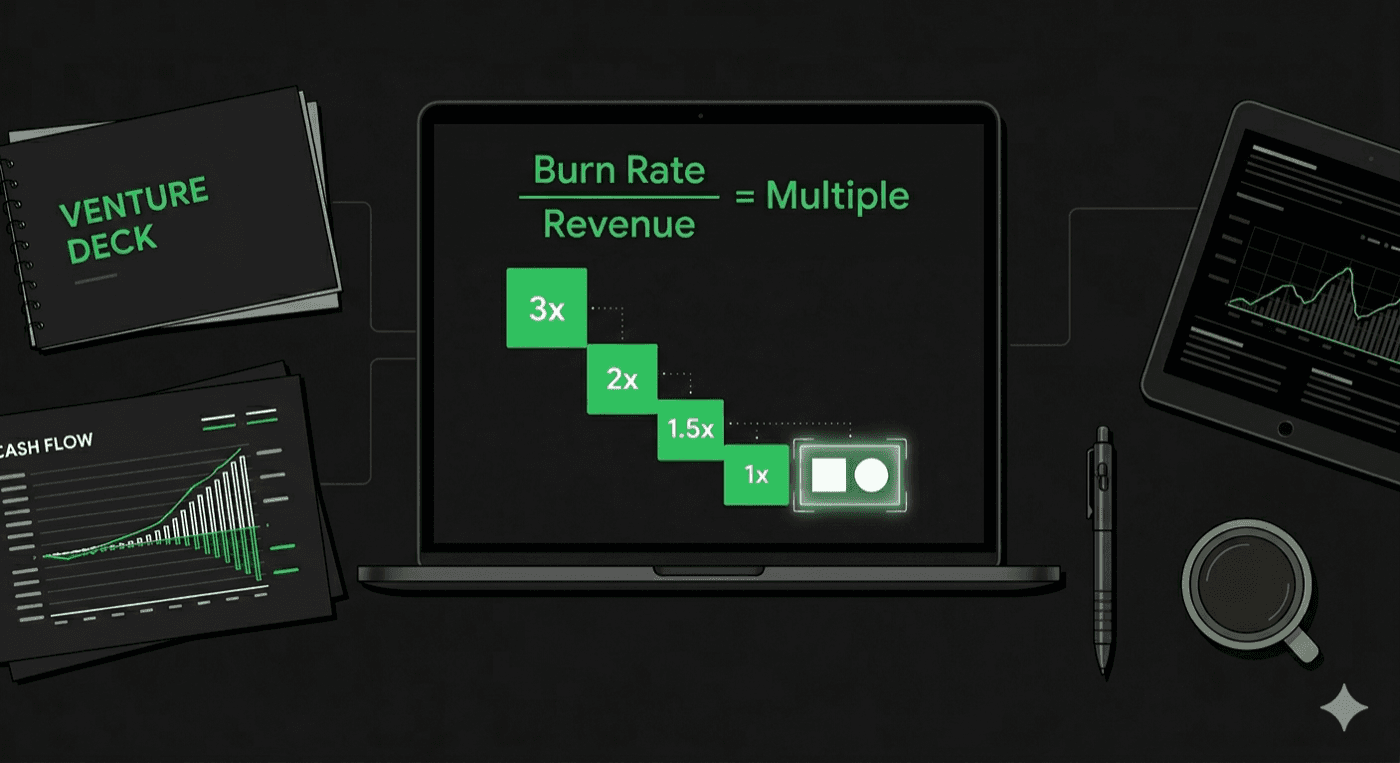
Absolute burn tells investors how big you are. Efficiency tells them whether the burn is working. The standard efficiency test is the burn multiple: net burn divided by net new ARR over the same period. A company that burns $1.5 million in a year while adding $1 million of net new ARR has a burn multiple of 1.5, meaning it paid $1.50 for each new recurring dollar.
The framework most investors reference comes from David Sacks's original Craft Ventures essay: below 1 is excellent, 1 to 1.5 is great, 1.5 to 2 is good, 2 to 3 is suspect, and above 3 signals real trouble for a venture-backed SaaS company. Early seed companies get grace because small ARR bases distort the ratio, but by Series A the multiple carries more weight than the dollar figure. A $300K monthly burn with a burn multiple of 1.2 reads as efficient growth. A $100K burn with a multiple of 4 reads as a leak.
We cover the mechanics, the stage adjustments, and the ways founders accidentally flatter this number in our full guide to the burn multiple.
When a "good" burn rate is still fatal
A burn rate can sit inside every benchmark range and still kill the company. The failure mode is what Paul Graham called "default dead" in his 2015 essay: at current burn and current growth, the company does not reach profitability before the cash runs out, and survival depends entirely on raising again. Benchmarks say nothing about whether that next raise will happen.
The math is worth running explicitly. Divide cash on hand by monthly net burn to get runway in months, then subtract the six or more months a raise typically takes from first meeting to money in the bank. What remains is the time you actually have to hit the milestone that justifies the round. Our startup runway calculator does this arithmetic for you and lets you model how hiring or cutting changes the answer.
Founders also tend to overestimate runway because they use average burn instead of forward burn. Annual contracts, seasonal hiring, and deferred payments create lumpy months, and the compression usually surfaces about a quarter before it becomes a crisis. That pattern, and what to do inside it, is the subject of our guide to the 90-day cash crunch. For the longer list of levers that extend the window before you get there, see our playbook on runway management.
Keeping burn in range without a finance hire
Most early-stage founders check burn when the books close, which means the number is three to six weeks old by the time they see it. At seed-stage burn rates, a hiring decision or a churned contract can move runway by months inside that blind spot. The fix is not more spreadsheets. It is books that stay current and a forecast that reads them continuously.
That is how Futureproof approaches it. Vic, our bookkeeping agent, keeps transactions categorized as they happen, and Margo, our FP&A agent, forecasts cash and runway from those live books. Burn becomes a number you check weekly, with the same freshness as your sales pipeline, instead of a surprise in the month-end package. The full six-agent finance team costs $1,000 per month flat, with no per-seat fees.
Frequently asked questions
Is a high burn rate always bad?
No. Burn is bad when it outruns growth or shortens runway past the point of recovery, not when it is merely large. A Series A company burning $250,000 per month with a burn multiple under 1.5 and 20 months of runway is in a stronger position than a seed company burning $40,000 with flat revenue. Judge burn against growth and runway, never in isolation.
How do investors evaluate burn rate?
Investors run three checks. They compare your net burn to stage norms like the table above, they compute your burn multiple to test efficiency, and they check whether your runway covers the next milestone plus a fundraising window. Clean, current books help here, because a founder who cannot state last month's net burn precisely raises doubts about everything downstream.
What burn multiple is good?
Using the framework David Sacks popularized, a burn multiple below 1 is excellent, 1 to 1.5 is great, 1.5 to 2 is good, and anything above 2 needs a story. Early seed companies get more latitude because small revenue bases inflate the ratio. By Series A, most investors want to see the multiple at 2 or below and trending down.
How much runway should a startup keep?
As of 2026, the standard advice is to raise for 18 to 24 months of runway and to start correcting course whenever projected runway falls under 12 months. Fundraising takes six months or more, so 12 months of runway really means about six months of operating room. Falling under six months without a term sheet in hand is an emergency, whatever your burn rate is.
Know your burn before someone asks
Every benchmark in this post assumes you know your actual net burn, this month, with confidence. That is the real gap for most early-stage teams, and it is the one an AI finance team closes first. Start with Futureproof and get live books, a weekly view of burn, and a runway forecast that updates itself.