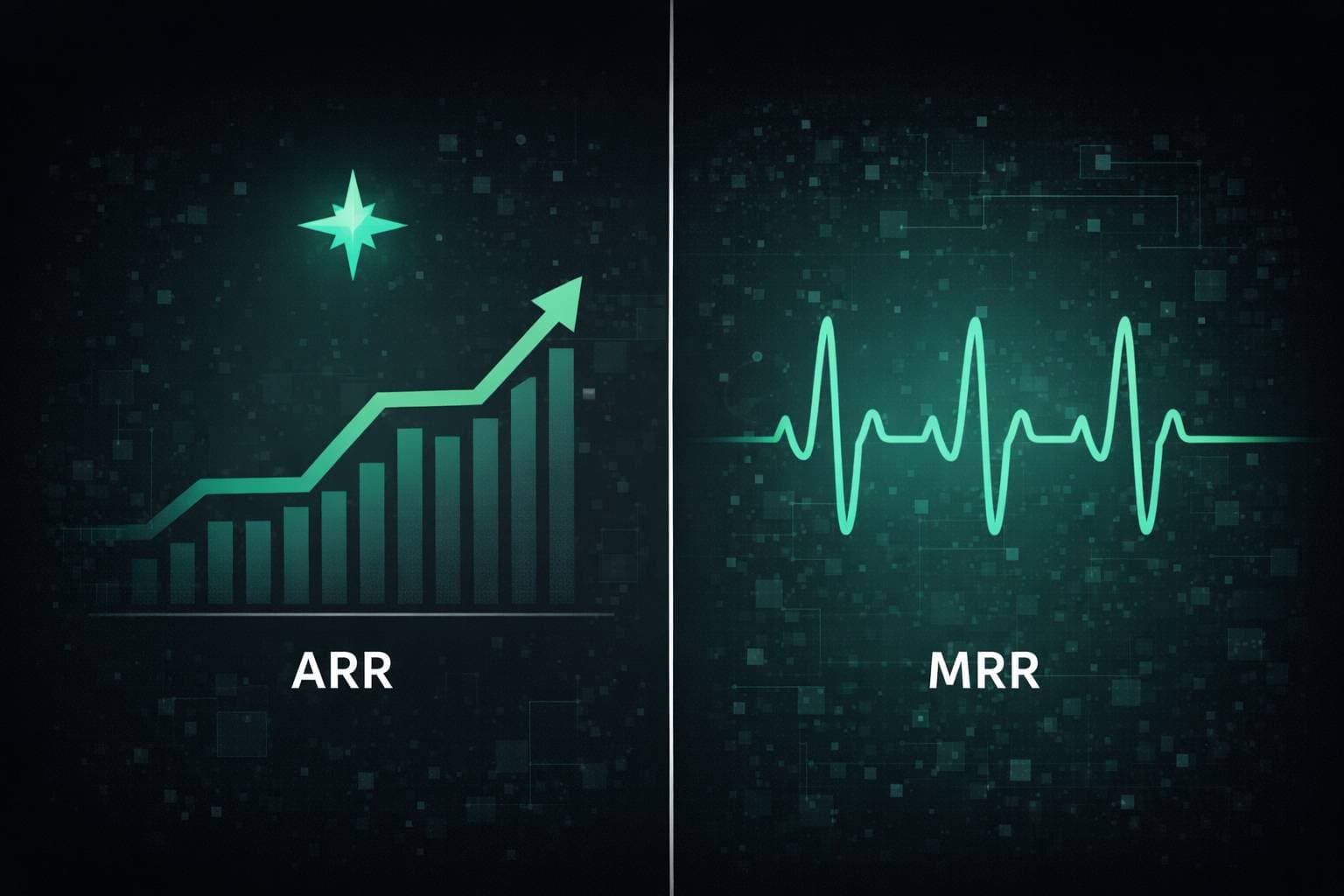



ARR and revenue measure different things, which is why they almost never match. ARR is a snapshot metric: the annualized value of your recurring contracts as of today, looking forward. GAAP revenue is an earned amount: what you actually delivered during a period under revenue recognition rules, looking backward. One is a speedometer, the other is an odometer, and confusion between them is the single most common metrics mistake first-time SaaS founders make in front of investors.
The mismatch is not an error to fix. It is information, and once you can explain the gap between the two numbers, both become more useful. This guide covers what each measures, the specific reasons they diverge, and which number belongs in which conversation.
What is ARR actually measuring?
ARR annualizes the recurring revenue in force right now: active subscription contracts, normalized to a yearly run rate. Sign a $12,000 annual contract today and ARR increases by $12,000 today, even though you have earned none of it yet. Cancel it next month and ARR drops by $12,000 next month, even though the cash may be in your bank and partially earned.
ARR is a contract-momentum metric. It answers "how big is the business as currently subscribed," which is why growth conversations, valuations, and comparisons run on it. It is also a defined-by-you metric: ARR is not part of GAAP, so its credibility depends entirely on your definitional discipline, chiefly that it includes only genuinely recurring revenue. Two edge cases worth settling early: CARR (contracted ARR) counts signed contracts not yet live and should be labeled separately from live ARR, and usage-based revenue typically enters ARR as a trailing-average annualization (say, trailing three months times four), a policy you disclose rather than a standard you inherit. The related-metric zoo (ACV, TCV, MRR) is untangled in our ACV vs ARR vs TCV vs MRR guide.
What is GAAP revenue actually measuring?
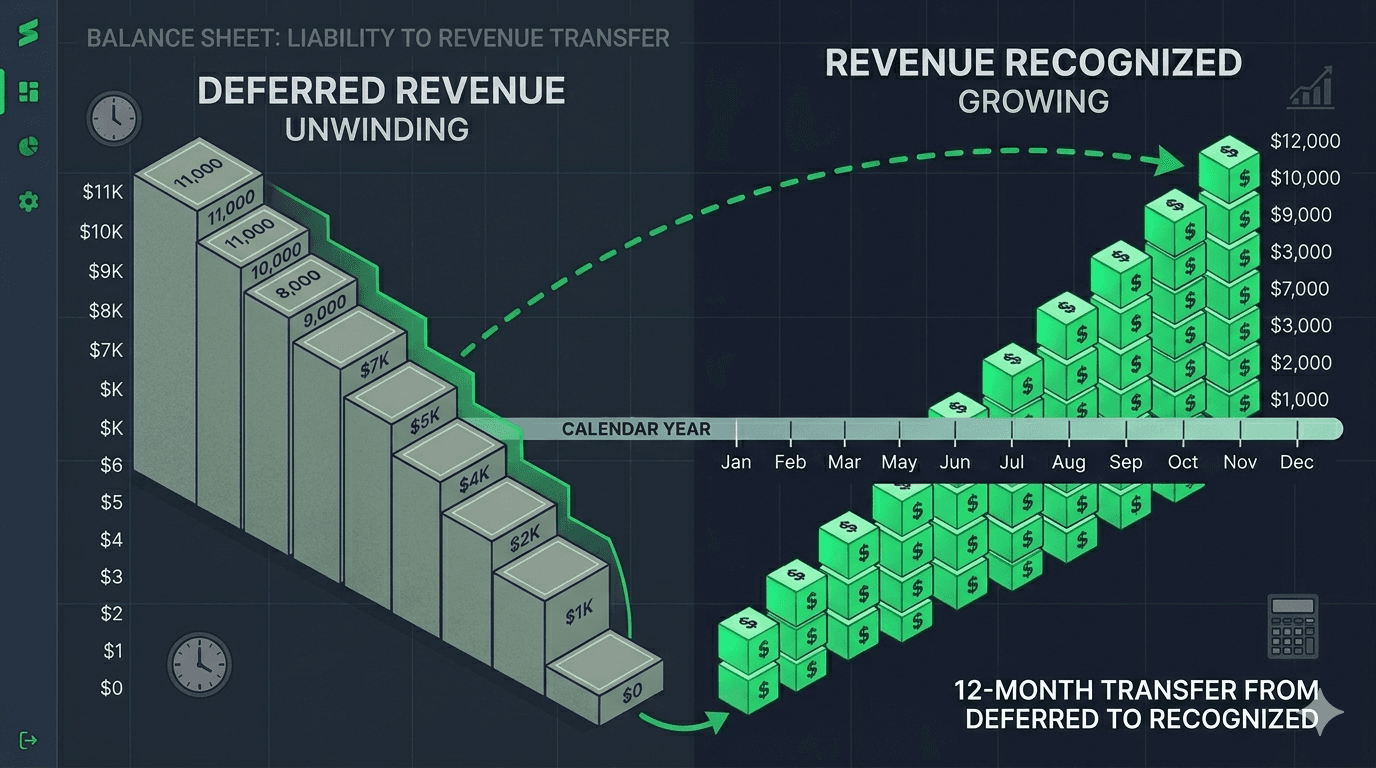
Revenue is what you earned in a period by delivering the service, recognized under accrual accounting as performance obligations are satisfied, not when cash arrives. That $12,000 annual prepay becomes $1,000 of revenue per month across the year; the unearned remainder sits in deferred revenue as a liability. The full framework lives in our ASC 606 revenue recognition guide.
Revenue is the number your financial statements, your taxes, and your diligence run on. Unlike ARR, you do not get to define it.
Why don't ARR and revenue match?
Six structural reasons, all normal:
| Source of divergence | Effect |
|---|---|
| Timing: ARR moves at signing, revenue moves with delivery | ARR leads revenue in growth periods |
| One-time and services revenue counts in revenue, never in ARR | Revenue can exceed ARR/12 in heavy-services months |
| Mid-month starts and partial periods | Revenue prorates; ARR does not |
| Churn timing: when ARR drops is a policy choice; many teams, and most diligence analysts, drop annual-contract ARR at term end or non-renewal rather than at the cancellation notice | Pick one convention and disclose it |
| Usage-based components | In revenue when earned; in ARR only per your policy |
| Discounts, credits, and refunds | Hit revenue precisely; hit ARR per your definition |
A worked example makes it concrete. On March 15 you sign a $12,000 annual deal and bill it upfront. ARR on March 31: up $12,000. March revenue from that deal: roughly $500 (half a month). Cash: $12,000. Deferred revenue: $11,500. Four different numbers, all correct, each answering a different question. If your monthly revenue times twelve roughly trails your ARR while you grow, things are working as designed; a fast-growing company's revenue chases its ARR the way an odometer chases a speedometer.
Which number do investors want?
Both, for different jobs. Growth and momentum conversations run on ARR; it is the language of SaaS benchmarks and valuation multiples. Diligence runs on GAAP revenue and its reconciliation to ARR, because that reconciliation is where inflated ARR definitions go to be discovered. The dangerous position is quoting an ARR you cannot tie back to recognized revenue and billing data; a founder who can bridge the two numbers on request reads as someone whose books can be trusted, a theme our guide to ARR, MRR, and SaaS financial health expands on.
The bridge itself is smaller than it sounds. Using the March deal above plus an existing book of business, it fits in six lines:
| Line | Amount |
|---|---|
| ARR at March 1 | $60,000 |
| + New and expansion ARR (the March 15 deal) | $12,000 |
| − Churned ARR | $0 |
| = ARR at March 31 | $72,000 |
| GAAP revenue recognized in March | $5,500 |
The reconciliation note under it does the real work: March revenue is $5,000 earned from the existing $60,000 base (one month at $60,000 divided by 12) plus roughly $500 from the half-month of the new deal, and every gap between the two numbers traces to the timing and proration differences in the table above.
The practical rule: lead with ARR in the pitch, report both in the data room, and never let the two be computed by different people from different sources.
How do you keep ARR and revenue tied together?
The failure mode is architectural: revenue lives in the accounting tool while ARR lives in a spreadsheet fed from the billing system, maintained by different hands, and the two drift until an investor notices. The fix is computing both from the same reconciled foundation, the ledger and billing data, so the bridge between them is a report rather than a project.
That is how an AI finance team handles it: at Futureproof, Hugo computes ARR and MRR from billing data while the ledger's recognized revenue and deferred revenue schedules stay reconciled underneath, so "walk me from ARR to revenue" is an answer, not an assignment. It is part of the same $1,000 per month plan as the bookkeeping that keeps the foundation clean.
FAQ
Is ARR the same as annual revenue? No. ARR annualizes current recurring contracts (forward-looking); annual revenue is what you earned over twelve months (backward-looking). They converge only in a steady state with no growth, churn, or non-recurring revenue.
Why is my ARR higher than my revenue? Usually growth: ARR moves the moment contracts sign, revenue accrues as you deliver. New bookings raise ARR immediately while their revenue arrives month by month.
Is ARR a GAAP metric? No. ARR is a non-GAAP operating metric with no standardized definition. Its credibility comes from a disciplined definition and a clean bridge to GAAP revenue.
Which should a startup report to investors? Both: ARR for growth discussions, GAAP revenue in financial statements, and the reconciliation between them ready for diligence.
The bottom line
ARR tells you how big the machine is as configured; revenue tells you what the machine actually produced. They are supposed to differ, the difference is diagnostic, and the only real mistake is running them from two disconnected sources so that nobody can explain the gap. Compute both from one foundation, and the question disappears.
Start a 14-day trial of Futureproof, no credit card required, and see ARR and recognized revenue computed from the same reconciled books.