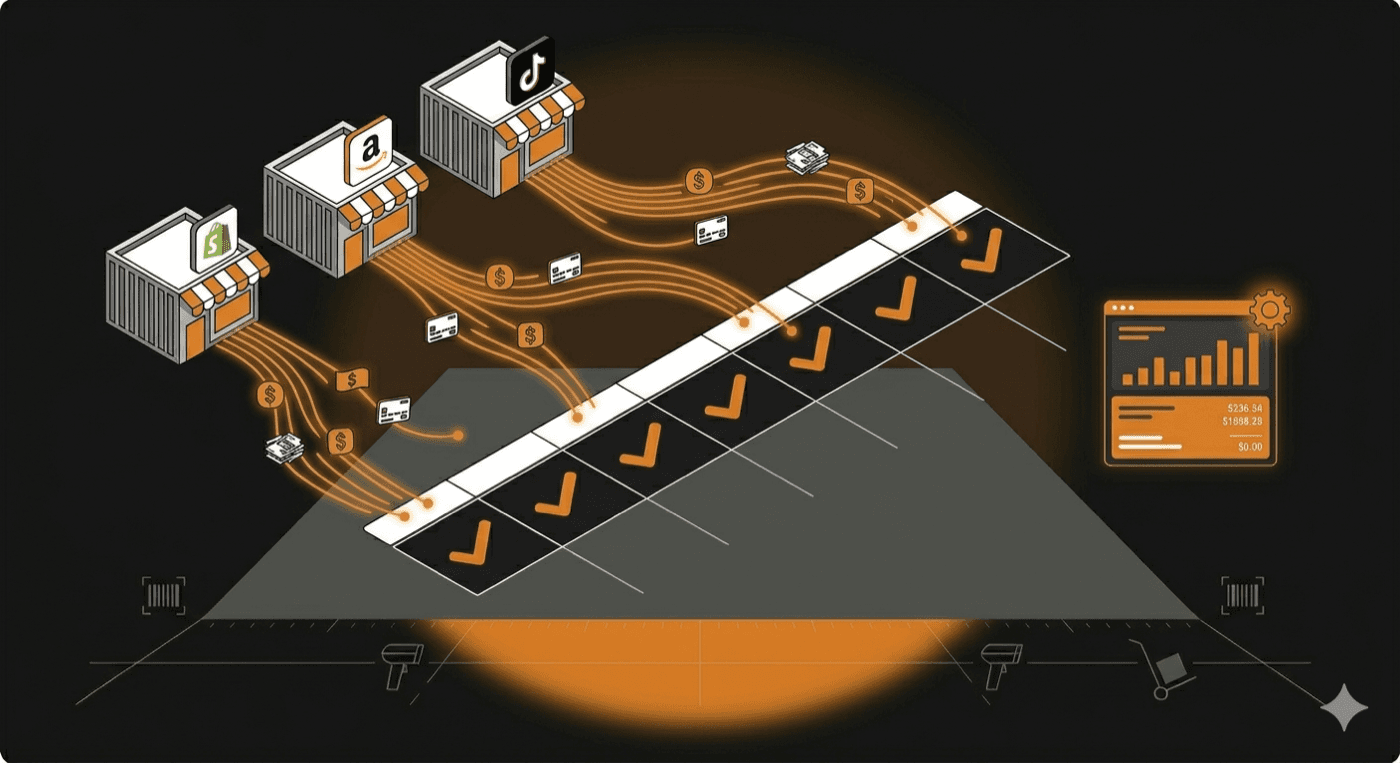



Ecommerce accounting software is rarely one product. Most operators assemble a stack: a general ledger, connector apps to pull in channel data, a profit dashboard, and a human bookkeeper to hold it together. The stacks work, up to a point. This guide covers the three ways operators typically build them, what each really costs, and when a single ledger beats the pile.
It is part of our complete guide to ecommerce accounting.
What does the typical ecommerce accounting stack look like?
After talking to operators across Amazon, Shopify, eBay, and TikTok Shop, the same three architectures show up again and again.
Stack one: the DIY ledger. A small-business accounting subscription, plus one connector app per channel to sync orders, plus a spreadsheet where the real analysis happens. You are the bookkeeper. This is where almost everyone starts, and it holds until channel volume makes weekly categorization a second job.
Stack two: profit dashboard plus bookkeeper. A seller analytics tool shows margin and PPC performance in near real time, while an outsourced bookkeeper keeps the official books a month behind. This is the most common setup for growing sellers, and it has a structural flaw: the dashboard and the books are two different systems doing two different calculations. When they disagree, and they will, you do not know which number to trust.
Stack three: ops platform plus accountant. An inventory or order-management platform runs operations and syncs summaries into the ledger, and an accounting firm closes the books. This is the upmarket version, and even the platforms themselves are candid about the boundary: they sync to your accounting software, they do not do your accounting. Someone still has to own the close, the reconciliation, and the question of what the numbers mean.
What does each stack actually cost?
The software subscriptions are the small part. The real line item is the humans stitching the stack together.
| Stack | Software | People | Realistic monthly total |
|---|---|---|---|
| DIY ledger + connectors | $100-$300 in subscriptions | Your own nights and weekends | Low cash cost, high founder-hours cost |
| Dashboard + bookkeeper | $150-$500 in subscriptions | Bookkeeper at $500-$2,000 | $650-$2,500 |
| Ops platform + accountant | $300-$1,500 in subscriptions | Bookkeeping plus controller-level review at $2,500-$7,000 | $2,800-$8,500 |
The people numbers come from published market rates: Eightx's 2026 pricing guide puts bookkeepers at $500 to $2,000 per month and controllers at $2,500 to $7,000, and that is before any strategic finance help, which runs $175 to $450 per hour at fractional CFO rates. For more on that top layer, see our guide to virtual CFO services.
Where do the stacks leak?
Three leaks show up regardless of which stack you run.
The dashboard and the ledger disagree. Analytics tools estimate fees from rate cards; your settlement reports contain the actual fees, reserves, and adjustments. The gap between estimated and actual is usually small per order and meaningful per quarter. If your margin number comes from a dashboard, it is a good guess, not an accounting fact. Our fee calculators are useful for pricing a product; your books are how you know what you kept.
Nobody owns the close. The connector app syncs summaries, the bookkeeper categorizes what they see, the dashboard runs its own math, and at month end the question "are these numbers final?" has no single owner. Payouts that do not tie back to orders, refunds booked in the wrong period, inventory that eats cash silently: these live in the seams between tools.
Every added channel multiplies the seams. A second marketplace means a second connector, a second settlement format, and a second way for the dashboard and books to diverge. The stack that worked at one channel quietly stops working at three.
When does one ledger beat the stack?
When the thing you actually want is the answer, not the assembly project. Futureproof replaces the stack with one ledger and a team that runs it: every order, fee, refund, and payout booked at the transaction level, settlements reconciled back to the deposit, margin per SKU and per channel computed from the books rather than estimated beside them. Amazon and eBay are fully live, Shopify is in beta, and TikTok Shop is coming.
The economics land in the middle of the table above: $1,000 per month flat for all six agents, with a monthly review call with a human financial specialist included. That is dashboard-plus-bookkeeper money for ops-platform-plus-accountant coverage, and the dashboard-versus-books disagreement disappears because there is only one set of numbers.
The honest boundary: if you love your current ops platform for purchasing and warehouse work, keep it. The stack problem is the accounting layer, and that is the layer worth consolidating first.
FAQ
What software do I need for ecommerce accounting?
At minimum, a general ledger that captures orders, fees, refunds, and payouts at the transaction level for every channel you sell on. Most operators add connector apps and a profit dashboard, then a bookkeeper to run the ledger. An AI finance team like Futureproof collapses those layers into one system for $1,000 per month, human review included.
Can I just use a profit dashboard instead of accounting software?
No. Dashboards estimate margin from rate cards and API data; they are not books. You still need a ledger for taxes, lending, and knowing your true numbers, and running both means two systems that can disagree. Dashboards are a fine analysis layer; they cannot file, close, or reconcile anything.
How much should an ecommerce operator spend on accounting?
Published market rates put a bookkeeper at $500 to $2,000 per month and controller-level review at $2,500 to $7,000, plus software. A reasonable benchmark: if your all-in accounting cost is above about $1,000 per month and your margin number still comes from a dashboard rather than your books, you are paying premium rates for numbers you still cannot rely on.
When should I move off the DIY stack?
When categorizing transactions competes with running the business, or when a second sales channel arrives. Multi-channel is the breaking point: every added channel multiplies the reconciliation work faster than revenue grows.
Ready to retire the stack? Start a 14-day trial or book a demo and see your real margin per SKU, from your actual books.