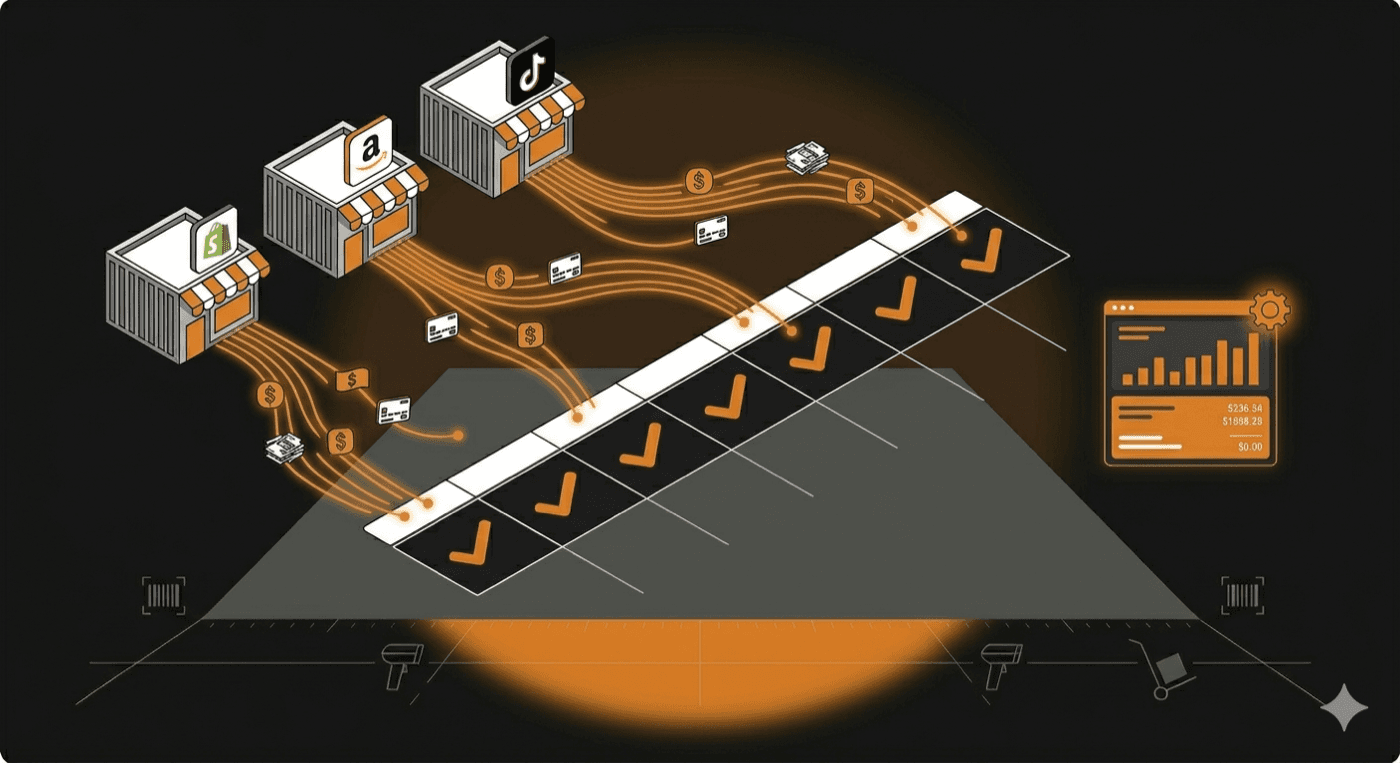



The Cin7 QuickBooks Online integration pushes your operational activity into your accounting file. Sales orders, purchase orders, invoices, payments, credit notes, inventory adjustments, and cost of goods sold flow from Cin7 into the general ledger accounts you map. Cin7 runs inventory and orders. QuickBooks stays the accounting record.
This is part of our complete guide to ecommerce accounting.
What does the Cin7 QuickBooks integration actually do?
Cin7 is direct about the division of labor. On its QuickBooks Online integration page, the answer to "Does Cin7 replace QuickBooks Online?" is no: QuickBooks Online "stays your source of truth for accounting and financial reporting," while Cin7 "handles inventory, orders, purchasing, and operations." That is a clear, well-drawn boundary, and it is the right one for an inventory platform to draw.
Setup follows four steps on Cin7's own description: connect the QuickBooks account from inside Cin7, map which QuickBooks accounts your sales, purchases, COGS, and adjustments post to, choose sync frequency and how tax and multi-currency are handled, then let transactions flow. Cin7 lists the synced objects as sales orders, purchase orders, invoices, payments, credit notes, inventory adjustments, and COGS, moving in both directions in a controlled way.
Cin7's accounting feature page adds the operational pieces around that sync: automated COGS calculation across materials, labor, and overhead, batch and expiration tracking, landed cost calculation that factors duties and freight, and multi-location stock. For a product business with real warehouse complexity, that is strong work, and none of it is what a general ledger does well on its own.
So the sync does what it says. The question is what happens after it finishes.
What does the sync not do?
Mapping is not closing. Once transactions land in QuickBooks with the right account codes, someone still has to turn a populated ledger into a finished month.
Start with money. Your marketplace does not deposit the sum of your invoices. It deposits net proceeds after referral fees, fulfillment fees, advertising, refunds, reserves, chargebacks, and timing adjustments, often on a settlement cycle that ignores your calendar month. Tying that deposit back to the orders and fees inside it is reconciliation work, and it sits downstream of any inventory sync, because the fees were never in the inventory system to begin with.
Then the close itself, none of which the sync touches: cutoff on orders that shipped in one period and settled in another, accruals for the ad invoice that arrives late, refunds and returns landed in the right month, inventory adjustments reviewed rather than accepted, and prepaid balances for a freight deposit paid in June against goods received in August.
Then the questions that come after the books are done. Which SKU actually earned money last quarter in accounting terms, not dashboard estimates. Whether you can fund a $60,000 purchase order in November and still cover payroll in January. Those are finance questions, not sync questions.
Cin7 acknowledges this boundary the way a software company can: it runs an Accounting Partner Network for accountants and bookkeepers, with Referral and Service partner tracks, so its customers have a human to hand the accounting work to. That network exists because the work exists.
Who closes the month once the sync is running?
Here is the split.
| Work item | Handled by the Cin7 QuickBooks sync | Still needs a person or another system |
|---|---|---|
| Sales, purchases, invoices, credit notes posted to the ledger | Yes, per your account mapping | Reviewing that the mapping still fits as channels change |
| COGS on inventory movement | Yes, calculated in Cin7 and pushed through | Confirming costing method and adjustments at period end |
| Landed cost on imported goods | Calculated in Cin7 | Judgment on what belongs in cost versus period expense |
| Marketplace fees, ads, refunds, reserves | No, these never enter the inventory system | Pulled from settlement data and booked |
| Payout reconciled to bank deposit | No | Reconciliation, every cycle, every channel |
| Month-end cutoff, accruals, prepaids | No | Close process |
| Margin per SKU in accounting terms | Partially, via reporting on inventory data | Computed from booked revenue net of all costs |
| Cash and runway questions | No | Forecasting against the ledger |
The usual answer to the right-hand column is the founder plus a bookkeeper, and that arrangement works right up until you add a second or third sales channel. Each channel brings a settlement format, a fee structure, and one more way for the operational numbers and the accounting numbers to drift apart. We wrote about how that pile compounds in ecommerce accounting software: stack it or replace it.
Can you keep Cin7 and change the accounting layer instead?
Yes, and for most sellers that is the sensible order of operations. Cin7 is the operational system. If purchasing, warehouse, kitting, batch tracking, and landed cost are running well there, ripping it out solves nothing. Cin7 Core lists at $349, $599, and $1,199 per month on its pricing page, with QuickBooks Online or Xero as the accounting integration on every tier, and that spend is buying inventory control, not accounting labor.
The layer worth reconsidering is the one underneath: QuickBooks plus a bookkeeper plus whatever spreadsheet holds the margin math.
| Layer | Cin7 + QuickBooks + bookkeeper | Cin7 for ops + Futureproof for finance |
|---|---|---|
| Inventory, warehouse, purchasing | Cin7 | Cin7, unchanged |
| General ledger | QuickBooks | Futureproof's ledger |
| Channel sales, fees, refunds, payouts | Depends on connectors and manual work | Pulled from the sales channels directly and booked |
| Settlement to deposit reconciliation | Bookkeeper, manually | Reconciled in the ledger |
| Month-end close | Bookkeeper, on their schedule | Run continuously, reviewed monthly |
| Margin per SKU and per channel | Spreadsheet built after the fact | Computed from booked numbers |
| Cash and affordability questions | Founder, or nobody | Forecast against the ledger |
| Human review | Whatever your bookkeeper's engagement covers | Monthly review call with a financial specialist, included |
Futureproof is six AI agents working on a single ledger: bookkeeping, payables, revenue and margin, forecasting, channel performance, and reporting. Channel data comes straight from the sales channels. Amazon and eBay are fully live, Shopify is in beta, and TikTok Shop is coming. Settlements are reconciled back to the deposit, so the margin figure and the bank balance come from the same set of records. It is $1,000 per month flat, with a monthly review call with a human financial specialist included.
Two honest boundaries before you go further.
Futureproof does not integrate with Cin7. There is no connector, and we are not promising one. Our channel data arrives from the sales channels themselves, not from your inventory platform.
Cost data living inside Cin7 does not flow to us automatically. Landed cost calculations, supplier cost updates, and BOM changes maintained in Cin7 stay in Cin7. What does flow in is vendor bills: forward them to your Futureproof bill inbox and they become captured costs in the ledger, which covers most of what a seller actually needs booked. If your costing model is deeply built out in Cin7 and you rely on it, keep using it and treat that as the operational cost record.
What should a Cin7 seller do first?
Finish the sync. It is worth having, and the account mapping step is where most of the value is created or lost, so take your time on it with whoever will be reading the resulting financials.
Then ask one diagnostic question: when your marketplace deposit hits the bank, does anyone tie it back to the orders and fees that produced it, on a schedule, without being asked? If the answer is no, the gap is not in Cin7. It is in the accounting layer underneath, and adding another connector will not close it. More on the underlying discipline in our guide to ecommerce bookkeeping.
FAQ
Does Cin7 do accounting?
Not as a general ledger. Cin7 does inventory accounting work: COGS calculation, landed cost, batch tracking, and inventory valuation, and it pushes the resulting entries into QuickBooks Online or Xero. Cin7 states plainly that it does not replace QuickBooks Online and that your accounting platform remains the source of truth for financial reporting. Your ledger, close, and financial statements live elsewhere.
Do I need QuickBooks with Cin7?
You need an accounting system, and Cin7's supported accounting integrations are QuickBooks Online and Xero, listed on every Cin7 Core tier. If you are staying inside Cin7's native integrations, one of those two is the answer. If you are open to replacing the accounting layer entirely, the ledger can live in a system like Futureproof that pulls channel data directly and runs the close, in which case you keep Cin7 for operations and maintain cost data there manually. There is no supported Cin7 connector to Futureproof, so that is a real tradeoff to weigh, not a technicality.
Does Futureproof integrate with Cin7?
No. We connect to sales channels, banks, and cards directly. Amazon and eBay are fully live, Shopify is in beta, and TikTok Shop is coming. Vendor bills arrive through the bill email inbox. Costs maintained inside Cin7 do not transfer automatically, and we have no Cin7 integration on the roadmap to promise you.
Will the Cin7 sync give me margin per SKU?
It gives you the inventory side of it: unit cost, landed cost, and COGS on movement. Accounting margin per SKU also needs the revenue side net of referral fees, fulfillment fees, advertising, refunds, and returns, and those costs never enter the inventory platform. They come from settlement data, which is why the margin question usually ends in a spreadsheet unless something books both halves in one ledger.
Keep Cin7 for operations. If the accounting layer underneath it is the part that keeps slipping, start a 14-day trial or book a demo and see your margin computed from booked numbers.