


Inventory accounting records the products you buy as an asset on the balance sheet, then moves each unit's cost to the profit and loss statement as cost of goods sold when it sells. For ecommerce brands, getting this right is the difference between guessing at profit from a bank balance and knowing true margin per SKU.
Most guides on this topic are written for accountants. This one is written for operators, because the operator version of the problem looks nothing like a textbook. It looks like a strong sales month that your books call a catastrophe, purely because a container of stock landed and you paid for it.
Why a Profitable Month Can Look Like a Disaster
Picture a brand that sells $80,000 in March and pays a supplier $60,000 for a container of new stock in the same month. On cash-basis books, that purchase hits the profit and loss statement immediately, so March shows a brutal loss even though the products that actually sold cost far less. Then April and May show inflated profits, because units keep selling with no purchase cost recorded against them.
Neither picture is true. The brand did not lose money in March and it is not printing money in April. Cash-basis books treat inventory purchases as expenses when paid, which scrambles the timing between what you spent and what you sold. This is the core reason inventory accounting exists, and it is the foundation of ecommerce accounting done properly.
The fix is accrual accounting applied to inventory. Stock you buy is not an expense. It is money converted into a different form of asset, and it only becomes an expense when a customer takes a unit off your hands. We cover the broader method decision in accrual vs cash basis accounting, but for any brand holding physical stock, the inventory half of that decision is already made for you.
Inventory Is an Asset Until the Moment It Sells
On the balance sheet, inventory sits as a current asset alongside cash and receivables. When you buy 1,000 units, your books do not get poorer. Cash goes down (or accounts payable goes up) and inventory goes up by the same amount. Total assets are unchanged, which matches reality: you traded money for products worth that money.
The expense happens at the point of sale. When a unit sells, its cost leaves the inventory asset and lands on the profit and loss statement as cost of goods sold, in the same period as the revenue it generated. That pairing is called the matching principle, and it is what makes gross margin a real number instead of an artifact of when you happened to pay suppliers.
Here is the full flow from purchase order to profit and loss statement.
| Stage | What the books record | Where it shows up |
|---|---|---|
| Purchase order placed | Nothing yet. A commitment is not a transaction | Nowhere |
| Goods received and invoiced | Inventory increases, accounts payable increases | Balance sheet (asset) |
| Freight, duties, tariffs paid | Capitalized into inventory as landed cost | Balance sheet (asset) |
| Unit sells | Cost moves from inventory to COGS | P&L, matched to the sale |
| Stock value falls below cost | Write-down to net realizable value | P&L, in the period identified |
Every row in that table answers a question operators actually ask. Why doesn't my PO show up in my books? Why did my margin look wrong the month the container landed? Why did my accountant book an expense for stock I never sold? The flow above is the answer to all three.
Landed Cost: What Actually Belongs in Inventory
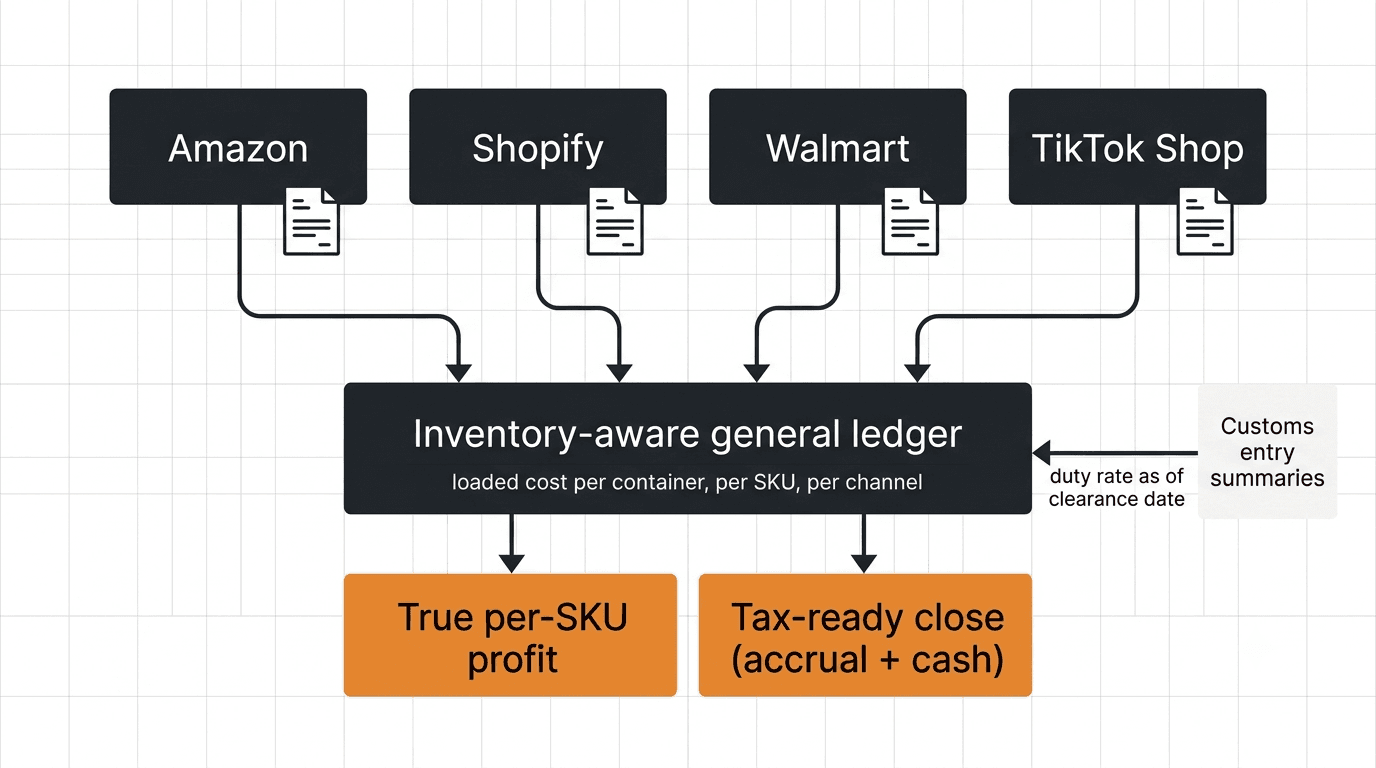
The number you capitalize into inventory is not the supplier invoice. Under GAAP, inventory cost includes everything it took to get units ready to sell: the factory price, ocean or air freight, customs duties and tariffs, and inbound handling. That total is the landed cost, and it is the real basis for per-unit profitability.
Brands that book freight and duties as generic operating expenses understate COGS and overstate gross margin, sometimes by ten points or more on imported goods. The distortion is worst for importing brands in a tariff environment, which is why we wrote a full guide to true landed cost and per-SKU profit. Outbound costs work differently: marketplace commissions, payment processing, and shipping to the customer are selling expenses, not inventory cost, though they still belong in your per-order margin math. Our ecommerce fee calculators break those down by channel.
The practical rule is simple. Costs incurred to get inventory to your warehouse ready for sale get capitalized into the asset. Costs incurred to get a sold unit to a customer get expensed as they happen.
A Worked Example: From Container to COGS
The numbers below are illustrative, but the mechanics are exactly what happens inside inventory-aware books. Suppose a brand imports 1,000 insulated bottles. The supplier invoice is $12,000, freight is $1,800, and duties are $1,200, for a landed cost of $15,000, or $15 per unit.
When the goods arrive and the invoices are booked, the entries look like this:
| Entry (illustrative) | Debit | Credit |
|---|---|---|
| Inventory | $12,000 | |
| Accounts payable (supplier) | $12,000 | |
| Inventory (freight and duties) | $3,000 | |
| Accounts payable (freight forwarder, customs) | $3,000 |
Nothing has touched the profit and loss statement yet. The brand holds a $15,000 asset. Now say 100 bottles sell in the first month at $40 each:
| Entry (illustrative) | Debit | Credit |
|---|---|---|
| Cash | $4,000 | |
| Revenue | $4,000 | |
| Cost of goods sold (100 × $15) | $1,500 | |
| Inventory | $1,500 |
The month shows $4,000 of revenue against $1,500 of COGS: a $2,500 gross profit and a 62.5% gross margin. The remaining 900 units stay on the balance sheet at $13,500 until they sell. Compare that with cash-basis books, which would have shown a $15,000 expense in month one and 100% margin every month after, and the value of doing this properly becomes obvious.
Perpetual vs Periodic: How the Books Stay Current
There are two systems for keeping the inventory balance accurate. A periodic system updates inventory only when you physically count it, backing into COGS with the formula: beginning inventory plus purchases minus ending inventory. A perpetual system updates inventory and COGS with every sale, so the books are current in real time.
| Periodic | Perpetual | |
|---|---|---|
| Inventory balance updated | At each physical count | On every sale |
| COGS known | After the count, in aggregate | Per order, per SKU |
| Shrinkage and errors | Buried inside COGS | Visible as discrepancies |
| Fit for ecommerce | Small catalogs, low velocity | Multi-channel brands at volume |
Ecommerce brands should run perpetual. Order volume is high, sales happen around the clock across channels, and per-SKU margin is the number that drives buying decisions. A periodic system can only tell you what COGS was in total, months after the fact, and it hides shrinkage, mispicks, and 3PL discrepancies inside a single blended number. Physical counts still matter under a perpetual system, but they become a check on the books rather than the only source of truth.
Costing Methods and Write-Downs
Once landed cost varies between purchase batches, you need a rule for which cost leaves inventory when a unit sells. FIFO assumes the oldest cost sells first, weighted average blends all batches, and LIFO assumes the newest cost sells first. The choice changes reported COGS, taxes, and margin, and we compare them in detail in FIFO vs LIFO. Most ecommerce brands land on FIFO or weighted average, which is also what mainstream inventory systems support.
Inventory does not always hold its value while it waits. GAAP requires carrying inventory at the lower of cost or net realizable value, meaning the estimated selling price minus the costs to sell. If 200 of those $15 bottles can now only clear $10 net of fees, the brand records a $1,000 write-down (200 units times the $5 shortfall), reducing inventory and taking the loss in the period the decline is identified, not when the units eventually sell. Aging stock that quietly loses value is one of the most expensive blind spots in ecommerce, and our guide to dead stock covers how to spot it and clear it before the write-down grows.
What Makes Ecommerce Inventory Accounting Hard in Practice
None of the mechanics above are exotic. What makes ecommerce hard is volume and fragmentation. Costs arrive across supplier invoices, freight bills, customs entries, and 3PL statements, and each SKU's landed cost changes with every reorder. Sales flow in from Shopify, Amazon, and wholesale, each with its own fees, returns, and payout timing. Returns reverse both the revenue entry and the COGS entry, and only when units come back sellable.
Doing this by hand means a spreadsheet that allocates every freight bill across SKUs and a bookkeeper who reconciles channel payouts to individual orders. Most brands do it quarterly at best, which means buying decisions run on stale margin data. Our ecommerce bookkeeping guide walks through the full monthly workflow if you want to see everything the process touches.
This is the layer Futureproof automates. Theo captures supplier, freight, and duty bills as they arrive and ties costs to inventory lots, Vic keeps perpetual, inventory-aware books with per-SKU cost tracking, and Margo turns those margins into forecasts you can buy against. Amazon and eBay integrations are fully live, with Shopify in beta. If you want inventory accounting handled by a finance team instead of a spreadsheet, start your 14-day trial.
Frequently Asked Questions
Is inventory an expense or an asset?
Inventory is an asset from the moment you acquire it until the moment it sells. It sits on the balance sheet as a current asset at its landed cost. The cost becomes an expense, recorded as cost of goods sold, only when the unit sells, matching the expense to the revenue it produced.
Can an ecommerce brand use cash-basis accounting for inventory?
Not if the brand wants usable numbers, and often not for tax either. Expensing purchases when paid makes heavy buying months look like losses and later months look artificially profitable. The IRS generally requires businesses whose inventory is material to income to account for it, although small-business exceptions exist below certain revenue thresholds. Accrual, inventory-aware books are the standard for a reason.
What costs are included in inventory?
Everything required to get units ready to sell: the supplier's price, inbound freight, customs duties and tariffs, and inbound handling or prep. Together these form landed cost, the per-unit basis for COGS. Outbound costs such as marketplace fees, payment processing, and shipping to customers are selling expenses and are recorded as they occur.
When do you write down inventory?
When inventory's net realizable value, the expected selling price minus costs to sell, drops below its cost on the books. GAAP requires recording the loss in the period the decline is identified rather than waiting for the units to sell. Common triggers include seasonal stock past its window, damaged goods, and slow movers being cleared below cost.
Should ecommerce brands use perpetual or periodic inventory?
Perpetual. It updates inventory and COGS with every order, which is what makes per-SKU margin visible while it can still change decisions. Periodic systems only reveal aggregate COGS after a physical count and bury shrinkage inside it. Counts still happen under perpetual, but as verification rather than as the system of record.